

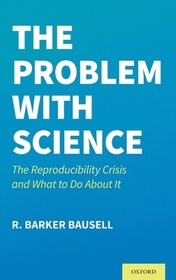
The Problem with Science
The Reproducibility Crisis and What to do About It
-
10% KEDVEZMÉNY?
- A kedvezmény csak az 'Értesítés a kedvenc témákról' hírlevelünk címzettjeinek rendeléseire érvényes.
- Kiadói listaár GBP 37.99
-
17 152 Ft (16 335 Ft + 5% áfa)
Az ár azért becsült, mert a rendelés pillanatában nem lehet pontosan tudni, hogy a beérkezéskor milyen lesz a forint árfolyama az adott termék eredeti devizájához képest. Ha a forint romlana, kissé többet, ha javulna, kissé kevesebbet kell majd fizetnie.
- Kedvezmény(ek) 10% (cc. 1 715 Ft off)
- Kedvezményes ár 15 437 Ft (14 702 Ft + 5% áfa)
Iratkozzon fel most és részesüljön kedvezőbb árainkból!
Feliratkozom
17 152 Ft

Beszerezhetőség
Megrendelésre a kiadó utánnyomja a könyvet. Rendelhető, de a szokásosnál kicsit lassabban érkezik meg.
Why don't you give exact delivery time?
A beszerzés időigényét az eddigi tapasztalatokra alapozva adjuk meg. Azért becsült, mert a terméket külföldről hozzuk be, így a kiadó kiszolgálásának pillanatnyi gyorsaságától is függ. A megadottnál gyorsabb és lassabb szállítás is elképzelhető, de mindent megteszünk, hogy Ön a lehető leghamarabb jusson hozzá a termékhez.
A termék adatai:
- Kiadó OUP USA
- Megjelenés dátuma 2021. március 31.
- ISBN 9780197536537
- Kötéstípus Keménykötés
- Terjedelem296 oldal
- Méret 160x236x27 mm
- Súly 522 g
- Nyelv angol 202
Kategóriák
Rövid leírás:
Recent events have vividly underscored the societal importance of science, yet the majority of the public are unaware that a large proportion of published scientific results are simply wrong. The Problem with Science explains in nontechnical language how such fallacy occurs, how it gets published in respected scientific journals, and how it can largely be avoided.
TöbbHosszú leírás:
Recent events have vividly underscored the societal importance of science, yet the majority of the public are unaware that a large proportion of published scientific results are simply wrong. The Problem with Science is an exploration of the manifestations and causes of this scientific crisis, accompanied by a description of the very promising corrective initiatives largely developed over the past decade to stem the spate of irreproducible results that have come to characterize many of our sciences.
More importantly, Dr. R. Barker Bausell has designed it to provide guidance to practicing and aspiring scientists regarding how (a) to change the way in which science has come to be both conducted and reported in order to avoid producing false positive, irreproducible results in their own work and (b) to change those institutional practices (primarily but not exclusively involving the traditional journal publishing process and the academic reward system) that have unwittingly contributed to the present crisis. There is a need for change in the scientific culture itself. A culture which prioritizes conducting research correctly in order to get things right rather than simply getting it published.
Partly an introductory survey of the reproducibility crisis, partly a series of recommendations to students and scholars that could, if employed, reduce the severity of the crisis, this work includes extensive endnotes with each chapter, providing access to a vast literature on this topic ... The reproducibility crisis is a problem of interest to a large readership spanning many disciplines. Many of the sources discussed, including some of the author's own previous works, would be an excellent starting point for more information about this topic. An essential acquisition for all academic and public libraries.
Tartalomjegyzék:
Introduction
Part I. BACKGROUND AND FACILITATORS OF THE CRISIS
Chapter 1: Publication Bias
Chapter 2: False Positive Results and a Nontechnical Overview of their Modeling
Chapter 3: Questionable Research Practices (QRPs) and their Devastating Scientific Effects
Chapter 4: A Few Case Studies of QRP Driven Irreproducibility Effects
Chapter 5: The Return of Pathological Science (actually it never went away)
Part II. APPROACHES FOR IDENTIFYING IRREPRODUCIBLE FINDINGS
Chapter 6: The Replication Process
Chapter 7: Multiple-Study Replication Initiatives
Chapter 8: Damage Control for Learning that One's Study Failed to Replicate
PART III: STRATEGIES FOR INCREASING THE REPRODUCIBILITY OF PUBLISHED SCIENTIFIC RESULTS
Chapter 9: Publishing Issues and their Impact upon Reproducibility
Chapter 10: Preregistration, Data Sharing, and Other Salutary Behaviors
Chapter 11: A (Very) Few Concluding Thoughts

