

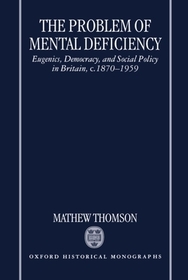
The Problem of Mental Deficiency
Eugenics, Democracy, and Social Policy in Britain, c.1870-1959
Sorozatcím: Oxford Historical Monographs;
-
10% KEDVEZMÉNY?
- A kedvezmény csak az 'Értesítés a kedvenc témákról' hírlevelünk címzettjeinek rendeléseire érvényes.
- Kiadói listaár GBP 197.50
-
89 171 Ft (84 925 Ft + 5% áfa)
Az ár azért becsült, mert a rendelés pillanatában nem lehet pontosan tudni, hogy a beérkezéskor milyen lesz a forint árfolyama az adott termék eredeti devizájához képest. Ha a forint romlana, kissé többet, ha javulna, kissé kevesebbet kell majd fizetnie.
- Kedvezmény(ek) 10% (cc. 8 917 Ft off)
- Kedvezményes ár 80 254 Ft (76 433 Ft + 5% áfa)
Iratkozzon fel most és részesüljön kedvezőbb árainkból!
Feliratkozom
89 171 Ft

Beszerezhetőség
Megrendelésre a kiadó utánnyomja a könyvet. Rendelhető, de a szokásosnál kicsit lassabban érkezik meg.
Why don't you give exact delivery time?
A beszerzés időigényét az eddigi tapasztalatokra alapozva adjuk meg. Azért becsült, mert a terméket külföldről hozzuk be, így a kiadó kiszolgálásának pillanatnyi gyorsaságától is függ. A megadottnál gyorsabb és lassabb szállítás is elképzelhető, de mindent megteszünk, hogy Ön a lehető leghamarabb jusson hozzá a termékhez.
A termék adatai:
- Kiadó OUP Oxford
- Megjelenés dátuma 1998. március 12.
- ISBN 9780198206927
- Kötéstípus Keménykötés
- Terjedelem360 oldal
- Méret 224x145x24 mm
- Súly 563 g
- Nyelv angol 0
Kategóriák
Rövid leírás:
This is the first full study of the great alarm about `mental defectives' in Britain between 1870 and 1959, and the resulting policies of segregation, community care, and sexual sterilization. Mathew Thomson examines the origins of these policies in central government and shows how they were put into practice by health professionals and local authorities. He reveals how policy-makers avoided extremist measures such as compulsory sterilization (introduced in Germany and parts of the US during this period), not for reasons of liberal principle but because of the socially conservative and anti-interventionist nature of British political culture.
TöbbHosszú leírás:
This is the first detailed assessment of the development and implementation of social policy to deal with the problem of the `mentally deficient' in Britain between 1870 and 1959. Mathew Thomson analyses all the factors involved in the policy-making process, beginning with the politics of the legislature and showing how the demands of central government were interpreted by local authorities, resulting in a wide and varied distribution of medical, institutional, and community care in different parts of the country. The efforts of health professionals, voluntary organizations and the families themselves are considered, alongside questions about the influence of changing concepts of class, gender, and citizenship. The author queries the belief that the policy of segregation was largely unsuccessful, and reveals a hitherto unrecognized system of care in the community. He reframes our understanding of the campaign for sterilization and examines why British policy-makers avoided extremist measures such as the compulsory sterilization introduced in Germany and parts of the US during this period. Thomson shows that the problem of mental deficiency cannot be understood simply in terms of eugenics but must also be considered as part of the process of adjusting to democracy in the twentieth century.
This text clearly stands as the most significant account to-date of the social policies developed for those labelled as mentally and socially deficient.

