

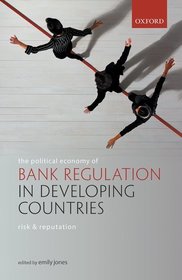
The Political Economy of Bank Regulation in Developing Countries: Risk and Reputation
-
10% KEDVEZMÉNY?
- A kedvezmény csak az 'Értesítés a kedvenc témákról' hírlevelünk címzettjeinek rendeléseire érvényes.
- Kiadói listaár GBP 112.50
-
50 793 Ft (48 375 Ft + 5% áfa)
Az ár azért becsült, mert a rendelés pillanatában nem lehet pontosan tudni, hogy a beérkezéskor milyen lesz a forint árfolyama az adott termék eredeti devizájához képest. Ha a forint romlana, kissé többet, ha javulna, kissé kevesebbet kell majd fizetnie.
- Kedvezmény(ek) 10% (cc. 5 079 Ft off)
- Kedvezményes ár 45 714 Ft (43 538 Ft + 5% áfa)
Iratkozzon fel most és részesüljön kedvezőbb árainkból!
Feliratkozom
50 793 Ft

Beszerezhetőség
Megrendelésre a kiadó utánnyomja a könyvet. Rendelhető, de a szokásosnál kicsit lassabban érkezik meg.
Why don't you give exact delivery time?
A beszerzés időigényét az eddigi tapasztalatokra alapozva adjuk meg. Azért becsült, mert a terméket külföldről hozzuk be, így a kiadó kiszolgálásának pillanatnyi gyorsaságától is függ. A megadottnál gyorsabb és lassabb szállítás is elképzelhető, de mindent megteszünk, hogy Ön a lehető leghamarabb jusson hozzá a termékhez.
A termék adatai:
- Kiadó OUP Oxford
- Megjelenés dátuma 2020. március 19.
- ISBN 9780198841999
- Kötéstípus Keménykötés
- Terjedelem406 oldal
- Méret 231x161x26 mm
- Súly 740 g
- Nyelv angol 0
Kategóriák
Rövid leírás:
Drawing on in-depth analysis of eleven countries across Africa, Asia ,and Latin America this book shows how financial globalisation is changing politics of regulation in developing countries.
TöbbHosszú leírás:
This is an open access title available under the terms of a CC BY-NC-ND 4.0 International licence. It is free to read at Oxford Scholarship Online and offered as a free PDF download from OUP and selected open access locations.
International banking standards are intended for the regulation of large, complex, risk-taking international banks with trillions of dollars in assets and operations across the globe. Yet they are being implemented in countries with nascent financial markets and small banks that have yet to venture into international markets. Why is this? The Political Economy of Bank Regulation in Developing Countries: Risk and Reputation explores the politics of banking regulation in eleven countries across Africa, Asia, and Latin America. It shows how financial globalization generates strong reputational and competitive incentives for developing countries to converge on international standards. Politicians, regulators, and large banks in developing countries implement international standards to attract international investment, bolster their professional standing, and further integrate their countries into global finance. Convergence is not inevitable or uniform: implementation is often contested and regulators adapt international standards to the local context. This book contributes to our understanding of the ways in which governments and firms in the core of global finance powerfully shape regulatory decisions in the periphery, and the ways that governments and firms from peripheral developing countries manoeuvre within the constraints and opportunities created by financial globalization.
Emily Jones' edited collection explores how the governments of poor countries encounter and respond to global regulatory regimes. The study thus probes the exuberance — often real but sometimes staged — with which eleven case study countries have adopted enhanced Basel standards, a regulatory framework prepared by the Basel Committee on Banking Supervision (BCBS).
Tartalomjegyzék:
Part I: Introduction, cross-country variation, and analytical argument
The puzzle: peripheral developing countries implementing international banking standards
The challenges international banking standards pose for peripheral developing countries
The politics of regulatory convergence and divergence
Part II: Case studies
Pakistan: Politicians, regulations, and banks advocate Basel
Rwanda: Running without legs
Ghana: Reformist politicians drive Basel implementation
West African Economic and Monetary Union: Central bankers drive Basel under IMF pressure
Tanzania: From institutional hiatus to the return of policy-based lending
Kenya: 'Dubai' in the Savannah
Bolivia: Pulling in two directions - the developmental state and Basel standards
Nigeria: Catch 22 - navigating Basel standards in Nigeria's fragile banking sector
Angola: “For the English to see”
Vietnam: The dilemma of bringing global financial standards to a socialist market economy
Ethiopia: Raising a vegetarian tiger?
Part III: Conclusion
Conclusion: Key findings and policy recommendations

