

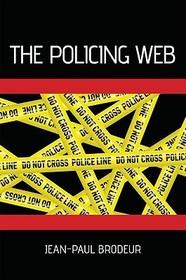
The Policing Web
Sorozatcím: Studies in Crime and Public Policy;
-
10% KEDVEZMÉNY?
- A kedvezmény csak az 'Értesítés a kedvenc témákról' hírlevelünk címzettjeinek rendeléseire érvényes.
- Kiadói listaár GBP 94.00
-
42 441 Ft (40 420 Ft + 5% áfa)
Az ár azért becsült, mert a rendelés pillanatában nem lehet pontosan tudni, hogy a beérkezéskor milyen lesz a forint árfolyama az adott termék eredeti devizájához képest. Ha a forint romlana, kissé többet, ha javulna, kissé kevesebbet kell majd fizetnie.
- Kedvezmény(ek) 10% (cc. 4 244 Ft off)
- Kedvezményes ár 38 197 Ft (36 378 Ft + 5% áfa)
Iratkozzon fel most és részesüljön kedvezőbb árainkból!
Feliratkozom
42 441 Ft

Beszerezhetőség
Megrendelésre a kiadó utánnyomja a könyvet. Rendelhető, de a szokásosnál kicsit lassabban érkezik meg.
Why don't you give exact delivery time?
A beszerzés időigényét az eddigi tapasztalatokra alapozva adjuk meg. Azért becsült, mert a terméket külföldről hozzuk be, így a kiadó kiszolgálásának pillanatnyi gyorsaságától is függ. A megadottnál gyorsabb és lassabb szállítás is elképzelhető, de mindent megteszünk, hogy Ön a lehető leghamarabb jusson hozzá a termékhez.
A termék adatai:
- Kiadó OUP USA
- Megjelenés dátuma 2010. október 14.
- ISBN 9780199740598
- Kötéstípus Keménykötés
- Terjedelem416 oldal
- Méret 157x236x35 mm
- Súly 703 g
- Nyelv angol
- Illusztrációk 4 black and white illustrations 0
Kategóriák
Rövid leírás:
Taking another look at what is meant by "policing," Jean-Paul Brodeur offers a comprehensive and novel theory on what policing is, how it has developed, and the various forms it takes.
TöbbHosszú leírás:
In this comprehensive study, Jean-Paul Brodeur examines the diversity of the policing web. Policing agencies such as criminal investigation units, intelligence services, private security companies, and military policing organizations, are examined in addition to public uniformed police, to show the extent to which policing extends far beyond the confines of public police working in uniform and visible to all. The study also includes a consideration of military policing both when compatible with the values of democracy and when in opposition. It also examines criminal organizations enforcing their own rules in urban zones deserted by the police and criminal individuals acting as police informants since they too are part of the policing web, even though they do not qualify as legitimate policing agents or agencies.
The underlying argument of The Policing Web is that the diverse strands of the policing web are united by a common definition that emphasizes the licence granted to policing agencies to use, either legally or with complete impunity, means that are otherwise prohibited as crimes to the rest of the population. This claim is argued for throughout the book and its paradoxical consequences investigated. Although much effort is devoted to presenting a comprehensive model linking all the components of policing, it is acknowledged that the 'policing web' is by no means a neat and well-integrated structure. Even the belief that it will develop into a tightly coordinated system is in itself questionable. Indeed, the study shows that there is not just one policing web, but several, depending on the country, police history and culture, and the images of policing which shape the mind of the community. These often overlooked factors are nonetheless essential components of the context of policing and are discussed within an international framework.
Overall, the book is very accessible to graduate and even some undergraduate readers and is an important step in producing a better theorized analytic policing literature.
Tartalomjegyzék:
List of Tables
List of Figures
Acknowledgements
Introduction
The Police Assemblage
History
Police Images
Elements of a Theory of Policing
Police in Uniform
Police Investigation
High and Low Policing
Private Security
Edges of Policing
Conclusion
Appendix
Bibliography

