

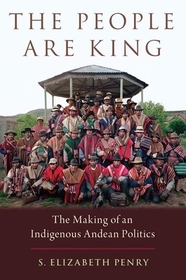
The People Are King
The Making of an Indigenous Andean Politics
-
10% KEDVEZMÉNY?
- A kedvezmény csak az 'Értesítés a kedvenc témákról' hírlevelünk címzettjeinek rendeléseire érvényes.
- Kiadói listaár GBP 102.50
-
46 278 Ft (44 075 Ft + 5% áfa)
Az ár azért becsült, mert a rendelés pillanatában nem lehet pontosan tudni, hogy a beérkezéskor milyen lesz a forint árfolyama az adott termék eredeti devizájához képest. Ha a forint romlana, kissé többet, ha javulna, kissé kevesebbet kell majd fizetnie.
- Kedvezmény(ek) 10% (cc. 4 628 Ft off)
- Kedvezményes ár 41 651 Ft (39 668 Ft + 5% áfa)
Iratkozzon fel most és részesüljön kedvezőbb árainkból!
Feliratkozom
46 278 Ft

Beszerezhetőség
Megrendelésre a kiadó utánnyomja a könyvet. Rendelhető, de a szokásosnál kicsit lassabban érkezik meg.
Why don't you give exact delivery time?
A beszerzés időigényét az eddigi tapasztalatokra alapozva adjuk meg. Azért becsült, mert a terméket külföldről hozzuk be, így a kiadó kiszolgálásának pillanatnyi gyorsaságától is függ. A megadottnál gyorsabb és lassabb szállítás is elképzelhető, de mindent megteszünk, hogy Ön a lehető leghamarabb jusson hozzá a termékhez.
A termék adatai:
- Kiadó OUP USA
- Megjelenés dátuma 2020. január 14.
- ISBN 9780195161601
- Kötéstípus Keménykötés
- Terjedelem320 oldal
- Méret 160x236x22 mm
- Súly 573 g
- Nyelv angol
- Illusztrációk 15 halftones 0
Kategóriák
Rövid leírás:
The People are King is the first ethnohistorical study of the transformation of Andean communities over three centuries, from the Inca era into the nineteenth century, which traces the movement of indigenous people toward self-government.
TöbbHosszú leírás:
In the sixteenth century, in what is now modern-day Peru and Bolivia, Andean communities were forcibly removed from their traditional villages by Spanish colonizers and resettled in planned, self-governed towns modeled after those in Spain. But rather than merely conforming to Spanish cultural and political norms, indigenous Andeans adopted and gradually refashioned the religious practices dedicated to Christian saints and political institutions imposed on them, laying claim to their own rights and the sovereignty of the collective. The People Are King shows how common Andean people produced a new kind of civil society over three centuries of colonialism, merging their traditional understanding of collective life with the Spanish notion of the común to demand participatory democracy. S. Elizabeth Penry explores how this hybrid concept of self-rule spurred the indigenous rebellions that erupted across Latin America in the eighteenth century, not only against Spanish rulers, but against native hereditary nobility, for acting against the will of the comuneros.
Through the letters and documents of the Andean people themselves, The People Are King gives voice to a vision of community-based democracy that played a central role in the Age of Atlantic Revolutions and continues to galvanize indigenous movements in Bolivia today.
This book by Elizabeth Penry gives a history of ordinary Andeans of the Audiencia de Charcas who, throughout the centuries of Spanish domination, defined themselves by reinterpreting colonial institutions and ideas. It shows how those people struggled to govern themselves and to acquire full rights. It also demonstrates how they moved from 'a politics of hereditary nobility, the caciques, to a hybrid form of participatory democracy, with the town council at its heart, that had roots in both the Andean and Spanish worlds.' This history is based on an impressive analysis of historical sources coming from many archives, and written with microhistory tools: interwoven stories that make a complex transformation comprehensible.... This is a wonderfully written book, which explores a significant part of the rich Andean historiography and presents well-analysed cases.
Tartalomjegyzék:
Acknowledgments
A Note on Terminology
Introduction: The Genesis of an Andean Christianity and Politics
Part I Inca and Early Spanish Peru
Chapter 1 Incas and Asanaqi in Qullasuyu
Chapter 2 Spanish República and Inca Tyranny
Chapter 3 Resettlement: Spaniards Found New Towns for "Indians"
Part II The Andeanization of Spanish Institutions and Christianity
Chapter 4 Andeans Found Their Own Towns: The Andeanization of Reducción
Chapter 5 Cofradía and Cabildo in the Eighteenth Century: The Merger of Andean Religiosity and Town Leadership
Chapter 6 Rational Bourbons and Radical Comuneros: Civil Practices That Shape Towns
Part III The Revolutionary Común
Chapter 7 Comunero Politics and the King's Justice: The Común Takes Moral Action
Chapter 8 A Lettered Revolution: A Brotherhood of Communities
Conclusion The Rise of the Común and Its Legacy
Notes
Bibliography
Index

