

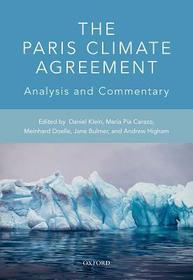
The Paris Agreement on Climate Change
Analysis and Commentary
-
10% KEDVEZMÉNY?
- A kedvezmény csak az 'Értesítés a kedvenc témákról' hírlevelünk címzettjeinek rendeléseire érvényes.
- Kiadói listaár GBP 132.50
-
59 823 Ft (56 975 Ft + 5% áfa)
Az ár azért becsült, mert a rendelés pillanatában nem lehet pontosan tudni, hogy a beérkezéskor milyen lesz a forint árfolyama az adott termék eredeti devizájához képest. Ha a forint romlana, kissé többet, ha javulna, kissé kevesebbet kell majd fizetnie.
- Kedvezmény(ek) 10% (cc. 5 982 Ft off)
- Kedvezményes ár 53 841 Ft (51 278 Ft + 5% áfa)
Iratkozzon fel most és részesüljön kedvezőbb árainkból!
Feliratkozom
59 823 Ft

Beszerezhetőség
Megrendelésre a kiadó utánnyomja a könyvet. Rendelhető, de a szokásosnál kicsit lassabban érkezik meg.
Why don't you give exact delivery time?
A beszerzés időigényét az eddigi tapasztalatokra alapozva adjuk meg. Azért becsült, mert a terméket külföldről hozzuk be, így a kiadó kiszolgálásának pillanatnyi gyorsaságától is függ. A megadottnál gyorsabb és lassabb szállítás is elképzelhető, de mindent megteszünk, hogy Ön a lehető leghamarabb jusson hozzá a termékhez.
A termék adatai:
- Kiadó OUP Oxford
- Megjelenés dátuma 2017. július 20.
- ISBN 9780198789338
- Kötéstípus Keménykötés
- Terjedelem468 oldal
- Méret 254x185x29 mm
- Súly 1084 g
- Nyelv angol 20
Kategóriák
Rövid leírás:
The Paris Agreement fundamentally alters the reach and scope of the international climate change regime. This book provides the first legal commentary to the Agreement's articles, putting them in context and detailing how they are to be understood and put into action.
TöbbHosszú leírás:
The most important climate agreement in history, the Paris Agreement on Climate Change represents the commitment of the nations of the world to address and curb climate change. Signed in December 2015, it entered into force on 4th November 2016. Countries are moving into implementation, and efforts at all levels will be needed to fulfill its ambitious goals.
The Paris Climate Agreement: Commentary and Analysis combines a comprehensive legal appraisal and critique of the new Agreement with a practical and structured commentary to all its Articles. Part I discusses the general context for the Paris Agreement, detailing the scientific, political, and social drivers behind it, providing an overview of the pre-existing regime, and tracking the history of the negotiations. It examines the evolution of key concepts such as common but differentiated responsibilities, and analyses the legal form of the Agreement and the nature of its provisions. Part II comprises individual chapters on each Article of the Agreement, with detailed commentary of the provisions which highlights central aspects from the negotiating history and the legal nature of the obligations. It describes the institutional arrangements and considerations for national implementation, providing practical advice and prospects for future development. Part III reflects on the Paris Agreement as a whole: its strengths and weaknesses, its potential for further development, and its relationship with other areas of public international law and governance.
The book is an invaluable resource for academics and practitioners, policy makers, and actors in the private sector and civil society, as they negotiate the implementation of the Agreement in domestic law and policy.
Tartalomjegyzék:
Foreword
Part I: Introductory Chapters
Introduction: Scientific and Political Drivers for the Agreement
A. Background and the Role of Science
B. Politics, Economics, and Society
Foundations for the Paris Agreement
A. The Legal and Policy Framework of the United Nations Climate Change Regime
B. Pre-2020 Climate Action and teh Emergent Role of Non-party Stakeholders
The Negotiating History of the Paris Agreement
Central Concepts in the Paris Agreement and How They Evolved
The Legal Form of the Paris Agreement and Nature of its Obligations
Part II: Analysis of the Provisions of the Agreement
Contextual Provisions (Preamble and Article 1)
Objective (Article 2.1)
Guiding Principles and General Obligation (Article 2.2 and Article 3)
Mitigation (Article 4)
Conserving and Enhancing Sinks and Reservoirs of Greenhouse Gases, including Forests (Article 5)
Voluntary Cooperation (Article 6)
Adaptation (Article 7)
Loss and Damage (Article 8)
Climate Finance (Article 9)
Technology Development and Transfer (Article 10)
Capacity-Building (Article 11)
Education, Training, Public Awareness, Participation and Access to Information (Article 12)
Transparency (Article 13)
Global Stocktake (Article 14)
Facilitating Implementation of and Promoting Compliance (Article 15)
Institutional Arrangements and Final Clauses (Articles 16-29)
Part III: Concluding Reflections
Assessment of Strengths and Weaknesses
Implications for Public International Law
Epilogue
Selected BibliographyIndex

