

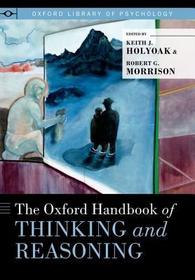
The Oxford Handbook of Thinking and Reasoning
Sorozatcím: Oxford Library of Psychology;
-
10% KEDVEZMÉNY?
- A kedvezmény csak az 'Értesítés a kedvenc témákról' hírlevelünk címzettjeinek rendeléseire érvényes.
- Kiadói listaár GBP 192.50
-
86 913 Ft (82 775 Ft + 5% áfa)
Az ár azért becsült, mert a rendelés pillanatában nem lehet pontosan tudni, hogy a beérkezéskor milyen lesz a forint árfolyama az adott termék eredeti devizájához képest. Ha a forint romlana, kissé többet, ha javulna, kissé kevesebbet kell majd fizetnie.
- Kedvezmény(ek) 10% (cc. 8 691 Ft off)
- Kedvezményes ár 78 222 Ft (74 498 Ft + 5% áfa)
Iratkozzon fel most és részesüljön kedvezőbb árainkból!
Feliratkozom
86 913 Ft

Beszerezhetőség
Megrendelésre a kiadó utánnyomja a könyvet. Rendelhető, de a szokásosnál kicsit lassabban érkezik meg.
Why don't you give exact delivery time?
A beszerzés időigényét az eddigi tapasztalatokra alapozva adjuk meg. Azért becsült, mert a terméket külföldről hozzuk be, így a kiadó kiszolgálásának pillanatnyi gyorsaságától is függ. A megadottnál gyorsabb és lassabb szállítás is elképzelhető, de mindent megteszünk, hogy Ön a lehető leghamarabb jusson hozzá a termékhez.
A termék adatai:
- Kiadó OUP USA
- Megjelenés dátuma 2012. április 19.
- ISBN 9780199734689
- Kötéstípus Keménykötés
- Terjedelem864 oldal
- Méret 191x257x53 mm
- Súly 1667 g
- Nyelv angol 0
Kategóriák
Rövid leírás:
The Oxford Handbook of Thinking and Reasoning brings together the contributions of many of the leading researchers in thinking and reasoning to create the most comprehensive overview of research on thinking and reasoning that has ever been available. Each chapter includes a bit of historical perspective on the topic, and concludes with some thoughts about where the field seems to be heading.
TöbbHosszú leírás:
Thinking and reasoning, long the academic province of philosophy, have over the past century emerged as core topics of empirical investigation and theoretical analysis in the modern fields of cognitive psychology, cognitive science, and cognitive neuroscience. Formerly seen as too complicated and amorphous to be included in early textbooks on the science of cognition, the study of thinking and reasoning has since taken off, brancing off in a distinct direction from the field from which it originated.
The Oxford Handbook of Thinking and Reasoning is a comprehensive and authoritative handbook covering all the core topics of the field of thinking and reasoning. Written by the foremost experts from cognitive psychology, cognitive science, and cognitive neuroscience, individual chapters summarize basic concepts and findings for a major topic, sketch its history, and give a sense of the directions in which research is currently heading. Chapters include introductions to foundational issues and methods of study in the field, as well as treatment of specific types of thinking and reasoning and their application in a broad range of fields including business, education, law, medicine, music, and science. The volume will be of interest to scholars and students working in developmental, social and clinical psychology, philosophy, economics, artificial intelligence, education, and linguistics.
For all those who want to learn how the mind works, this is a must-read book... Besides pointing out the transition of the field of thinking and reasoning from philosophy to science, the editors of this book also give readers of this book a sense of the direction in which actual research is heading on this field... Chapter organization is excellent and very conducive to learning and absorption of material... This is an excellent volume on the growing field of thinking and reasoning, now a part of high-level human cognition which includes creative thinking, decision making and problem solving.
Tartalomjegyzék:
1. Thinking and Reasoning: A Reader's Guide
Keith J. Holyoak and Robert G. Morrison
Part I: General Approaches to Thinking and Reasoning
2. Normative Systems: Logic, Probability, and Rational Choice
Nick Chater and Mike Oaksford
3. Bayesian Inference
Tom Griffiths, Josh Tenenbaum, and Charles Kemp
4. Knowledge Representation
Arthur B. Markman
5. Computational Modeling of Higher Cognition
Leonidas A. A. Doumas and John E. Hummel
6. Neural Substrate of Thinking
Robert G. Morrison and Barbara Knowlton
7. Mental Function as Genetic Expression: Emerging Insights from Cognitive Neurogenetics
Adam E. Green and Kevin N. Dunbar
Part II: Deductive, Inductive and Abductive Reasoning
8. Dual-process Theories of Reasoning: Facts and fallacies
Jonathan St. B. T. Evans
9. Inference in Mental Models
P. N. Johnson-Laird
10. Similarity
Robert L. Goldstone, Ji Yun Son
11. Concepts and Categories: Memory, Meaning, and Metaphysics
Lance J. Rips, Edward E. Smith, and Douglas L. Medin
12. Causal Learning and Inference
Marc Buehner and Patricia W. Cheng
13. Analogy and Relational Reasoning
Keith J. Holyoak
14. Explanation and Abductive Inference
Tania Lombrozo
15. Rational Argument
Ulrike Hahn, Mike Oaksford
Part III. Judgment and Decision Making
16. Decision Making
Robyn A. LeBoeuf, Eldar Shafir
17. Judgment Heuristics
Dale Griffin
18. Cognitive Hierarchies and Emotions in Behavioral Game Theory
Colin Camerer and Alec Smith
19. Moral Judgment
Michael Waldmann, Jonas Nagel, and Alex Wiegmann
20. Motivated Thinking
Daniel C. Molden and E. Tory Higgins
Part IV. Problem Solving, Intelligence, and Creative Thinking
21. Problem Solving
Miriam Bassok and Laura R. Novick
22. On the Distinction between Rationality and Intelligence: Implications for Understanding Individual Differences in Reasoning
Keith E. Stanovich
23. Cognition and the Creation of Ideas
Steve M. Smith and Tom B. Ward
24. Insight
J. Jason van Steenburgh, Jessica I. Fleck, Mark Beeman, and John Kounios
25. Genius
Dean Keith Simonton
Part V. Ontogeny, Phylogeny, Language and Culture
26. Development of Thinking in Children
Susan A. Gelman and Brandy N. Frazier
27. The Human Enigma
Derek Penn and Dan Povinelli
28. Language and Thought
Lila Gleitman, Anna Papafragou
29. Thinking in Society and Culture
Tage Rai
Part VI. Modes of Thinking
30. Mathematical Cognition
John Opfer and Robert Siegler
31. Visuospatial Thinking
Mary Hegarty and Andrew T. Stull
32. Gesture in Thought
Susan Goldin-Meadow and Susan Wagner Cook
33. Impact of Aging on Thinking
Shannon McGillivray, Michael C. Friedman, and Alan D. Castel
34. The Cognitive Neuroscience of Thought Disorder in Schizophrenia
Peter Bachman and Tyrone D. Cannon
Part VII. Thinking in Practice
35. Scientific Thinking and Reasoning
Kevin N. Dunbar and David Klahr
36. Legal Reasoning
Barbara A. Spellman and Fred Schauer
37. Thinking and Reasoning in Medicine
Vimla L. Patel, Jose F. Arocha, and Jiajie Zhang
38. Thinking in Business
Jeffrey Lowenstein
39. Musical Thought
William Forde Thompson and Paolo Ammirante
40. Learning to Think: Cognitive Mechanisms of Knowledge Transfer
Ken Koedinger, Ido Roll

