

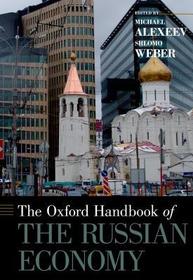
The Oxford Handbook of the Russian Economy
Sorozatcím: Oxford Handbooks;
-
10% KEDVEZMÉNY?
- A kedvezmény csak az 'Értesítés a kedvenc témákról' hírlevelünk címzettjeinek rendeléseire érvényes.
- Kiadói listaár GBP 185.00
-
83 527 Ft (79 550 Ft + 5% áfa)
Az ár azért becsült, mert a rendelés pillanatában nem lehet pontosan tudni, hogy a beérkezéskor milyen lesz a forint árfolyama az adott termék eredeti devizájához képest. Ha a forint romlana, kissé többet, ha javulna, kissé kevesebbet kell majd fizetnie.
- Kedvezmény(ek) 10% (cc. 8 353 Ft off)
- Kedvezményes ár 75 175 Ft (71 595 Ft + 5% áfa)
Iratkozzon fel most és részesüljön kedvezőbb árainkból!
Feliratkozom
83 527 Ft

Beszerezhetőség
Megrendelésre a kiadó utánnyomja a könyvet. Rendelhető, de a szokásosnál kicsit lassabban érkezik meg.
Why don't you give exact delivery time?
A beszerzés időigényét az eddigi tapasztalatokra alapozva adjuk meg. Azért becsült, mert a terméket külföldről hozzuk be, így a kiadó kiszolgálásának pillanatnyi gyorsaságától is függ. A megadottnál gyorsabb és lassabb szállítás is elképzelhető, de mindent megteszünk, hogy Ön a lehető leghamarabb jusson hozzá a termékhez.
A termék adatai:
- Kiadó OUP USA
- Megjelenés dátuma 2013. július 18.
- ISBN 9780199759927
- Kötéstípus Keménykötés
- Terjedelem864 oldal
- Méret 254x183x48 mm
- Súly 1538 g
- Nyelv angol
- Illusztrációk 151 illustrations 0
Kategóriák
Rövid leírás:
This Handbook is the most comprehensive up-to-date study of the Russian economy available. Russian and western authors analyze the current economic situation, trace the impact of Soviet legacies and of post-Soviet transition policies, examine the main social challenges, and propose directions for reforms.
TöbbHosszú leírás:
By 1999, Russia's economy was growing at almost 7% per year, and by 2008 reached 11th place in the world GDP rankings. Russia is now the world's second largest producer and exporter of oil, the largest producer and exporter of natural gas, and as a result has the third largest stock of foreign exchange reserves in the world, behind only China and Japan. But while this impressive economic growth has raised the average standard of living and put a number of wealthy Russians on the Forbes billionaires list, it has failed to solve the country's deep economic and social problems inherited from the Soviet times. Russia continues to suffer from a distorted economic structure, with its low labor productivity, heavy reliance on natural resource extraction, low life expectancy, high income inequality, and weak institutions. While a voluminous amount of literature has studied various individual aspects of the Russian economy, in the West there has been no comprehensive and systematic analysis of the socialist legacies, the current state, and future prospects of the Russian economy gathered in one book.
The Oxford Handbook of the Russian Economy fills this gap by offering a broad range of topics written by the best Western and Russian scholars of the Russian economy. While the book's focus is the current state of the Russian economy, the first part of the book also addresses the legacy of the Soviet command economy and offers an analysis of institutional aspects of Russia's economic development over the last decade. The second part covers the most important sectors of the economy. The third part examines the economic challenges created by the gigantic magnitude of regional, geographic, ethnic, religious and linguistic diversity of Russia. The fourth part covers various social issues, including health, education, and demographic challenges. It will also examine broad policy challenges, including the tax system, rule of law, as well as corruption and the underground economy. Michael Alexeev and Shlomo Weber provide for the first time in one volume a complete, well-rounded, and essential look at the complex, emerging Russian economy.
The editors observe that there has been no comprehensive and systematic analysis of the Russian economy gathered in one volume (pp. 1-2). This book is intended to fill that gap. It succeeds.
Tartalomjegyzék:
1. Introduction
A Look at the Past
2. Modernization and the Russian Economy: Three Hundred Years of Catching Up - Vladimir Mau and Tatiana Drobyshevskaya
3. Command economy and its legacy - Richard E. Ericson
4. Russia's Economic Transition - Anders Aslund
5. Transformational recession - Vladimir Popov
6. Growth trends in Russia after 1998 - Revold M. Entov and Oleg V. Lugovoy
Institutions and governance
7. Institutional performance - Leonid Polishchuk
8. Corporate governance in Russia - Ruben Enikolopov and Sergey Stepanov
9. The Russian tax system - Michael V. Alexeev and Robert F. Conrad
10. The Unofficial Economy in Russia - Byung-Yeon Kim
11. Russian Corruption - Mark J. Levin and Georgy A. Satarov
Resources and environment
12. Russia's dependence on resources - Clifford G. Gaddy and Barry W. Ickes
13. The Russian oil sector - Arild Moe and Valeriy A. Kryukov
14. The natural gas sector - Arild Moe and Valeriy A. Kryukov
15. Russian electricity market: variants of development - Alexander Vasin
16. The economics of mineral resources -Stephen Fortescue
17. The challenge of reforming environmental regulation in Russia - Alexander A. Golub, Mikhail Kozeltsev, Alexander Martusevich and Elena Strukova
Financial and Real sectors
18. Economics of the military-industrial complex - Steven Rosefielde
19. Blame the Switchman? Russian Railways Restructuring After Ten Years - Russell Pittman.
20. Russian Agriculture and Transition - Zvi Lerman and David Sedik
21. Science, High tech industries and innovation - Valery Makarov and Alexander Varshavsky
22. Russian banking as an active volcano - Koen Schoors and Ksenia Yudaeva
23. Financial and credit markets - Pekka Sutela
24. Russian Trade and Foreign Direct Investment Policy at the Crossroads - David G. Tarr and Natalia Volchkova
Regions
25. Economic geography of Russia - Andrei Markevich and Tatiana N. Mikhailova
26. Fiscal federalism: Impact of Political and Fiscal (De)centralization - Michael V. Alexeev and Shlomo Weber
27. Regional Challenges: the Case of Siberia - Judith Thornton
Policy and Social Challenges
28. Labor Market Adjustment: Is Russia Different? - Vladimir Gimpelson and Rostislav Kapeliushnikov
29. Privatization - J. David Brown, John S. Earle, and Scott Gelbach
30. Higher Education Reform and Access to College in Russia - Michael W. Kaganovich
31. Russia's healthcare system: difficult path of reform - Sergey Shishkin
32. Poverty and Inequality in Russia - Michael Lokshin and Ruslan Yemtsov
33. Recent demographic developments in the Russian Federation - Irina Denisova and Judith Shapiro

