

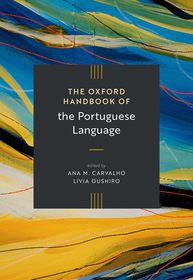
The Oxford Handbook of the Portuguese Language
Sorozatcím: Oxford Handbooks;
-
10% KEDVEZMÉNY?
- A kedvezmény csak az 'Értesítés a kedvenc témákról' hírlevelünk címzettjeinek rendeléseire érvényes.
- Kiadói listaár GBP 169.00
-
76 303 Ft (72 670 Ft + 5% áfa)
Az ár azért becsült, mert a rendelés pillanatában nem lehet pontosan tudni, hogy a beérkezéskor milyen lesz a forint árfolyama az adott termék eredeti devizájához képest. Ha a forint romlana, kissé többet, ha javulna, kissé kevesebbet kell majd fizetnie.
- Kedvezmény(ek) 10% (cc. 7 630 Ft off)
- Kedvezményes ár 68 673 Ft (65 403 Ft + 5% áfa)
Iratkozzon fel most és részesüljön kedvezőbb árainkból!
Feliratkozom
76 303 Ft

Beszerezhetőség
Még nem jelent meg, de rendelhető. A megjelenéstől számított néhány héten belül megérkezik.
Why don't you give exact delivery time?
A beszerzés időigényét az eddigi tapasztalatokra alapozva adjuk meg. Azért becsült, mert a terméket külföldről hozzuk be, így a kiadó kiszolgálásának pillanatnyi gyorsaságától is függ. A megadottnál gyorsabb és lassabb szállítás is elképzelhető, de mindent megteszünk, hogy Ön a lehető leghamarabb jusson hozzá a termékhez.
A termék adatai:
- Kiadó OUP Oxford
- Megjelenés dátuma 2026. július 23.
- ISBN 9780192863881
- Kötéstípus Keménykötés
- Terjedelem784 oldal
- Méret 246x171 mm
- Nyelv angol 700
Kategóriák
Rövid leírás:
This handbook brings together leading experts in the field to provide a comprehensive overview of the principal historical and contemporary aspects of the Portuguese language from a wide range of perspectives. The chapters explore all facets of the language, from traditional structural topics to language contact and language ideologies.
TöbbHosszú leírás:
This handbook brings together leading experts in the field to provide a comprehensive overview of the principal historical and contemporary aspects of the Portuguese language from a wide range of perspectives. The first part of the volume explores the main structural characteristics of Portuguese, featuring extensive cross-dialectal comparisons, while the second offers multiple analyses of the language from different theoretical traditions. The chapters in Part III examine the main diachronic developments in Portuguese, introduce the historical, geographical, and social aspects of the origins and expansions of the language, and provide the main features of each of the eight national varieties. Part IV highlights the crucial role that language contact has played in shaping many Portuguese varieties across the world, while Part V investigates the acquisition and teaching of Portuguese. In the final part the focus shifts to how the language is perceived by society: chapters discuss language attitudes, perceptions, and ideologies, as well as efforts to standardize Portuguese; the final chapter explores recent proposals to counter linguistic discrimination and foster linguistic respect. The Oxford Handbook of the Portuguese Language will appeal to undergraduate and graduate students as well as established scholars, whether they are specialists in Portuguese linguistics or researchers in a related field looking to learn more about the language.
TöbbTartalomjegyzék:
I. The structure of Portuguese
Phonetics
Phonology
Morphology
Syntax
Semantics
Pragmatics
Lexicon
II. Approaches to the analysis of Portuguese
Computational linguistics
Corpus linguistics
Discourse analysis in Brazil
Formal minimalist analyses
Grammaticalization: Functionality and categorization
Historical sociolinguistics
Language variation and change
Psycholinguistics
III. Portuguese across time and space
From Latin to Portuguese
Portuguese expansion
Angola
Brazil
Cabo Verde
Macau
Mozambique
Portugal
S--o Tom-- and Pr--ncipe
Timor
IV. Portuguese in contact
Dialect contact in Lusophone communities
Portuguese in contact with Indigenous languages in Brazil
Portuguese in contact with Spanish across national borders
Portuguese-lexified creoles
Linguistic anthropological approaches to Portuguese in the diaspora
V. Portuguese acquisition and teaching
L1 language acquisition
L2 and L3 language acquisition
The acquisition of Portuguese as heritage language
Portuguese as a host language
VI. Community perspectives of Portuguese
Portuguese in the Arts
Perceptual dialectology
Language ideologies and attitudes
Language policy in colonial and modern Brazil
Negro(a) and negritude: The language of race and anti-racism in Brazilian Portuguese
Gender-neutral Brazilian Portuguese: Forms, uses, and ideologies
Linguistic respect: A matter of linguistic rights

