

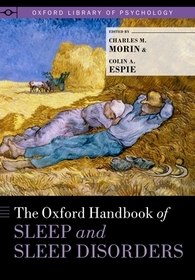
The Oxford Handbook of Sleep and Sleep Disorders
Sorozatcím: Oxford Library of Psychology;
-
10% KEDVEZMÉNY?
- A kedvezmény csak az 'Értesítés a kedvenc témákról' hírlevelünk címzettjeinek rendeléseire érvényes.
- Kiadói listaár GBP 222.50
-
100 458 Ft (95 675 Ft + 5% áfa)
Az ár azért becsült, mert a rendelés pillanatában nem lehet pontosan tudni, hogy a beérkezéskor milyen lesz a forint árfolyama az adott termék eredeti devizájához képest. Ha a forint romlana, kissé többet, ha javulna, kissé kevesebbet kell majd fizetnie.
- Kedvezmény(ek) 10% (cc. 10 046 Ft off)
- Kedvezményes ár 90 413 Ft (86 108 Ft + 5% áfa)
Iratkozzon fel most és részesüljön kedvezőbb árainkból!
Feliratkozom
100 458 Ft

Beszerezhetőség
Megrendelésre a kiadó utánnyomja a könyvet. Rendelhető, de a szokásosnál kicsit lassabban érkezik meg.
Why don't you give exact delivery time?
A beszerzés időigényét az eddigi tapasztalatokra alapozva adjuk meg. Azért becsült, mert a terméket külföldről hozzuk be, így a kiadó kiszolgálásának pillanatnyi gyorsaságától is függ. A megadottnál gyorsabb és lassabb szállítás is elképzelhető, de mindent megteszünk, hogy Ön a lehető leghamarabb jusson hozzá a termékhez.
A termék adatai:
- Kiadó OUP USA
- Megjelenés dátuma 2012. március 15.
- ISBN 9780195376203
- Kötéstípus Keménykötés
- Terjedelem928 oldal
- Méret 257x185x55 mm
- Súly 1746 g
- Nyelv angol 0
Kategóriák
Rövid leírás:
A great deal of progress has been made in the characterization, assessment and treatment of sleep disorders in recent years. Detailing the functions of sleep and its effect on cognition and development, The Oxford Handbook of Sleep and Sleep Disorders offers a comprehensive, practical approach to the evaluation and treatment of patients with sleep disorders.
TöbbHosszú leírás:
From the ancients to the present day, the importance of sleep has seldom been disputed, but it has never had top billing in comparison to other components of healthy living. Now, however, it seems that the combined critical mass of research, the needs of the population, and the shifting weight of professional interest is pushing sleep to the academic and research forefront. The Oxford Handbook of Sleep and Sleep Disorders provides a comprehensive and state-of-the-art review of knowledge about current research and clinical developments in normal and abnormal sleep.
The handbook comprises three sections: Section I covers the basics of normal sleep, its functions, and its relationships to emotions, cognitions, performance, psychopathology, and public health and safety issues. Section II addresses abnormal sleep, including disorders like insomnia, parasomnias, circadian rhythm disorders, and sleep apnea. An informed classification of sleep/wake disorders is presented along with a protocol for assessing sleep-wake complaints and evidence-based treatment options. Section III provides a developmental perspective on sleep and sleep problems in childhood, adolescence, and in late life, and a discussion of sleep disturbances in selected special populations.
Written by eminent international experts from diverse fields of study and clinical backgrounds, this handbook is a comprehensive resource that will meet the needs of clinicians, researchers, and trainees with an interest in the multidisciplinary and emerging field of sleep medicine.
this book is a rather clever mix of the psychological and empirical research on sleep, with a focus on special populations or difficulties with sleep. I would recommend this book as something of a tour de force; it is up-to-date, authoritative and extremely intriguing.
Tartalomjegyzék:
Introduction
Charles M. Morin and Colin Espie
Section I. Sleep
1. Sleep and the brain
Philippe Peigneux, Charline Urbain, and Remy Schmitz
2. The regulation of human sleep and wakefulness: Sleep Homeostasis and Circadian Rhythmicity
Derk-Jan Dijkn and Alpar Lazar
3. The functions of sleep
Yvonne Harrison
4. Sleep and human development
Kathryn A. Lee and Elisabeth A. Rosen
5. Sleep and human performance
Timothy H. Monk
6. The role of sleep in neurocognitive function
Matthew P. Walker
7. Sleep and emotion
Martica Hall, Jessica Levenson, and Brant Hasler
8. Sleep, Dreams, and Dreaming
Joseph De Koninck
9. Sleep and psychopathology
Polina Eidelman, Anda Gershon, Eleanor McGlinchey, and Allison G. Harvey
10. Sleep and psychotropic drugs
Dieter Riemann and Christoph Nissen
11. Sleep and society
Sara Arber, Robert Meadows, and Susan Venn
12. Sleep, work, and occupational stress
Torbjörn ?kerstedt and Göran Kecklund
13. Sleep and gender: the paradox of sex and sleep?
Helen S. Driver
14. Sleep and the psychology curriculum
Jason Ellis
Section II. Sleep Disorders
Epidemiology, Classification, and Assessment
15. Epidemiology of sleep
Kevin Morgan
16. A socio-economic perspective on sleep disorders
Damien Leger
17. Forensic aspects of sleep disorders
Rosalind D. Cartwright
18. Sleep disorders classification and diagnosis
Jack D. Edinger and Charles M. Morin
19. Clinical assessment of sleep-wake complaints
James K. Wyatt, Jamie A. Cvengros, and Jason C. Ong
Sleep/Wake Disorders
20. Insomnia I: Etiology and conceptualization
Philip Gehrman, James Findley, and Michael Perlis
21. Insomnia II: Behavioral and physiological assessment
Célyne H. Bastien, Isabelle Turcotte, and Genevi?ve St-Jean
22. Insomnia III: Therapeutic Approaches
Kenneth L. Lichstein, Gregory S. Vander Wal, and Haley R. Dillon
23. Sleep and psychiatric disorders
Rachel Manber, Tricia Haynes, and Allison T. Siebern
24. Sleep and medical disorders
Leanne Fleming and Judith R. Davidson
25. Sleep and substance abuse disorders
J. Todd Arnedt, Deirdre A. Conroy, and Kirk J. Brower
26. Parasomnias I: Nightmares
Anne Germain
27. Parasomnias II: Night terrors and somnambulism
Antonio Zadra and Mathieu Pilon
28. Circadian rhythm disorders I: Phase-advanced & phase-delayed syndromes
Leon C. Lack and Helen R. Wright
29. Circadian rhythm disorders II: Shift-work and jet-lag
Annie Valli?res and Emmanuelle Bastille-Denis
30. Sleep-related breathing disorders
Terri E. Weaver and Lichuan Ye
31. Hypersomnia and narcolepsy
Yves Dauvilliers and Sophie Bayard
32. Restless legs syndrome and periodic limb movements
Richard P. Allen
Section III. Sleep and Special Populations
33. Sleep-related problems in childhood
Melisa Moore and Jodi A. Mindell
34. Sleep-related problems in adolescence
Amy R. Wolfson and Edward B. O'Malley
35. Sleep disturbances in elderly
Jeanne E. Maglione and Sonia Ancoli-Israel
36. Sleep disturbances and learning disability (mental retardation)
Luci D. Wiggs
37. Sleep-Wake Disturbances and Fatigue in Individuals with Traumatic Brain Injury
Marie-Christine Ouellet, Simon Beaulieu-Bonneau, and Charles M. Morin
38. Sleep Disturbance and Chronic Pain: Biobehavioral Interactions
Michael T. Smith, Adeel Nasir, Claudia M. Campbell, and Renata Okonkwo
Conclusion

