

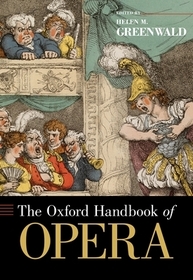
The Oxford Handbook of Opera
Sorozatcím: Oxford Handbooks;
-
10% KEDVEZMÉNY?
- A kedvezmény csak az 'Értesítés a kedvenc témákról' hírlevelünk címzettjeinek rendeléseire érvényes.
- Kiadói listaár GBP 215.00
-
97 072 Ft (92 450 Ft + 5% áfa)
Az ár azért becsült, mert a rendelés pillanatában nem lehet pontosan tudni, hogy a beérkezéskor milyen lesz a forint árfolyama az adott termék eredeti devizájához képest. Ha a forint romlana, kissé többet, ha javulna, kissé kevesebbet kell majd fizetnie.
- Kedvezmény(ek) 10% (cc. 9 707 Ft off)
- Kedvezményes ár 87 365 Ft (83 205 Ft + 5% áfa)
Iratkozzon fel most és részesüljön kedvezőbb árainkból!
Feliratkozom
97 072 Ft

Beszerezhetőség
Megrendelésre a kiadó utánnyomja a könyvet. Rendelhető, de a szokásosnál kicsit lassabban érkezik meg.
Why don't you give exact delivery time?
A beszerzés időigényét az eddigi tapasztalatokra alapozva adjuk meg. Azért becsült, mert a terméket külföldről hozzuk be, így a kiadó kiszolgálásának pillanatnyi gyorsaságától is függ. A megadottnál gyorsabb és lassabb szállítás is elképzelhető, de mindent megteszünk, hogy Ön a lehető leghamarabb jusson hozzá a termékhez.
A termék adatai:
- Kiadó OUP USA
- Megjelenés dátuma 2014. november 20.
- ISBN 9780195335538
- Kötéstípus Keménykötés
- Terjedelem1218 oldal
- Méret 178x249x61 mm
- Súly 1928 g
- Nyelv angol
- Illusztrációk 49 halftones, 2 line drawings, 50 music examples 0
Kategóriák
Rövid leírás:
The Oxford Handbook of Opera offers a series of trenchant, cutting-edge, and previously unpublished essays on the most important and compelling issues confronting those who think and write about opera. The handbook emphasizes not only operas themselves, but such broad concerns of the discipline as genre, voice, performance, censorship, staging, film, editions, and aesthetics.
TöbbHosszú leírás:
What is opera? Contributors to The Oxford Handbook of Opera respond to this deceptively simple question with a rich and compelling exploration of opera's adaption to changing artistic and political currents. Fifty of the world's most respected scholars cast opera as a fluid entity that continuously reinvents itself in a reflection of its patrons, audience, and creators. The synergy of power, performance, and identity recurs thematically throughout the volume's major topics: "Words, Music, and Meaning"; "Performance and Production"; "Opera and Society"; and "Transmission and Reception." Individual essays engage with repertoire from Monteverdi, Mozart, and Meyerbeer to Strauss, Henze, and Adams in studies of composition, national identity, transmission, reception, sources, media, iconography, humanism, the art of collecting, theory, analysis, commerce, singers, directors, criticism, editions, politics, staging, race, and gender. The title of the penultimate section, "Opera on the Edge," suggests the uncertainty of opera's future: is opera headed towards catastrophe or have social and musical developments of the last hundred years stimulated something new and exciting-and, well, operatic? In an epilogue to the volume, a contemporary opera composer speaks candidly about opera composition today.
The Oxford Handbook of Opera is an essential companion to scholars, educators, advanced students, performers, and knowledgeable listeners: those who simply love opera.
The best writers here are erudite, witty, thoughtful, a little weird. They can analyse and explain but they are are still prepared to surrender to the impact of a greedy, usually overtly emotional art form
Tartalomjegyzék:
CONTENTS
List of Figures
List of Musical Examples
List of Tables
List of Contributors
Acknowledgements
A Note about Translations and Music Examples
INTRODUCTION: Helen M. Greenwald
PART I. WHAT IS OPERA?
1. Tim Carter: What is Opera?
2. Emanuele Senici: Genre
3. Derek B. Scott: Musical Theater(s)
4. Monika Hennemann: Operatorio?
5. Lydia Goehr: The Concept of Opera
PART II. WORDS, MUSIC, AND MEANING
The Libretto and the Score
6. Vincent Giroud: Oft-Told Tales
7. Marina Frolova-Walker: The Problem of National Style
8. Damien Colas: Musical Dramaturgy
9. Andreas Giger: Versification
10. John Warrack: The German Libretto of the Early Nineteenth Century
11. William Drabkin: Analyzing Opera
Humanism, Verisimilitude, and Voice
12. Wendy Heller: Opera between the Ancients and the Moderns
13. Thomas Betzwieser: Verisimilitude
14. Michal Grover-Friedlander: Voice
15. Julian Rushton: Characterization
16. Lawrence Kramer: Meaning
PART III: PERFORMANCE AND PRODUCTION
17. Hilary Poriss: Divas and Divos
18. Martha Feldman: Castrato Acts
19. Mark Everist: Rehearsal Practices
20. Simon Williams: Acting
21. Ryan Minor: The Chorus
22. Alessandro Di Profio: The Orchestra
23. Linda Tomko: Dance
24. Katherine Syer: Production Aesthetics and Materials
25. Veronica Isaac: Costumes
26. Ulrich Mueller: Regietheater/ Director's Theater
27. Mary Hunter: Historically Informed Performance
PART IV: OPERA AND SOCIETY
28. Marianne Betz: Opera Composition and Cultural Environment
29. Valeria De Lucca: Patronage
30. Georgia Cowart: Audiences
31. Daniela Macchione: Autographs, Memorabilia, and the Aesthetics of Collecting
32. Marc Weiner: Politics
33. Jesse Rosenberg: Religion
34. John Graziano: Race
35. Alexandra Wilson: Gender
36. W. Anthony Sheppard: Exoticism
37. Francesco Izzo: Censorship
PART V: TRANSMISSION AND RECEPTION
38. Louise Stein: How Opera Traveled
39. James Parakilas: The Operatic Canon
40. Paul Watt: Critics
41. Thomas Christensen: Soundings Offstage
42. Marcia J. Citron: Visual Media
43. Helen M. Greenwald: Operatic Images
44. Linda Fairtile: Sources
45. Charles Brauner: Reconstructions
46. Patricia Brauner: Editing Opera
47. Philip Gossett: Writing the History of Opera
PART VI: OPERA ON THE EDGE
48. Joy H. Calico: 1900-1945
49. Robert Fink: After the Canon
EPILOGUE
50. Jake Heggie: Composing Opera Today
Index of Musical Works
General Index

