

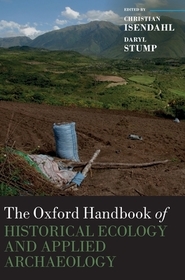
The Oxford Handbook of Historical Ecology and Applied Archaeology
Sorozatcím: Oxford Handbooks;
-
10% KEDVEZMÉNY?
- A kedvezmény csak az 'Értesítés a kedvenc témákról' hírlevelünk címzettjeinek rendeléseire érvényes.
- Kiadói listaár GBP 135.00
-
60 952 Ft (58 050 Ft + 5% áfa)
Az ár azért becsült, mert a rendelés pillanatában nem lehet pontosan tudni, hogy a beérkezéskor milyen lesz a forint árfolyama az adott termék eredeti devizájához képest. Ha a forint romlana, kissé többet, ha javulna, kissé kevesebbet kell majd fizetnie.
- Kedvezmény(ek) 10% (cc. 6 095 Ft off)
- Kedvezményes ár 54 857 Ft (52 245 Ft + 5% áfa)
Iratkozzon fel most és részesüljön kedvezőbb árainkból!
Feliratkozom
60 952 Ft

Beszerezhetőség
Megrendelésre a kiadó utánnyomja a könyvet. Rendelhető, de a szokásosnál kicsit lassabban érkezik meg.
Why don't you give exact delivery time?
A beszerzés időigényét az eddigi tapasztalatokra alapozva adjuk meg. Azért becsült, mert a terméket külföldről hozzuk be, így a kiadó kiszolgálásának pillanatnyi gyorsaságától is függ. A megadottnál gyorsabb és lassabb szállítás is elképzelhető, de mindent megteszünk, hogy Ön a lehető leghamarabb jusson hozzá a termékhez.
A termék adatai:
- Kiadó OUP Oxford
- Megjelenés dátuma 2019. január 11.
- ISBN 9780199672691
- Kötéstípus Keménykötés
- Terjedelem656 oldal
- Méret 246x171 mm
- Súly 1482 g
- Nyelv angol 0
Kategóriák
Rövid leírás:
Historical ecology is based on the recognition that humans are not only capable of modifying their environments, but that all environments on earth have already been directly or indirectly modified. This Handbook provides examples of how people interact with their environments and presents outlines of the methods used to understand these changes.
TöbbHosszú leírás:
The Oxford Handbook of Historical Ecology and Applied Archaeology presents theoretical discussions, methodological outlines, and case-studies describing the field of overlap between historical ecology and the emerging sub-discipline of applied archaeology to highlight how modern environments and landscapes have been shaped by humans. Historical ecology is based on the recognition that humans are not only capable of modifying their environments, but that all environments on earth have already been directly or indirectly modified. This includes anthropogenic climate change, widespread deforestations, and species extinctions, but also very local alterations, the effects of which may last a few years, or may have legacies lasting centuries or more.
With contributions from anthropologists, archaeologists, human geographers, and historians, this volume focuses not just on defining human impacts in the past, but on the ways that understanding these changes can help inform contemporary practices and development policies. Some chapters present examples of how ancient or current societies have modified their environments in sustainable ways, while others highlight practices that had unintended long-term consequences. The possibilities of learning from these practices are discussed, as is the potential of using the long history of human resource exploitation as a method for building or testing models of future change.
The volume offers overviews for students, researchers, and professionals with an interest in conservation or development projects who want to understand what practical insights can be drawn from history, and who seek to apply their work to contemporary issues.
Tartalomjegyzék:
Introduction: The Construction of the Present through the Reconstruction of the Past.
Part 1: Potential and Pitfalls
Introduction
New Paths into the Anthropocene: Applying Historical Ecologies to the Human Future
Thinking Like an Archaeologist and Thinking Like an Engineer: A Utilitarian-Perspective Archaeology
Expedience, Impermanence, and Unplanned Obsolescence: The Coming-About of Agricultural Features and Landscapes
Just How Long Does 'Long-Term' Have to Be? Matters of Temporal Scale as Impediments to Interdisciplinary Understanding in Historical Ecology
Archaeology, Historical Sciences, and Environmental Conservation
Landscaping, Landscape Legacies, and Landesque Capital in Pre-Columbian Amazonia
Integrating Geoarchaeology with Archaeology for Interdisciplinary Understanding of Societal-Environmental Relations
Part 2: Approaches and Applications
Introduction
Digging for Indigenous Knowledge: 'Reverse Engineering' and Stratigraphic Sequencing as a Potential Archaeological Contribution to Sustainability Assessments
Linking the Past and Present of the Ancient Maya: Lowland Land Use, Population Distribution, and Density in the Late Classic Period
Paleozoology Is Valuable to Conservation Biology
Historic Molecules Connect the Past to Modern Conservation
Community and Conservation: Documenting Millennial Scale Sustainable Resource Use at Lake Mývatn, Iceland
Soils, Plants, and Texts: An Archaeologist's Toolbox
Grappling with Interpreting and Testing People-Landscape Dynamics
From Narratives to Algorithms: Extending Archaeological Explanation beyond Archaeology
Growing the Ancient Maya Social-Ecological System from the Bottom Up
Wells, Land, and History: Archaeology and Rural Development in Southern Africa
Participatory Checking and the Temporality of Landscapes: Increasing Trust and Relevance in Qualitative Research
Freelisting as a Tool for Assessing Cognitive Realities of Landscape Transformation: A Case Study from Amazonia
Part 3: Reviving Past Technologies
Introduction
A 1980 Attempt at Reviving Ancient Irrigation Practices in the Pacific: Rationale, Failure, and Success
The Invisible Landscape: The Etruscan Cuniculi of Tuscania as a Determinant of Present-Day Landscape and a Valuable Tool for Sustainable Water Management
The Rehabilitation of Pre-Hispanic Agricultural Infrastructure to Support Rural Develoment in the Peruvian Andes: The Work of the Cusichaca Trust
Applied Archaeology in the Americas: Evaluating Archaeological Solutions to the Impacts of Global Environmental Change
Indigenous Technologies, Archaeology, and Rural Development in the Andes: Three Decades of Trials in Bolivia, Ecuador, and Peru
Part 4: Bridging the Past and Present
Introduction
Quality of Life and Prosperity in Ancient Households and Communities
Applied Perspectives on Pre-Columbian Maya Water Management Systems: What are the Insights for Water Security?
Beyond Rhetoric: Towards a Framework for an Applied Historical Ecology of Urban Planning
Culture, Power, History: Implications for Understanding Global Environmental Change
Energy Gain and the Evolution of Organization
Conclusion: Anthropocentric Historical Ecology, Applied Archaeology, and the Future of a Useable Past

