

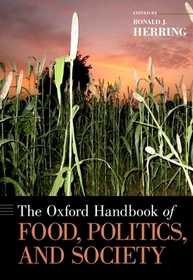
The Oxford Handbook of Food, Politics, and Society
Sorozatcím: Oxford Handbooks;
-
10% KEDVEZMÉNY?
- A kedvezmény csak az 'Értesítés a kedvenc témákról' hírlevelünk címzettjeinek rendeléseire érvényes.
- Kiadói listaár GBP 185.00
-
83 527 Ft (79 550 Ft + 5% áfa)
Az ár azért becsült, mert a rendelés pillanatában nem lehet pontosan tudni, hogy a beérkezéskor milyen lesz a forint árfolyama az adott termék eredeti devizájához képest. Ha a forint romlana, kissé többet, ha javulna, kissé kevesebbet kell majd fizetnie.
- Kedvezmény(ek) 10% (cc. 8 353 Ft off)
- Kedvezményes ár 75 175 Ft (71 595 Ft + 5% áfa)
Iratkozzon fel most és részesüljön kedvezőbb árainkból!
Feliratkozom
83 527 Ft

Beszerezhetőség
Megrendelésre a kiadó utánnyomja a könyvet. Rendelhető, de a szokásosnál kicsit lassabban érkezik meg.
Why don't you give exact delivery time?
A beszerzés időigényét az eddigi tapasztalatokra alapozva adjuk meg. Azért becsült, mert a terméket külföldről hozzuk be, így a kiadó kiszolgálásának pillanatnyi gyorsaságától is függ. A megadottnál gyorsabb és lassabb szállítás is elképzelhető, de mindent megteszünk, hogy Ön a lehető leghamarabb jusson hozzá a termékhez.
A termék adatai:
- Kiadó OUP USA
- Megjelenés dátuma 2015. február 19.
- ISBN 9780195397772
- Kötéstípus Keménykötés
- Terjedelem904 oldal
- Méret 178x249x55 mm
- Súly 1610 g
- Nyelv angol 0
Kategóriák
Rövid leírás:
Politics decides who gets what and how. At the most elemental level, food has, for most of our history, been intensely political: who gets to eat what, how often, and through what means of acquisition or entitlement? The Oxford Handbook of Food, Politics, and Society confronts the issue of food in politics through three major dimensions: ecology, technology and property.
TöbbHosszú leírás:
Politics decides who gets what and how. At the most elemental level, food has, for most of our history, been intensely political: who gets to eat what, how often, and through what means of acquisition or entitlement? The scale of the polity in question has shifted over time, from very local divisions to that of the international community imagined in the Millennium Development Goals of the United Nations. Simultaneously, the numbers and factional interests of people asserting political stakes in food and agriculture have likewise shifted up and out. For example, Europeans have used a variety of policy and social-movement tactics to influence what Africans eat; American diplomats have applied pressure to delegitimize European political choices about what not to eat; and conflicts over safety regulations have muddied the line between agricultural protectionism and justifiable precaution in confronting novel foods. As an object of governmentality, food has never been so prominent.
The thirty-five chapters in this handbook confront three major themes in the political regulation of food: ecology, technology and property. Following Ronald J. Herring's editorial introduction, the first section examines power struggles over knowledge and authority in food technology and production: who gets to be the voice of authority in agricultural research and scientific knowledge; who decides the best ways to alleviate hunger in poor countries; and who decides issues of food safety and nutritional standards. The second section addresses the political economy of food production: land power and production; distribution and trade; land reform; food entitlements and welfare policy; agricultural subsidies; and agribusiness. The third section looks at agriculture and the environment: ecological approaches to agricultural development; sustainable farming; biotechnology; climate change; livestock; and wild foods. The fourth section addresses food politics and global civil society: global food systems; cultural debates over genetically modified foods; food safety; food labeling; the politics of grocery shopping; regulation of biotechnology; and coexistence of GM, organic and conventional crops. The fifth and final section looks at food movements and the frontiers of food politics: global food movements; organic farming as a transnational phenomenon; the intersection of local and global food narratives; the agrifood industry in developing countries; the agricultural land rush; and agricultural futures.
Tartalomjegyzék:
List of Contributors
Introduction: Food, Politics, and Society
1. How is Food Political? Market, State, and Knowledge
Ronald J. Herring
Part I Production: Technology, Knowledge, and Politics
2. Science, Politics, and the Framing of Modern Agricultural Technologies
John Harriss, Drew Stewart
3. Genetically Improved Crops
Martina Newell-McGloughlin
4. Agroecological Intensification of Smallholder Farming
Rebecca Nelson, Robert Coe
5. The Hardest Case: What Blocks Improvements in Agriculture in Africa?
Robert L. Paarlberg
6. The Poor, Malnutrition, Biofortification, and Biotechnology
Alexander Stein
7. Biofuels: Competition for Land, Resources, and Political Subsidies
David Pimentel, Michael Burgess
8. Alternative Paths to Food Security
Norman Uphoff
Part II Normative Knowledge: Ethics, Rights, and Distributive Justice
9. Ethics of Food Production and Consumption
Michiel Korthals
10. Food, Justice, and Land
Saturnino M. Borras Jr., Jennifer C. Franco
11. Food Security, Productivity, and Gender Inequality
Bina Agarwal
12. Delivering Food Subsidy: The State and the Market
Ashok Kotwal, Bharat Ramaswami
13. Diets, Nutrition, and Poverty: Lessons from India
Raghav Gaiha, Raghbendra Jha, Vani S. Kulkarni, Nidhi Kaicker
14. Food Price and Trade Policy Biases: Inefficient, Inequitable, yet not Inevitable
Kym Andersen
15. Intellectual Property Rights and the Politics of Food
Krishna Ravi Srinivas
16. Is Food the Answer to Malnutrition
David E. Sahn
Part III Nature: Food, Agriculture, and the Environment
17. Fighting Mother Nature with Biotechnology
Alan McHughen
18. Climate Change and Agriculture: Countering Doomsday Scenarios
Derrill D. Watson II
19. Wild Foods
Jules Pretty, Zareen Bharucha
20. Livestock in the Food Debate
Purvi Mehta-Bhatt, Paulo Ficarelli
21. The Social Vision of the Alternative Food Movement
Siddhartha Shome
Part IV Food Values: Ideas, Interests, and Culture
22. Food Values Beyond Nutrition
Ann Grodzins Gold
23. Cultural Politics of Food Safety: Genetically Modified Food in Japan, France, and the United States
Kyoko Sato
24. Food Safety
Bruce Chassy
25. The Politics of Food Labeling and Certification
Emily Clough
26. The Politics of Grocery Shopping: Eating, Voting, and (Possibly) Transforming the Food System
Josée Johnston, Norah MacKendrick
27. The Political Economy of Regulation of Biotechnology in Agriculture
Gregory D. Graff, Gal Hochman, David Zilberman
28. Coexistence in the Fields? GM, Organic, and Conventional Food Crops
Janice Thies
Part V Global Meets Local: Contestations, Movements, and Expertise
29. Global Movements for Food Justice
M. Jahi Chappell
30. The Rise of the Organic Foods Movement as a Transnational Phenomenon
Tomas Larsson
31. Global Meets Local in Food Narratives: The Case of the Thai Papaya
Sarah Davidson Evanega, Mark Lynas
32. Thinking the African Food Crisis: The Sahel Forty Years On
Michael J. Watts
33. Transformation of the Agrifood Industry in Developing Countries
Thomas Reardon, C. Peter Timmer
34. The Twenty-first Century Agricultural Land Rush
Gregory Thaler
35. Agricultural Futures: The Politics of Knowledge
Ian Scoones
Index

