

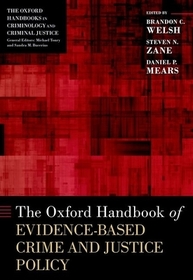
The Oxford Handbook of Evidence-Based Crime and Justice Policy
Sorozatcím: Oxford Handbooks;
-
20% KEDVEZMÉNY?
- A kedvezmény csak az 'Értesítés a kedvenc témákról' hírlevelünk címzettjeinek rendeléseire érvényes.
- Kiadói listaár GBP 122.50
-
55 308 Ft (52 675 Ft + 5% áfa)
Az ár azért becsült, mert a rendelés pillanatában nem lehet pontosan tudni, hogy a beérkezéskor milyen lesz a forint árfolyama az adott termék eredeti devizájához képest. Ha a forint romlana, kissé többet, ha javulna, kissé kevesebbet kell majd fizetnie.
- Kedvezmény(ek) 20% (cc. 11 062 Ft off)
- Kedvezményes ár 44 247 Ft (42 140 Ft + 5% áfa)
- A kedvezmény érvényes eddig: 2026. június 30.
Iratkozzon fel most és részesüljön kedvezőbb árainkból!
Feliratkozom
55 308 Ft

Beszerezhetőség
Becsült beszerzési idő: A Prosperónál jelenleg nincsen raktáron, de a kiadónál igen. Beszerzés kb. 3-5 hét..
A Prosperónál jelenleg nincsen raktáron.
Why don't you give exact delivery time?
A beszerzés időigényét az eddigi tapasztalatokra alapozva adjuk meg. Azért becsült, mert a terméket külföldről hozzuk be, így a kiadó kiszolgálásának pillanatnyi gyorsaságától is függ. A megadottnál gyorsabb és lassabb szállítás is elképzelhető, de mindent megteszünk, hogy Ön a lehető leghamarabb jusson hozzá a termékhez.
A termék adatai:
- Kiadó OUP USA
- Megjelenés dátuma 2024. február 1.
- ISBN 9780197618110
- Kötéstípus Keménykötés
- Terjedelem704 oldal
- Méret 183x244x78 mm
- Súly 1247 g
- Nyelv angol 475
Kategóriák
Rövid leírás:
The Oxford Handbook of Evidence-Based Crime and Justice Policy showcases much of what is right with evidence-based crime and justice policy as well as confronts the challenges that it faces today and looking forward. Bringing together leading scholars and researchers in criminology, criminal justice, sociology, psychology, education, health, and the law, this handbook promotes new and productive ways to think about evidence-based policy, shows how research can contribute to and guide evidence-based policy in juvenile justice, criminal justice, and alternatives to system responses, and identifies strategies that can increase reliance on evidence-based policy. It is the most authoritative and scholarly source on research and experience on evidence-based policy as it applies to crime and justice in the United States and across the Western world.
TöbbHosszú leírás:
The need for and the threats to improved public policy are equally acute. Crime policy agenda continues to be driven by anecdotal evidence and political ideology, resulting in a patchwork of programs, policies, and practices. All-too-frequently, the need for them is uncertain, they rest on unclear theoretical foundations, they are implemented poorly, and their effectiveness in preventing or controlling crime, or furthering justice, is unknown. Putting research evidence at center-stage in political and policy decisions can go a long way to addressing this state of affairs by ensuring that the best available data informs decisions that affect the public good.
Situated within this wider context, The Oxford Handbook of Evidence-Based Crime and Justice Policy showcases much of what is right with evidence-based crime and justice policy as well as confronts the challenges that it faces today and looking forward. Bringing together leading scholars and researchers in criminology, criminal justice, sociology, psychology, education, health, and the law, this handbook promotes new and productive ways to think about evidence-based policy, shows how research can contribute to and guide evidence-based policy in juvenile justice, criminal justice, and alternatives to system responses, and identifies strategies that can increase reliance on evidence-based policy. It is the most authoritative and scholarly source on research and experience on evidence-based policy as it applies to crime and justice in the United States and across the Western world.
Brandon Welsh, Steven Zane, and Daniel Mears have developed a great resource for students, practitioners, and academics concerned with evidence-based policy. With chapters covering a variety of topics from leading scholars around the world, The Oxford Handbook of Evidence-Based Crime and Justice Policy is a valuable reference that should be in close reach on any bookshelf.
Tartalomjegyzék:
1. Evidence-Based Crime and Justice Policy
Brandon C. Welsh, Steven N. Zane, and Daniel P. Mears
PART I. CONCEPTS, METHODS, AND CRITICAL PERSPECTIVES
2. Evaluating Research and Assessing Research Evidence
Brandon C. Welsh and Daniel P. Mears
3. Translational Criminology and Evidence-Based Policy and Practice
Cody W. Telep
4. Implementation Science for Evidence-Based Policy
Dean L. Fixsen, Melissa Van Dyke, and Karen A. Blase
5. Toward System-Level Change, Population Impacts, and Equity
Holly S. Schindler
PART II: JUVENILE JUSTICE
6. Advancing the Evidence-Based Era: 25 Years of Lessons Learned in Washington State's Juvenile Justice System
Elizabeth K. Drake and Lauren Knoth-Peterson
7. Systems of Change: The Pennsylvania Model
Shawn Peck, Janet A. Welsh, Kristopher T. Glunt, and Roger Spaw
8. Diversion: What Do We Know?
Roger Smith
9. Evidence-Based Innovations in Juvenile Probation
David L. Myers and Kelly Orts
10. Using Evidence-Based Practices to Improve Juvenile Drug Treatment Courts
Christopher J. Sullivan, Vitor Goncalves, and Nicole McKenna
11. Evidence-Oriented Youth Justice
Jeffrey A. Butts, John K. Roman, and Katheryne Pugliese
PART III: CRIMINAL JUSTICE
12. Legitimacy and Evidence-Based Policy
Justice Tankebe and Anthony Bottoms
13. Evidence-Based Policing
Cynthia Lum and Christopher S. Koper
14. CCTV Video Surveillance and Crime Control: The Current Evidence and Important Next Steps
Eric L. Piza
15. Rehabilitation for Enduring Change: Toward Evidence-Based Corrections
Michael Rocque
16. Incarceration-Based Drug Treatment
Ojmarrh Mitchell
17. Making Prisoner Reentry Evidence-Based
Helen Kosc and David S. Kirk
18. Evidence-Based Policy for Diverse Criminal Justice Populations
Kaelyn Sanders, Jennifer Cobbina-Dungy, and Henrika McCoy
PART IV: ALTERNATIVES TO SYSTEM RESPONSES
19. Early Prevention as an Alternative to Imprisonment: The Research Evidence on Monetary Costs and Benefits
Brandon C. Welsh, Heather Paterson, and David P. Farrington
20. Evidence-Based Intervention Programs Targeting Antisocial Children and Youth in Norway: Parent Management Training, the Oregon Model (PMTO)
Terje Ogden, Elisabeth Askeland, and Kristine Amlund-Hagen
21. Systems of Change: Communities That Care
Abigail A. Fagan
22. Reducing School Crime and Student Misbehavior: An Evidence-Based Analysis
Allison Ann Payne
23. Evidence-Based Strategies for Preventing Urban Youth Violence
Katherine M. Ross, Colleen S. Walsh, Angela G. Angulo, Carine E. Leslie, and
Patrick H. Tolan
24. A Place Management Approach to Promote Evidence-Based Crime Prevention
Tamara D. Herold
25. Using Research to Inform Services for Victims of Crime
Jillian Turanovic, Julie L. Kuper, and Mackenzie Masters
PART V: PROMOTING GREATER USE OF EVIDENCE-BASED POLICY
26. Social Inequality and Evidence-Based Policy: An Agenda for Change
Nancy Rodriguez
27. Applying What We Know and Building an Evidence Base: Reducing Disproportionate Minority Contact
Steven N. Zane
28. Applying What We Know and Building an Evidence Base: Reducing Gun Violence
John J. Donohue
29. Mass Evidence-Based Policy as an Alternative to Mass Incarceration
Daniel P. Mears and Joshua C. Cochran
30. “Big Data” and Evidence-Based Policy and Practice: The Advantages, Challenges, and Long-Term Potential of Naturally Occurring Data
Daniel T. O'Brien
31. Imposed Use: A New Route to Evidence-Based Policy
Steven N. Zane
32. The Role of Policymakers, Criminal Justice Administrators and Practitioners, and Citizens in Creating, Evaluating, and Using Evidence-Based Policy
Daniel P. Mears and Natasha A. Frost

