

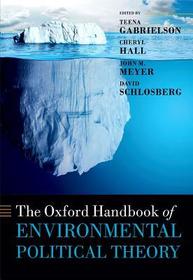
The Oxford Handbook of Environmental Political Theory
Sorozatcím: Oxford Handbooks;
-
10% KEDVEZMÉNY?
- A kedvezmény csak az 'Értesítés a kedvenc témákról' hírlevelünk címzettjeinek rendeléseire érvényes.
- Kiadói listaár GBP 150.00
-
67 725 Ft (64 500 Ft + 5% áfa)
Az ár azért becsült, mert a rendelés pillanatában nem lehet pontosan tudni, hogy a beérkezéskor milyen lesz a forint árfolyama az adott termék eredeti devizájához képest. Ha a forint romlana, kissé többet, ha javulna, kissé kevesebbet kell majd fizetnie.
- Kedvezmény(ek) 10% (cc. 6 773 Ft off)
- Kedvezményes ár 60 953 Ft (58 050 Ft + 5% áfa)
Iratkozzon fel most és részesüljön kedvezőbb árainkból!
Feliratkozom
67 725 Ft

Beszerezhetőség
Megrendelésre a kiadó utánnyomja a könyvet. Rendelhető, de a szokásosnál kicsit lassabban érkezik meg.
Why don't you give exact delivery time?
A beszerzés időigényét az eddigi tapasztalatokra alapozva adjuk meg. Azért becsült, mert a terméket külföldről hozzuk be, így a kiadó kiszolgálásának pillanatnyi gyorsaságától is függ. A megadottnál gyorsabb és lassabb szállítás is elképzelhető, de mindent megteszünk, hogy Ön a lehető leghamarabb jusson hozzá a termékhez.
A termék adatai:
- Kiadó OUP Oxford
- Megjelenés dátuma 2016. január 7.
- ISBN 9780199685271
- Kötéstípus Keménykötés
- Terjedelem682 oldal
- Méret 246x171 mm
- Súly 1310 g
- Nyelv angol 0
Kategóriák
Rövid leírás:
This volume defines, illustrates, and challenges the field on environmental political theory. Through a broad range of approaches, it shows how scholars have used concepts, methods, and arguments from political theory and closely related disciplines to address contemporary environmental problems.
TöbbHosszú leírás:
Set at the intersection of political theory and environmental politics, yet with broad engagement across the environmental social sciences and humanities, The Oxford Handbook of Environmental Political Theory, defines, illustrates, and challenges the field of environmental political theory (EPT).
Featuring contributions from distinguished political scientists working in this field, this volume addresses canonical theorists and contemporary environmental problems with a diversity of theoretical approaches. The initial volume focuses on EPT as a field of inquiry, engaging both traditions of political thought and the academy. In the second section, the handbook explores conceptualizations of nature and the environment, as well as the nature of political subjects, communities, and boundaries within our environments. A third section addresses the values that motivate environmental theorists -- including justice, responsibility, rights, limits, and flourishing -- and the potential conflicts that can emerge within, between, and against these ideals. The final section examines the primary structures that constrain or enable the achievement of environmental ends, as well as theorizations of environmental movements, citizenship, and the potential for on-going environmental action and change.
For anyone seriously concerned with environmental issues and understanding the associated politics, this is a book they should have on their shelves. It can be consulted on a wide range of topics, and represents a true state-of-theart guide. It is difficult to select specific contributions to highlight, but having been engaged with research that addressed notions of environmental justice, I was drawn to the four chapters that explicitly tackled this topic. These provide an historical overview of the concept's evolution, and they also demonstrate vital insights to the challenges being posed by the need to seek 'climate justice', or the efforts to minimise harm associated with climate change and the 'structural injustice' of its harmful impacts, symbolising how the least developed countries may suffer the worst impacts of climate change despite contributing little to the problem.The Handbook is thoroughly worthy of the label 'treasure trove'.
Tartalomjegyzék:
I. Introduction
Introducing Environmental Political Theory
II. Environmental Political Theory as a Field of Inquiry
A. Engaging Traditions of Political Thought
EPT and the History of Western Political Theory
Culture and Difference: Non-Western Approaches to Defining Environmental Issues
EPT and the Liberal Tradition
EPT and Republicanism
Human Nature, Non-Human Nature, and Needs: EPT and Critical Theory
B. Engaging the Academy
Environmental Political Theory, Environmental Ethics, and Political Science: Bridging the Gap
Environmental Political Theory's Contribution to Sustainability Studies
EPT and Environmental Action Research Teams
III. Rethinking Nature and Political Subjects
A. Nature, Environment, and the Political
'Nature' and the (Built) Environment
Theorizing the Nonhuman through Spatial and Environmental Thought
Challenging the Human x Environment Framework
Environmental Management in the Anthropocene
B. Environment, Community, and Boundaries
Interspecies
Floral Sensations: Plant Biopolitics
Cosmopolitanism and the Environment
IV. Ends, Goals, Ideals
A. Sustainability
Sustainability - Post-sustainability - Unsustainability
Population, Environmental Discourse, and Sustainability
Are There Limits to Limits?
Beyond Orthodox Undifferentiated Economic Growth
B. Justice, Rights, and Responsibility
Environmental and Climate Justice
Environmental Human Rights
Responsibility for Climate Change as a Structural Injustice
Environmental Justice and the Anthropocene Meme
C. Freedom, Agency, and Flourishing
The Limits of Freedom and the Freedom of Limits
Bodies, Environment, and Agency
Cultivating Human and Non-Human Capabilities for Mutual Flourishing
Consumption and Well-Being
V. Power, Structures, and Change
A. Identifying Structural Constraints and Possibilities
Capital, Environmental Degradation, and Economic Externalization
Environmental Governmentality
Political Economy of the Greening of the State
Environmental Science and Politics
Democracy as Constraint and Possibility for Environmental Action
Environmental Authoritarianism and China
Global Environmental Governance
B. Theorizing Citizenship, Movements, and Action
Global Environmental Justice & the Environmentalisms of the Poor
Indigenous Environmental Movements & the Function of Governance Institutions
Reimagining Radical Environmentalism
Framing and Nudging for a Greener Future
Citizenship: Radical, Feminist, and Green
Ecological Democracy and the Co-Participation of Things

