

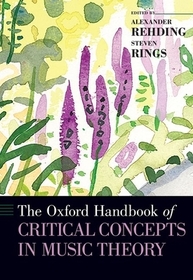
The Oxford Handbook of Critical Concepts in Music Theory
Sorozatcím: Oxford Handbooks;
-
10% KEDVEZMÉNY?
- A kedvezmény csak az 'Értesítés a kedvenc témákról' hírlevelünk címzettjeinek rendeléseire érvényes.
- Kiadói listaár GBP 165.00
-
74 497 Ft (70 950 Ft + 5% áfa)
Az ár azért becsült, mert a rendelés pillanatában nem lehet pontosan tudni, hogy a beérkezéskor milyen lesz a forint árfolyama az adott termék eredeti devizájához képest. Ha a forint romlana, kissé többet, ha javulna, kissé kevesebbet kell majd fizetnie.
- Kedvezmény(ek) 10% (cc. 7 450 Ft off)
- Kedvezményes ár 67 048 Ft (63 855 Ft + 5% áfa)
Iratkozzon fel most és részesüljön kedvezőbb árainkból!
Feliratkozom
74 497 Ft

Beszerezhetőség
Megrendelésre a kiadó utánnyomja a könyvet. Rendelhető, de a szokásosnál kicsit lassabban érkezik meg.
Why don't you give exact delivery time?
A beszerzés időigényét az eddigi tapasztalatokra alapozva adjuk meg. Azért becsült, mert a terméket külföldről hozzuk be, így a kiadó kiszolgálásának pillanatnyi gyorsaságától is függ. A megadottnál gyorsabb és lassabb szállítás is elképzelhető, de mindent megteszünk, hogy Ön a lehető leghamarabb jusson hozzá a termékhez.
A termék adatai:
- Kiadó OUP USA
- Megjelenés dátuma 2020. január 31.
- ISBN 9780190454746
- Kötéstípus Keménykötés
- Terjedelem856 oldal
- Méret 254x180x43 mm
- Súly 1542 g
- Nyelv angol
- Illusztrációk 290 0
Kategóriák
Rövid leírás:
Music Theory operates with a number of fundamental terms that are rarely explored in detail. This book offers in-depth reflections on key concepts from a range of philosophical and critical approaches that reflect the diversity of the contemporary music theory landscape.
TöbbHosszú leírás:
Music Theory has a lot of ground to cover. Especially in introductory classes a whole range of fundamental concepts are introduced at fast pace that can never be explored in depth or detail, as other new topics become more pressing. The short time we spend with them in the classroom belies the complexity (and, in many cases, the contradictions) underlying these concepts. This book takes the time to tarry over these complexities, probe the philosophical assumptions on which these concepts rest, and shine a light on all their iridescent facets.
This book presents music-theoretical concepts as a register of key terms progressing outwards from smallest detail to discussions of the music-theoretical project on the largest scale. The approaches individual authors take range from philosophical, historical, or analytical to systematic, cognitive, and critical-theorical-covering the whole diverse spectrum of contemporary music theory. In some cases authors explore concepts that have not yet been widely added to the theorist's toolkit but deserve to be included; in other cases concepts are expanded beyond their core repertory of application. This collection does not shy away from controversy. Taken in their entirety, the essays underline that music theory is on the move, exploring new questions, new repertories, and new approaches.
This collection is an invitation to take stock of music theory in the early twenty-first century, to look back and to encourage discussion about its future directions. Its chapters open up a panoramic view of the contemporary music-theoretical landscape with its expanding repertories and changing guiding questions, and offers suggestions as to where music theory is headed in years to come.
In reading it, I learned and I was exercised; the collection is outstanding indeed
Tartalomjegyzék:
Contributors
Introduction
1. Pitch, Tone, and Note
Bryan Parkhurst, Stephan Hammel
2. Interval
Henry Klumpenhouwer
3. Mode
Susan McClary
4. Scale
Matthew Gelbart
5. Tonic
Steven Rings
6. Timbre
David Blake
7. Texture
Jonathan De Souza
8. Repetition
Elizabeth Hellmuth Margulis
9. Meter
Richard Cohn
10. Temporalities
Martin Scherzinger
11. Groove
Guilherme Schmidt Camara, Anne Danielsen
12. Phrase
Janet Schmalfeldt
13. Music's Moving Form
Daniel Grimley
14. Expressive Timing
Mitch Ohriner
15. Melody
David Trippett
16. Consonance and Dissonance
Alexander Rehding
17. Tonal Harmony
Ian Quinn
18. Key and Modulation
Suzannah Clark
19. Cadence
Daniel Harrison
20. Sequence
Naomi Waltham-Smith
21. Polyphony
Michael Tenzer
22. Musical Grammar
Robert O. Gjerdingen
23. Beneath Improvisation
Vijay Iyer
24. Analytical Relationships
Marion Guck
25. Images, Visualization, and Representation
Dora Hanninen
26. What is Music, Anyway?
Andrew Bowie
Index

