

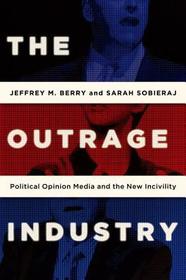
The Outrage Industry
Political Opinion Media and the New Incivility
Sorozatcím: Studies in Postwar American Political Development;
-
10% KEDVEZMÉNY?
- A kedvezmény csak az 'Értesítés a kedvenc témákról' hírlevelünk címzettjeinek rendeléseire érvényes.
- Kiadói listaár GBP 32.49
-
14 669 Ft (13 970 Ft + 5% áfa)
Az ár azért becsült, mert a rendelés pillanatában nem lehet pontosan tudni, hogy a beérkezéskor milyen lesz a forint árfolyama az adott termék eredeti devizájához képest. Ha a forint romlana, kissé többet, ha javulna, kissé kevesebbet kell majd fizetnie.
- Kedvezmény(ek) 10% (cc. 1 467 Ft off)
- Kedvezményes ár 13 202 Ft (12 573 Ft + 5% áfa)
Iratkozzon fel most és részesüljön kedvezőbb árainkból!
Feliratkozom
14 669 Ft

Beszerezhetőség
Megrendelésre a kiadó utánnyomja a könyvet. Rendelhető, de a szokásosnál kicsit lassabban érkezik meg.
Why don't you give exact delivery time?
A beszerzés időigényét az eddigi tapasztalatokra alapozva adjuk meg. Azért becsült, mert a terméket külföldről hozzuk be, így a kiadó kiszolgálásának pillanatnyi gyorsaságától is függ. A megadottnál gyorsabb és lassabb szállítás is elképzelhető, de mindent megteszünk, hogy Ön a lehető leghamarabb jusson hozzá a termékhez.
A termék adatai:
- Kiadó OUP USA
- Megjelenés dátuma 2016. augusztus 18.
- ISBN 9780190498467
- Kötéstípus Puhakötés
- Terjedelem288 oldal
- Méret 231x155x17 mm
- Súly 408 g
- Nyelv angol 0
Kategóriák
Rövid leírás:
A stimulating expose on how the roots of today's partisan rage lie in the "outrage industry" - deregulated, commodified media markets that will do anything for money and attention.
TöbbHosszú leírás:
In early 2012, conservative radio host Rush Limbaugh claimed that Sandra Fluke, a Georgetown University law student who advocated for insurance coverage of contraceptives, "wants to be paid to have sex." Over the next few days, Limbaugh attacked Fluke personally, often in crude terms, while a powerful backlash grew, led by organizations such as the National Organization for Women. But perhaps what was most notable about the incident was that it wasn't unusual. From Limbaugh's venomous attacks on Fluke to liberal radio host Mike Malloy's suggestion that Bill O'Reilly "drink a vat of poison... and choke to death," over-the-top discourse in today's political opinion media is pervasive.
Anyone who observes the skyrocketing number of incendiary political opinion shows on television and radio might conclude that political vitriol on the airwaves is fueled by the increasingly partisan American political system. But in The Outrage Industry Jeffrey M. Berry and Sarah Sobieraj show how the proliferation of outrage-the provocative, hyperbolic style of commentary delivered by hosts like Ed Schultz, Bill O'Reilly, and Sean Hannity- says more about regulatory, technological, and cultural changes, than it does about our political inclinations.
Berry and Sobieraj tackle the mechanics of outrage rhetoric, exploring its various forms such as mockery, emotional display, fear mongering, audience flattery, and conspiracy theories. They then investigate the impact of outrage rhetoric-which stigmatizes cooperation and brands collaboration and compromise as weak-on a contemporary political landscape that features frequent straight-party voting in Congress. Outrage tactics have also facilitated the growth of the Tea Party, a movement which appeals to older, white conservatives and has dragged the GOP farther away from the demographically significant moderates whose favor it should be courting. Finally, The Outrage Industry examines how these shows sour our own political lives, exacerbating anxieties about political talk and collaboration in our own communities. Drawing from a rich base of evidence, this book forces all of us to consider the negative consequences that flow from our increasingly hyper-partisan political media.
Jeffrey Berry and Sarah Sobieraj have written an important book about a phenomenon that has been a major contributor to partisan conflict and gridlock in Washington in recent years-the development of an increasingly hyperbolic, emotional and negative style of media commentary. The Outrage Industry will be must reading for anyone who wants to understand why our political system is so dysfunctional"
Tartalomjegyzék:
Chapter 1 Outrage
Chapter 2 Mapping Outrage in Blogs, Talk Radio, and Cable News
Chapter 3 The Perfect Storm
Chapter 4 It's a Business
Chapter 5 Political Anxiety and Outrage Fandom
Chapter 6 Mobilizing Outrage
Chapter 7 Continuity, Change, Synergy
Chapter 8 The Future of Outrage
Appendix

