

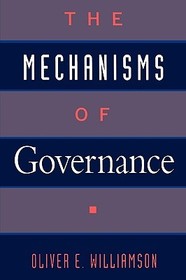
The Mechanisms of Governance
-
10% KEDVEZMÉNY?
- A kedvezmény csak az 'Értesítés a kedvenc témákról' hírlevelünk címzettjeinek rendeléseire érvényes.
- Kiadói listaár GBP 175.00
-
79 012 Ft (75 250 Ft + 5% áfa)
Az ár azért becsült, mert a rendelés pillanatában nem lehet pontosan tudni, hogy a beérkezéskor milyen lesz a forint árfolyama az adott termék eredeti devizájához képest. Ha a forint romlana, kissé többet, ha javulna, kissé kevesebbet kell majd fizetnie.
- Kedvezmény(ek) 10% (cc. 7 901 Ft off)
- Kedvezményes ár 71 111 Ft (67 725 Ft + 5% áfa)
Iratkozzon fel most és részesüljön kedvezőbb árainkból!
Feliratkozom
79 012 Ft

Beszerezhetőség
Megrendelésre a kiadó utánnyomja a könyvet. Rendelhető, de a szokásosnál kicsit lassabban érkezik meg.
Why don't you give exact delivery time?
A beszerzés időigényét az eddigi tapasztalatokra alapozva adjuk meg. Azért becsült, mert a terméket külföldről hozzuk be, így a kiadó kiszolgálásának pillanatnyi gyorsaságától is függ. A megadottnál gyorsabb és lassabb szállítás is elképzelhető, de mindent megteszünk, hogy Ön a lehető leghamarabb jusson hozzá a termékhez.
A termék adatai:
- Kiadó OUP USA
- Megjelenés dátuma 1996. június 20.
- ISBN 9780195078244
- Kötéstípus Keménykötés
- Terjedelem448 oldal
- Méret 241x164x34 mm
- Súly 712 g
- Nyelv angol
- Illusztrációk line figures 0
Kategóriák
Rövid leírás:
Oliver Williamson has helped to create a new perspective that economists use to understand the ways that organizations function. Traditionally, economists have viewed firms as "black boxes" that maximize some economic function (like profit). Williamson shows that decision makers in firms respond to economic factors - what he calls "transaction costs" - within the firm that affect both the structure of the individual firm and the structure of the industry within which the organization operates.
TöbbHosszú leírás:
New Institutional Economics is a new way to look at how organizations function. Rather than seeing the firm as a "black box", Williamson shows how decision makers respond to economic factors WITHIN the firm -- what he calls "transaction cost economics" (TCE). In this series of studies, Williamson shows how complexity expands in organizations because of bounded rationality and opportunism; that is the "bad news" of his message. The "good news" is that individuals within organizations become perceptive of resulting hazards they may and do encounter, and are adept at fashioning their organizations to cope creatively with difficult situations. This creativity accounts for diversity among organizations, in which governance structures are adapted to firm - or industry-specific hazards.
These papers have been slightly modified and linking passages have been added to them to impose a sort of unity on them. The book is therefore an extremely convenient collection on the overall theory and some of the applications of transaction cost economics as understood by the leading exponent of those economics ... it is on the understanding of the existence of the firm and its behaviour that he has made his greatest mark ... I believe that what is read will speak for itself and for good law and economics more eloquently than I can manage here.
Tartalomjegyzék:
Prologue
PART I: OVERVIEW
Chester Barnard and the Incipient Science of Organization
Transaction Cost Economics
PART II: CONCEPTS AND APPLICATIONS
Comparative Economic Organization: The Analysis of Discrete Strucutural Alternatives
Credible Commitments: Using Hostages to Support Exchange
Economic Institutions: Spontaneous and Intentional Governance
Corporate Finance and Corporate Governance
The Politics and Economics of Redistribution and Inefficiency
PART III: ORGANIZATIONS
Transaction Cost Economics and Organization Theory
Calculativeness, Trust, and Economic Organization
PART IV: PUBLIC POLICY
Delimiting Antitrust
Strategizing, Economizing, and Economic Organization
The Institutions and Governance of Economic Development and Reform
PART V: CONTROVERSY AND PERSPECTIVES
Transaction Cost Economics Meets Posnerian Law and Economics
Transaction Cost Economics and the Evolving Science of Organization
Glossary

