

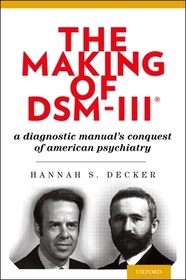
The Making of DSM-III
A Diagnostic Manual's Conquest of American Psychiatry
-
10% KEDVEZMÉNY?
- A kedvezmény csak az 'Értesítés a kedvenc témákról' hírlevelünk címzettjeinek rendeléseire érvényes.
- Kiadói listaár GBP 87.00
-
39 280 Ft (37 410 Ft + 5% áfa)
Az ár azért becsült, mert a rendelés pillanatában nem lehet pontosan tudni, hogy a beérkezéskor milyen lesz a forint árfolyama az adott termék eredeti devizájához képest. Ha a forint romlana, kissé többet, ha javulna, kissé kevesebbet kell majd fizetnie.
- Kedvezmény(ek) 10% (cc. 3 928 Ft off)
- Kedvezményes ár 35 352 Ft (33 669 Ft + 5% áfa)
Iratkozzon fel most és részesüljön kedvezőbb árainkból!
Feliratkozom
39 280 Ft

Beszerezhetőség
Megrendelésre a kiadó utánnyomja a könyvet. Rendelhető, de a szokásosnál kicsit lassabban érkezik meg.
Why don't you give exact delivery time?
A beszerzés időigényét az eddigi tapasztalatokra alapozva adjuk meg. Azért becsült, mert a terméket külföldről hozzuk be, így a kiadó kiszolgálásának pillanatnyi gyorsaságától is függ. A megadottnál gyorsabb és lassabb szállítás is elképzelhető, de mindent megteszünk, hogy Ön a lehető leghamarabb jusson hozzá a termékhez.
A termék adatai:
- Kiadó OUP USA
- Megjelenés dátuma 2013. június 13.
- ISBN 9780195382235
- Kötéstípus Puhakötés
- Terjedelem466 oldal
- Méret 231x152x33 mm
- Súly 658 g
- Nyelv angol
- Illusztrációk 33 illustrations 0
Kategóriák
Rövid leírás:
This book chronicles how American psychiatry went from its psychoanalytic heyday in the 1940s and '50s, through the virulent anti-psychiatry of the 1960s and '70s, into the late 20th-century descriptive, criteria-grounded model of mental disorders.
TöbbHosszú leírás:
In 1973, the American Psychiatric Association decided to publish a revised edition of their Diagnostic and Statistical Manual (DSM). There was great hope that a new manual would display psychiatry as a scientific field and aid in combating the attacks of an aggressive anti-psychiatry movement that had persisted for more than a decade.
The Making of DSM-III is a book about the manual that resulted in 1980-DSM-III-a far-reaching revisionist work that created a revolution in American psychiatry. Its development precipitated a historic clash between the DSM-III Task Force - a group of descriptive, empirically oriented psychiatrists and psychologists - and the psychoanalysts the Task Force was determined to dethrone from their dominance in American psychiatry. DSM-III also inaugurated an era in which it and the diagnostic manuals that followed played enormous roles in the daily lives of persons and organizations all over the world, for the DSMs have been translated into many languages.
The radical revision process was led by the psychiatrist Robert L. Spitzer, a many-talented man of great determination, energy, and tactical skills, arguably the most influential psychiatrist of the second half of the 20th Century. Spitzer created as major a change in descriptive psychiatry and classification as had the renowned German psychiatrist Emil Kraepelin, almost a century earlier. Kraepelin had been the epochal delineator of dementia praecox from manic-depressive illness, the forerunners of modern schizophrenia and bipolar disorder.
In her book, Hannah Decker portrays the many internal and external battles that roiled the creation of DSM-III and analyzes both its positive achievements and significant drawbacks. She also astutely explores the deleterious effects of the violent swings in scientific orientation that have dominated psychiatry over the past 200 years and are still alive today.
Decker has written a revealing and exciting book that is based on archival sources never before used as well as extensive interviews with the psychiatrists and psychologists who have brought into being the psychiatry we know today.
Tartalomjegyzék:
CONTENTS
Illustrations
INTRODUCTION
Section I: The History
1. A Pivotal Three Decades: American Psychiatry After World War II
Chronicle I: "Weller Than Well"
Chronicle II: "Psychiatry Kills"
Chronicle III: "Pseudopatients" and "Sexual Deviations"
2. Emil Kraepelin: Birth of Modern Descriptive Psychiatry
3. Kraepelin's Progeny: The "Neo-Kraepelinians"
Section II: The People
4. Robert L. Spitzer, Psychiatric Revolutionary
5. The DSM-III Task Force and Psychiatric Empiricism
Section III: The Making
6. A Brief History of Modern Classification and Problems with Reliability in
Diagnosis
7. The Revolution Begins, 1973-1976
8. A Snapshot in Time: DSM-III in Midstream, 1976
9. The Eruption of Discord Following the Midstream Conference
10. Clinicians Vs. Researchers again and New Antagonisms Over Sexuality
11. The Psychoanalytic Awakening to DSM-III
12. The Field Trials and Yet More Controversies
13. The Final Weeks
Conclusion
Notes
Interviews
Bibliography
Index
About the Author

