

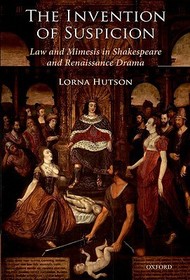
The Invention of Suspicion
Law and Mimesis in Shakespeare and Renaissance Drama
-
10% KEDVEZMÉNY?
- A kedvezmény csak az 'Értesítés a kedvenc témákról' hírlevelünk címzettjeinek rendeléseire érvényes.
- Kiadói listaár GBP 54.00
-
25 798 Ft (24 570 Ft + 5% áfa)
Az ár azért becsült, mert a rendelés pillanatában nem lehet pontosan tudni, hogy a beérkezéskor milyen lesz a forint árfolyama az adott termék eredeti devizájához képest. Ha a forint romlana, kissé többet, ha javulna, kissé kevesebbet kell majd fizetnie.
- Kedvezmény(ek) 10% (cc. 2 580 Ft off)
- Kedvezményes ár 23 219 Ft (22 113 Ft + 5% áfa)
Iratkozzon fel most és részesüljön kedvezőbb árainkból!
Feliratkozom
25 798 Ft

Beszerezhetőség
Megrendelésre a kiadó utánnyomja a könyvet. Rendelhető, de a szokásosnál kicsit lassabban érkezik meg.
Why don't you give exact delivery time?
A beszerzés időigényét az eddigi tapasztalatokra alapozva adjuk meg. Azért becsült, mert a terméket külföldről hozzuk be, így a kiadó kiszolgálásának pillanatnyi gyorsaságától is függ. A megadottnál gyorsabb és lassabb szállítás is elképzelhető, de mindent megteszünk, hogy Ön a lehető leghamarabb jusson hozzá a termékhez.
A termék adatai:
- Kiadó OUP Oxford
- Megjelenés dátuma 2011. április 14.
- ISBN 9780199691487
- Kötéstípus Puhakötés
- Terjedelem392 oldal
- Méret 234x155x22 mm
- Súly 600 g
- Nyelv angol
- Illusztrációk 5 black-and-white halftones 0
Kategóriák
Rövid leírás:
Lorna Hutson argues that changes in the English justice system in the sixteenth century towards greater participation (by JPs and jurors) had a decisive impact on English Renaissance drama. Her nuanced and closely researched book sheds new light on much of what we take for granted about character and plot in Shakespearean drama.
TöbbHosszú leírás:
The Invention of Suspicion argues that the English justice system underwent changes in the sixteenth century that, because of the system's participatory nature, had a widespread effect and a decisive impact on the development of English Renaissance drama. These changes gradually made evidence evaluation a popular skill: justices of peace and juries were increasingly required to weigh up the probabilities of competing narratives of facts. At precisely the same time, English dramatists were absorbing, from Latin legal rhetoric and from Latin comedy, poetic strategies that enabled them to make their plays more persuasively realistic, more 'probable'. The result of this enormously rich conjunction of popular legal culture and ancient forensic rhetoric was a drama in which dramatis personae habitually gather evidence and 'invent' arguments of suspicion and conjecture about one another, thus prompting us, as readers and audience, to reconstruct this 'evidence' as stories of characters' private histories and inner lives. In this drama, people act in uncertainty, inferring one another's motives and testing evidence for their conclusions. As well as offering an overarching account of how changes in juridical epistemology relate to post-Reformation drama, this book examines comic dramatic writing associated with the Inns of Court in the overlooked decades of the 1560s and 70s. It argues that these experiments constituted an influential sub-genre, assimilating the structures of Roman comedy to current civic and political concerns with the administration of justice. This sub-genre's impact may be seen in Shakespeare's early experiments in revenge tragedy, history play and romance comedy, in Titus Andronicus, Henry VI and The Comedy of Errors, as well as Jonson's Every Man in his Humour, Bartholomew Fair and The Alchemist. The book ranges from mid-fifteenth century drama, through sixteenth century interludes to the drama of the 1590s and 1600s. It draws on recent research by legal historians, and on a range of legal-historical sources in print and manuscript.
Hutson's book is powerful, innovative, and well-argued; I predict that it will be an unusually useful and influential book, in the sense that a very broad range of scholars will be able to engage productively with its larger argument about the sixteenth-century emergence and diffusion of a culture of forensic curiosity.
Tartalomjegyzék:
Preface
From Penitence to Evidence: Drama and the Legal Reformation
Rethinking Foucault: The Juridical Epistemology of English Renaissance Drama
Judicial Narrative and Dramatic Mimesis
From Intrigue to Detection: Transformations of Classical Comedy 1566-1594
Forensic rhetoric on the Popular Stage, I: Shakespeare's Histories
Forensic Rhetoric on the Popular Stage, II: Revenge Tragedy and Romantic Comedy in the 1590s
Jonson's Justices and Shakespeare's Constables: Sexual Suspicion and the Evidential Plot
Bibliography

