

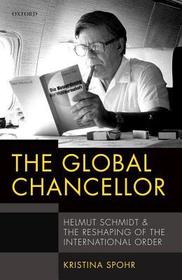
The Global Chancellor
Helmut Schmidt and the Reshaping of the International Order
-
10% KEDVEZMÉNY?
- A kedvezmény csak az 'Értesítés a kedvenc témákról' hírlevelünk címzettjeinek rendeléseire érvényes.
- Kiadói listaár GBP 61.00
-
27 541 Ft (26 230 Ft + 5% áfa)
Az ár azért becsült, mert a rendelés pillanatában nem lehet pontosan tudni, hogy a beérkezéskor milyen lesz a forint árfolyama az adott termék eredeti devizájához képest. Ha a forint romlana, kissé többet, ha javulna, kissé kevesebbet kell majd fizetnie.
- Kedvezmény(ek) 10% (cc. 2 754 Ft off)
- Kedvezményes ár 24 787 Ft (23 607 Ft + 5% áfa)
Iratkozzon fel most és részesüljön kedvezőbb árainkból!
Feliratkozom
27 541 Ft

Beszerezhetőség
Megrendelésre a kiadó utánnyomja a könyvet. Rendelhető, de a szokásosnál kicsit lassabban érkezik meg.
Why don't you give exact delivery time?
A beszerzés időigényét az eddigi tapasztalatokra alapozva adjuk meg. Azért becsült, mert a terméket külföldről hozzuk be, így a kiadó kiszolgálásának pillanatnyi gyorsaságától is függ. A megadottnál gyorsabb és lassabb szállítás is elképzelhető, de mindent megteszünk, hogy Ön a lehető leghamarabb jusson hozzá a termékhez.
A termék adatai:
- Kiadó OUP Oxford
- Megjelenés dátuma 2016. március 24.
- ISBN 9780198747796
- Kötéstípus Keménykötés
- Terjedelem228 oldal
- Méret 241x177x20 mm
- Súly 486 g
- Nyelv angol
- Illusztrációk 17 black and white images 0
Kategóriák
Rövid leírás:
Helmut Schmidt led West Germany from 1974 to 1982 amid a world economic crisis and one of the frostiest phases of the Cold War. At home in both security and economics, Schmidt became the supreme 'strategist of balance' and earned the nickname of 'world economist'. It was during his chancellorship that West Germany came of age on the global stage.
TöbbHosszú leírás:
Helmut Schmidt is the neglected chancellor of modern German history, overshadowed by 'the greats' - Bismarck, Adenauer, Brandt and Kohl. This volume retrieves Schmidt's true significance as a pivotal figure who helped reshape the global order during the crisis-ridden 1970s. This major reinterpretation, based on detailed research in Schmidt's private papers and numerous archives in Europe and America, reveals him as a leader equally skilled in economics and security, and adept at personal diplomacy, who dared to act as a 'double interpreter' between the superpowers during the nadir of the Cold War.
Schmidt was no mere 'crisis-manager': in fact he brought to the chancellorship a depth of reflection, evident in two decades of writings and speeches that justifies considering him an intellectual statesman on a par with Henry Kissinger. His achievements were prodigious. Hailed as the 'world economist', Schmidt helped create the G7 forum for global economic governance and the European Monetary System at a time when capitalism seemed on the rocks. And as the 'strategist of balance', he designed NATO's 'dual-track' response to the crisis caused by the massive Soviet arms buildup of Euro-missiles. This decision, Kristina Spohr argues, played a crucial part in holding together the Western alliance and paved the way to defusing the Cold War in Europe.
Schmidt brought his country to the top table of world politics - what he unashamedly called Weltpolitik - as an equal of the wartime victor powers. It was through his Chancellorship that West Germany came of age on the global stage.
The Global Chancellor is a very useful in-depth study which contextualizes West German diplomacy and initiatives within the international developments of the 1970s and early 1980s and constitutes an authoritative work on the chancellorship of Helmut Schmidt.
Tartalomjegyzék:
List of Illustrations
Abbreviations
Acknowledgments
Introduction
The World Economist
The Strategist of Balance
Defusing the Neutron Bomb
Constructing the Dual Track
The Double Interpreter
Conclusion
Bibliography
Index

