

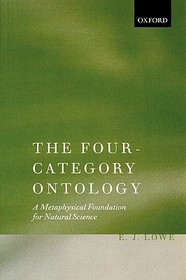
The Four-Category Ontology
A Metaphysical Foundation for Natural Science
-
10% KEDVEZMÉNY?
- A kedvezmény csak az 'Értesítés a kedvenc témákról' hírlevelünk címzettjeinek rendeléseire érvényes.
- Kiadói listaár GBP 59.00
-
26 638 Ft (25 370 Ft + 5% áfa)
Az ár azért becsült, mert a rendelés pillanatában nem lehet pontosan tudni, hogy a beérkezéskor milyen lesz a forint árfolyama az adott termék eredeti devizájához képest. Ha a forint romlana, kissé többet, ha javulna, kissé kevesebbet kell majd fizetnie.
- Kedvezmény(ek) 10% (cc. 2 664 Ft off)
- Kedvezményes ár 23 975 Ft (22 833 Ft + 5% áfa)
Iratkozzon fel most és részesüljön kedvezőbb árainkból!
Feliratkozom
26 638 Ft

Beszerezhetőség
Megrendelésre a kiadó utánnyomja a könyvet. Rendelhető, de a szokásosnál kicsit lassabban érkezik meg.
Why don't you give exact delivery time?
A beszerzés időigényét az eddigi tapasztalatokra alapozva adjuk meg. Azért becsült, mert a terméket külföldről hozzuk be, így a kiadó kiszolgálásának pillanatnyi gyorsaságától is függ. A megadottnál gyorsabb és lassabb szállítás is elképzelhető, de mindent megteszünk, hogy Ön a lehető leghamarabb jusson hozzá a termékhez.
A termék adatai:
- Kiadó OUP Oxford
- Megjelenés dátuma 2007. november 1.
- ISBN 9780199229819
- Kötéstípus Puhakötés
- Terjedelem238 oldal
- Méret 233x154x14 mm
- Súly 376 g
- Nyelv angol
- Illusztrációk 2 tables, 11 figures 0
Kategóriák
Rövid leírás:
E. J. Lowe, a prominent figure in contemporary metaphysics, sets out and defends his theory of what there is. His four-category ontology is a metaphysical system which recognizes four fundamental categories of beings: substantial and non-substantial particulars and substantial and non-substantial universals. Lowe argues that this system has an explanatory power which is unrivalled by more parsimonious theories and that this counts decisively in its favour. He shows that it provides a powerful explanatory framework for a unified account of causation, dispositions, natural laws, natural necessity and many other related matters, thus constituting a full metaphysical foundation for natural science.
TöbbHosszú leírás:
E. J. Lowe sets out and defends his theory of what there is. His four-category ontology is a metaphysical system that recognizes two fundamental categorial distinctions which cut across each other to generate four fundamental ontological categories. The distinctions are between the particular and the universal and between the substantial and the non-substantial. The four categories thus generated are substantial particulars, non-substantial particulars, substantial universals and non-substantial universals. Non-substantial universals include properties and relations, conceived as universals. Non-substantial particulars include property-instances and relation-instances, otherwise known as non-relational and relational tropes or modes. Substantial particulars include propertied individuals, the paradigm examples of which are persisting, concrete objects. Substantial universals are otherwise known as substantial kinds and include as paradigm examples natural kinds of persisting objects.
This ontology has a lengthy pedigree, many commentators attributing it to Aristotle on the basis of certain passages in his apparently early work, the Categories. At various times during the history of Western philosophy, it has been revived or rediscovered, but it has never found universal favour, perhaps on account of its apparent lack of parsimony as well as its commitment to universals. In pursuit of ontological economy, metaphysicians have generally preferred to recognize fewer than four fundamental ontological categories. However, Occam's razor stipulates only that we should not multiply entities beyond necessity; Lowe argues that the four-category ontology has an explanatory power unrivalled by more parsimonious systems, and that this counts decisively in its favour. He shows that it provides a powerful explanatory framework for a unified account of causation, dispositions, natural laws, natural necessity and many other related matters, such as the semantics of counterfactual conditionals and the character of the truthmaking relation. As such, it constitutes a thoroughgoing metaphysical foundation for natural science.
Contents List
The book is the fruit of many years of careful thought, and Lowe has anticipated most of the possible objectives to his system and answered them very carefully...Lowe's is the best and most comprehensive attempt I know of to present a system of ontological categories in terms acceptable to present-day analytical philosophers.
Tartalomjegyzék:
I. Metaphysics, Ontology, and Logic
Ontological Categories and Categorical Schemes
The Four-Category Ontology and its Rivals
Some Formal Ontological Relations
Formal Ontology and Logical Syntax
II. Objects and Properties
The Concept of an Object in Formal Ontology
Properties, Modes, and Universals
Ramsey's Problem and its Solution
III. Metaphysics and Natural Science
Dispositions Natural Laws
Kinds, Essence, and Natural Necessity
Categorial Ontology and Scientific Essentialism
IV. Truth, Truthmaking, and Metaphysical Realism
Metaphysical Realism and the Unity of Truth
Truthmaking, Necessity, and Essential Dependence

