

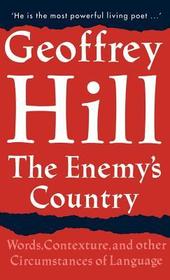
The Enemy's Country
Words, Contexture, and other Circumstances of Language
-
10% KEDVEZMÉNY?
- A kedvezmény csak az 'Értesítés a kedvenc témákról' hírlevelünk címzettjeinek rendeléseire érvényes.
- Kiadói listaár GBP 35.49
-
16 023 Ft (15 260 Ft + 5% áfa)
Az ár azért becsült, mert a rendelés pillanatában nem lehet pontosan tudni, hogy a beérkezéskor milyen lesz a forint árfolyama az adott termék eredeti devizájához képest. Ha a forint romlana, kissé többet, ha javulna, kissé kevesebbet kell majd fizetnie.
- Kedvezmény(ek) 10% (cc. 1 602 Ft off)
- Kedvezményes ár 14 421 Ft (13 734 Ft + 5% áfa)
Iratkozzon fel most és részesüljön kedvezőbb árainkból!
Feliratkozom
16 023 Ft

Beszerezhetőség
Megrendelésre a kiadó utánnyomja a könyvet. Rendelhető, de a szokásosnál kicsit lassabban érkezik meg.
Why don't you give exact delivery time?
A beszerzés időigényét az eddigi tapasztalatokra alapozva adjuk meg. Azért becsült, mert a terméket külföldről hozzuk be, így a kiadó kiszolgálásának pillanatnyi gyorsaságától is függ. A megadottnál gyorsabb és lassabb szállítás is elképzelhető, de mindent megteszünk, hogy Ön a lehető leghamarabb jusson hozzá a termékhez.
A termék adatai:
- Kiadó Clarendon Press
- Megjelenés dátuma 1991. augusztus 1.
- ISBN 9780198112167
- Kötéstípus Keménykötés
- Terjedelem168 oldal
- Méret 224x144x18 mm
- Súly 340 g
- Nyelv angol 0
Kategóriák
Rövid leírás:
Is poetry the distinctively free and self-contained form of language it has so often been called? Focusing on Dryden, but also looking at writers such as Donne, Hobbes, Marvell, and Pound, Geoffrey Hill examines the real conditions of poets' work, grounded as it is in the mundane drudgery and insecurity of historical existence. With humour and rigour, The Enemy's Country enacts the struggle of poetry for truth and meaning amid `the common practice of men'.
TöbbHosszú leírás:
Geoffrey Hill is University Professor at Boston University. He holds an honorary D. Litt. from the University of Leeds and is an Honorary Fellow of both Keble College, Oxford and Emmanuel College, Cambridge. Amongst many other recognitions of his work as a poet, he has received the Hawthornden Prize and the Whitbread Award. He gave the Clark Lectures, on which this book is based, in 1986.
`Well done!' is a familiar cry with a complex sense. It may applaud the merest knack, patronize a decent competence, or squarely recognize something at once finely-achieved and morally just. The language of true valuing is constantly shadowed by parodies of itself - sales-talk, sociable politeness, or gush. The Enemy's Country is concerned with the ways in which judgement is conveyed through language, and with the difficulty of clearing the terms of judgement not from but for the pressures of circumstance so that what is said may be fitting.
Poetry has sometimes been credited with a special place as a form of conduct in language, as if it were a world of words of its own from which the poet masterfully dispenses a distinctly free speech. These essays enquire whether such high praises, even when sincere, are apt to the real conditions of poets' work, to their share of drudgery, their fears of misapprehension or their need to please, to the entanglements of meaning in historical communities. The 'sheer perfection' of lyric utterance is shown to involve a recognition and acceptance of the poet's place in `the scheme of things', a scheme of business and accommodation which is not ideally clean but which remains a ground of the art's refinement.
Dryden is at the centre of the book. Around his exemplary figure, Geoffrey Hill describes with biting erudition and minutely sympathetic imagination the perplexities and felicity of genius in writers such as Donne, Hobbes, and Marvell. The book closes with a study of Pound's `Envoi:1919' in which Hill, characteristically, brings together humour, scrupulousness, and enquiring commitment to the hopes of poetry. The Enemy's Country enacts `virtue's struggle to clear and maintain its own meaning amid the commonplace approximation, the common practice of men'.
`Hill speaks at one point of `not unduly imposing one's own perplexities,' but it is precisely in his lucid exposition of these perplexities that the merit of this extraordinary guide to The Enemy's Country lies.'
The Spectator
Tartalomjegyzék:
A Note on the Title; A Note on References in the Text; 1. Unhappy Circumstances; 2. The Tartar's Bow and the Bow of Ulysses; 3. Caveats Enough in their Own Walks; 4. Dryden's Prize-Song; 5. "Envoi: 1919"; Notes; Index
Több
