

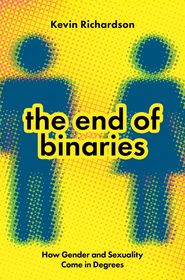
The End of Binaries
How Gender and Sexuality Come in Degrees
-
10% KEDVEZMÉNY?
- A kedvezmény csak az 'Értesítés a kedvenc témákról' hírlevelünk címzettjeinek rendeléseire érvényes.
- Kiadói listaár GBP 22.99
-
10 379 Ft (9 885 Ft + 5% áfa)
Az ár azért becsült, mert a rendelés pillanatában nem lehet pontosan tudni, hogy a beérkezéskor milyen lesz a forint árfolyama az adott termék eredeti devizájához képest. Ha a forint romlana, kissé többet, ha javulna, kissé kevesebbet kell majd fizetnie.
- Kedvezmény(ek) 10% (cc. 1 038 Ft off)
- Kedvezményes ár 9 341 Ft (8 897 Ft + 5% áfa)
Iratkozzon fel most és részesüljön kedvezőbb árainkból!
Feliratkozom
10 379 Ft

Beszerezhetőség
Becsült beszerzési idő: A Prosperónál jelenleg nincsen raktáron, de a kiadónál igen. Beszerzés kb. 3-5 hét..
A Prosperónál jelenleg nincsen raktáron.
Why don't you give exact delivery time?
A beszerzés időigényét az eddigi tapasztalatokra alapozva adjuk meg. Azért becsült, mert a terméket külföldről hozzuk be, így a kiadó kiszolgálásának pillanatnyi gyorsaságától is függ. A megadottnál gyorsabb és lassabb szállítás is elképzelhető, de mindent megteszünk, hogy Ön a lehető leghamarabb jusson hozzá a termékhez.
A termék adatai:
- Kiadó OUP USA
- Megjelenés dátuma 2026. március 18.
- ISBN 9780197812235
- Kötéstípus Puhakötés
- Terjedelem296 oldal
- Méret 234x157x22 mm
- Súly 299 g
- Nyelv angol 688
Kategóriák
Rövid leírás:
The End of Binaries articulates a philosophical alternative to binary ways of thinking about gender and sexuality. It proposes a spatial theory of gender and sexuality, where a person's gender or sexuality should be understood as a location within a multidimensional space.
TöbbHosszú leírás:
We live in a world in which the boundaries of gender and sexual orientation are increasingly being contested. Gender categories like man and woman cannot do justice to non-binary, genderqueer, and trans people. Common categories of sexual orientation, like heterosexual and homosexual, are unhelpful for understanding a new generation of people whose sexual identities do not neatly fit within those categories. These various social binaries-man/woman, heterosexual/homosexual--are now a fraught way to understand social identity.
At the same time as there is resistance to these binaries, there are also those who reinforce and protect them. Across the United States and other countries, there has been a wave of legislation targeting perceived threats to the gender binary system. Books with trans characters are being removed from the shelves of public libraries. There is a surge of legislation prohibiting trans women from using women's restrooms. There is legislation that challenges the legality of drag performances. All of these efforts are attempts to preserve the dominant gender and sexuality binaries.
The End of Binaries articulates a philosophical alternative to these binary ways of thinking about gender and sexuality. It proposes a spatial theory of gender and sexuality, where a person's gender or sexuality should be understood as a location within a multidimensional space. Just as the boundaries of countries divide up geographical territories, social boundaries divide up regions of gender and sexuality space. And just as each person has an exact location represented by a GPS coordinate, each person has a gender and sexual location that represents their distinctive way of being gendered or sexually oriented. The spatial approach to gender and sexuality fundamentally understands gender and sexuality as complex, diverse, and continuous. The spatial framework is a more accurate (and more just) way to understand the diversity of gender and sexuality.
Tartalomjegyzék:
Introduction
I The Gender Binary: Definition and Stakes
1. The Gender Binary
2. Gender Critical Feminism: Making Feminism Great Again
II The Complexity of Gender
3. What is a Woman? The Quest to Define Gender
4. No Fact of Matter: the Case for Gender Indeterminacy
III The Spatial Theory of Gender
5. Gender Prototypes
6. Gender by Degree
7. Negotiating the Binary
IV The Spatial Theory of Sexual Orientation
8. From Non-Binary Gender to Non-Binary Sexual Orientation
9. Sexual Orientation in Context
10. "Just a Little Gay": How Sexual Orientation Comes in Degrees
V Binary Abolition
11. Spatial Abolition
Acknowledgments

