

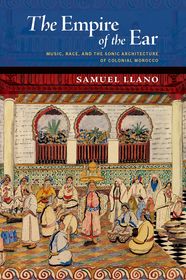
The Empire of the Ear
Music, Race, and the Sonic Architecture of Colonial Morocco
Sorozatcím: New Cultural History of Music;
-
10% KEDVEZMÉNY?
- A kedvezmény csak az 'Értesítés a kedvenc témákról' hírlevelünk címzettjeinek rendeléseire érvényes.
- Kiadói listaár GBP 68.00
-
30 702 Ft (29 240 Ft + 5% áfa)
Az ár azért becsült, mert a rendelés pillanatában nem lehet pontosan tudni, hogy a beérkezéskor milyen lesz a forint árfolyama az adott termék eredeti devizájához képest. Ha a forint romlana, kissé többet, ha javulna, kissé kevesebbet kell majd fizetnie.
- Kedvezmény(ek) 10% (kb. 3 070 Ft)
- Kedvezményes ár 27 632 Ft (26 316 Ft + 5% áfa)
Iratkozzon fel most és részesüljön kedvezőbb árainkból!
Feliratkozom
30 702 Ft

Beszerezhetőség
Becsült beszerzési idő: A Prosperónál jelenleg nincsen raktáron, de a kiadónál igen. Beszerzés kb. 3-5 hét..
A Prosperónál jelenleg nincsen raktáron.
Why don't you give exact delivery time?
A beszerzés időigényét az eddigi tapasztalatokra alapozva adjuk meg. Azért becsült, mert a terméket külföldről hozzuk be, így a kiadó kiszolgálásának pillanatnyi gyorsaságától is függ. A megadottnál gyorsabb és lassabb szállítás is elképzelhető, de mindent megteszünk, hogy Ön a lehető leghamarabb jusson hozzá a termékhez.
A termék adatai:
- Kiadó OUP USA
- Megjelenés dátuma 2026. augusztus 3.
- ISBN 9780197628270
- Kötéstípus Keménykötés
- Terjedelem320 oldal
- Méret 236x166x30 mm
- Súly 562 g
- Nyelv angol
- Illusztrációk 17 figures, 2 maps 0
Kategóriák
Rövid leírás:
The Empire of the Ear shows how auditory culture, music, and musicology played a key role in negotiating the cultural struggles of colonialism in Morocco (1912-56) by helping to redraw society's ethnic and racial boundaries. Author Samuel Llano tells the story of France and Spain's use of music as a proxy for domination, the Moroccan and Maghrebi musicians and scholars who challenged deep-seated European views through scholarship, and collaborations between Maghrebi and European scholars and musicians that obscured the lines between oppression and contestation, demonstrating that race was the primary principle governing the performance and study of Morocco's music repertoires and the shaping of identification among rural and urban populations.
TöbbHosszú leírás:
This is an open access title available under the terms of a CC BY-NC-ND 4.0 International licence. It is free to read at Oxford Scholarship Online and offered as a free PDF download from OUP and selected open access locations.
Any study of colonial Morocco (1912-56) presents unique and compelling challenges due to the simultaneous presence in its territory of two foreign powers, France and Spain. The colonialist rivalry between these two countries formed dynamic and changing narratives of Morocco's musical cultures. Through their accounts of Morocco's musical activity and sound practices, French and Spanish musicologists gave shape to models of social organization that they wished to implant in Morocco at the expense of the local populations. But music was also an important instrument of resistance even if opposition to colonial rule meant adopting and subverting the discursive tropes and rhetorical strategies first formulated in the work of European scholars.
In The Empire of the Ear: Music, Race, and the Sonic Architecture of Colonial Morocco, author Samuel Llano demonstrates that auditory culture, music, and musicology played a key role in negotiating the cultural struggles of colonialism in Morocco by helping to redraw society's ethnic and racial boundaries. Music was deeply involved in shaping a colonial rivalry between France and Spain, with both powers fighting to lead the discovery and promotion of Morocco's music, particularly the Andalusi and Amazigh repertoires. Llano further illuminates the ways in which France and Spain used music to promote markedly distinct and competing racial agendas in order to categorize and control Moroccan populations and their cultural practices. At the same time, he delves deeply into the significant roles that Moroccan and Maghrebi musicians and scholars played in fostering performance criteria and producing scholarship that challenged deep-seated European views, acting as a form of anti-colonial resistance. As he explores music's dual role as an instrument of power and resistance, Llano demonstrates that the impact of colonial rivalry on music scholarship and performance was more complex than the coloniser/colonised binary suggests. Finally, he analyzes how collaborations between Maghrebi and European scholars and musicians in transcription and performance obscured the lines between oppression and contestation, pushing resistance into a liminal space.
In exploring these cultural tensions, The Empire of the Ear argues that race was the primary principle governing the performance and study of Morocco's music repertoires and the shaping of forms of identification among rural and urban populations.
Tartalomjegyzék:
Acknowledgements
List of Figures and Maps
Notes on Transliteration
List of abbreviations
Introduction
The Discovery, Revival, and Invention of Morocco's Music Repertoires
Arab Music, Comparative Musicology, and the Science of Colonialism
French Racial Policy and Musique Berbère
The Spanish Invention of Hispano-Muslim Music
The Rise of the 'Moroccan Ear'
Sharqi Music and the Making of the Western Mediterranean
Moroccan Trance: Unruly Bodies and the Colonial Imagination
A Moroccan Pastorale: The Rural Soundscape of Colonial Morocco
The Sound Politics of Racial Segregation in Urban Morocco
Epilogue
Published Books and Articles
Notes
Index

