

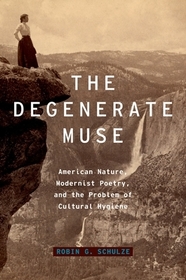
The Degenerate Muse
American Nature, Modernist Poetry, and the Problem of Cultural Hygiene
Sorozatcím: Modernist Literature and Culture;
-
10% KEDVEZMÉNY?
- A kedvezmény csak az 'Értesítés a kedvenc témákról' hírlevelünk címzettjeinek rendeléseire érvényes.
- Kiadói listaár GBP 87.00
-
39 280 Ft (37 410 Ft + 5% áfa)
Az ár azért becsült, mert a rendelés pillanatában nem lehet pontosan tudni, hogy a beérkezéskor milyen lesz a forint árfolyama az adott termék eredeti devizájához képest. Ha a forint romlana, kissé többet, ha javulna, kissé kevesebbet kell majd fizetnie.
- Kedvezmény(ek) 10% (cc. 3 928 Ft off)
- Kedvezményes ár 35 352 Ft (33 669 Ft + 5% áfa)
Iratkozzon fel most és részesüljön kedvezőbb árainkból!
Feliratkozom
39 280 Ft

Beszerezhetőség
Megrendelésre a kiadó utánnyomja a könyvet. Rendelhető, de a szokásosnál kicsit lassabban érkezik meg.
Why don't you give exact delivery time?
A beszerzés időigényét az eddigi tapasztalatokra alapozva adjuk meg. Azért becsült, mert a terméket külföldről hozzuk be, így a kiadó kiszolgálásának pillanatnyi gyorsaságától is függ. A megadottnál gyorsabb és lassabb szállítás is elképzelhető, de mindent megteszünk, hogy Ön a lehető leghamarabb jusson hozzá a termékhez.
A termék adatai:
- Kiadó OUP USA
- Megjelenés dátuma 2013. szeptember 19.
- ISBN 9780199920327
- Kötéstípus Keménykötés
- Terjedelem336 oldal
- Méret 165x236x30 mm
- Súly 567 g
- Nyelv angol 0
Kategóriák
Rövid leírás:
The early twentieth century marked a dramatic shift in the American conception of nature. This book analyzes the ways in which the scientific recasting of American nature as an antidote for degeneration influenced work of important modernist writers Harriet Monroe, Ezra Pound, and Marianne Moore.
TöbbHosszú leírás:
This book offers an important reconsideration of the cultural impulses that drove American literary modernism. America's modernist poets came of age in a nation struggling to redefine its relationship with poetry and with nature. In the early twentieth century, Darwinian science dictated that as countries became more civilized, as their citizens dwelt increasingly in the realms of artifice they created, they ceased to engage in the invigorating struggles against nature that kept them fit. Civilization led to the medical condition known as degeneration, the morbid deviation of men from an identifiable "normal type." Eager to save America from the fate of a degenerate Europe, Progressive Era reformers prescribed the invigorating contact with American nature as a means to keep the American race clean and healthy. In order for nature to serve as an antidote for degeneration, however, it needed to remain a realm of hard facts and unremitting forces, a delusion-free place free of art that cleansed the mind rather than clouded it. Drawing on a wide range of primary and archival sources, this book argues that the widespread American turn back to nature in the early twentieth century had profound consequences for America's modernist poets. Like other Americans of their day, Harriet Monroe, Ezra Pound, and Marianne Moore heeded the widespread American call to head back to nature for the sake of the nation's health, but they faced a difficult challenge. Turning to American nature as a means to combat the threat of American degeneration in their literary work, they needed to create a form of American poetry that would be a cure for degeneration rather than a cause. My work reveals the ways in which Monroe's, Pound's, and Moore's struggles to create and publish poems that could resist degeneration by keeping faith with American nature influenced ideas about what American poetry should be and do in the twentieth century.
Ultimately, by redefining nature's role in American literature as one of intellectual fertility rather than stagnation, Robin Schulze constructs a convincing case for the idea that American literary modernism succeeded in making nature itself modern.
Tartalomjegyzék:
Table of Contents
Introduction: Toward a Modern Nature
Chapter One: Nature Study, Degeneration, and the Problem of Poetry
Chapter Two: Harriet Monroe's Pioneer Modernism
Chapter Three: Ezra Pound and the Poetics of Hygiene
Chapter Four: Marianne Moore, Degeneration, and Domestication
Chapter Five: Marianne Moore, Nature, and National Health
Conclusion
Bibliography

