

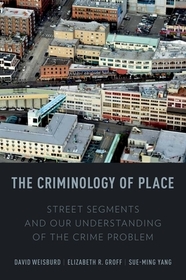
The Criminology of Place
Street Segments and Our Understanding of the Crime Problem
-
10% KEDVEZMÉNY?
- A kedvezmény csak az 'Értesítés a kedvenc témákról' hírlevelünk címzettjeinek rendeléseire érvényes.
- Kiadói listaár GBP 43.99
-
19 861 Ft (18 915 Ft + 5% áfa)
Az ár azért becsült, mert a rendelés pillanatában nem lehet pontosan tudni, hogy a beérkezéskor milyen lesz a forint árfolyama az adott termék eredeti devizájához képest. Ha a forint romlana, kissé többet, ha javulna, kissé kevesebbet kell majd fizetnie.
- Kedvezmény(ek) 10% (cc. 1 986 Ft off)
- Kedvezményes ár 17 875 Ft (17 024 Ft + 5% áfa)
Iratkozzon fel most és részesüljön kedvezőbb árainkból!
Feliratkozom
19 861 Ft

Beszerezhetőség
Megrendelésre a kiadó utánnyomja a könyvet. Rendelhető, de a szokásosnál kicsit lassabban érkezik meg.
Why don't you give exact delivery time?
A beszerzés időigényét az eddigi tapasztalatokra alapozva adjuk meg. Azért becsült, mert a terméket külföldről hozzuk be, így a kiadó kiszolgálásának pillanatnyi gyorsaságától is függ. A megadottnál gyorsabb és lassabb szállítás is elképzelhető, de mindent megteszünk, hogy Ön a lehető leghamarabb jusson hozzá a termékhez.
A termék adatai:
- Kiadó OUP USA
- Megjelenés dátuma 2012. november 22.
- ISBN 9780199928637
- Kötéstípus Puhakötés
- Terjedelem288 oldal
- Méret 234x155x15 mm
- Súly 635 g
- Nyelv angol
- Illusztrációk 24 b/w line, 4 b/w halftone, 28 color halftone 0
Kategóriák
Rövid leírás:
David Weisburd, Elizabeth Groff, and Sue-Ming Yang present a new way of looking at crime by examining why specific streets in a city have specific crime trends over time. Reorienting the study of crime by focusing not on individuals and communities, but on small units of geography, the authors identify a large group of possible crime risk and protective factors for street segments and an array of interventions that could be implemented to address them. A groundbreaking book, The Criminology of Place radically alters traditional thinking about the crime problem and what we should do about it.
TöbbHosszú leírás:
The study of crime has focused primarily on why particular people commit crime or why specific communities have higher crime levels than others. In The Criminology of Place, David Weisburd, Elizabeth Groff, and Sue-Ming Yang present a new and different way of looking at the crime problem by examining why specific streets in a city have specific crime trends over time. Based on a 16-year longitudinal study of crime in Seattle, Washington, the book focuses our attention on small units of geographic analysis-micro communities, defined as street segments. Half of all Seattle crime each year occurs on just 5-6 percent of the city's street segments, yet these crime hot spots are not concentrated in a single neighborhood and street by street variability is tremendous. Weisburd, Groff, and Yang set out to explain why.
The Criminology of Place shows how much essential information about crime is inevitably lost when we focus on larger units like neighborhoods or communities. Reorienting the study of crime by focusing on small units of geography, the authors identify a large group of possible crime risk and protective factors for street segments and an array of interventions that could be implemented to address them. The Criminology of Place is a groundbreaking book that radically alters traditional thinking about the crime problem and what we should do about it.
"This is a very important book for policy-makers, practitioners and academics. The authors carefully and systematically build their case that effective crime prevention efforts must be focused first on a small number of high crime problem places. The detail of their arguments transforms hotspot policing and prevention in the same way keyhole surgery has transformed medical care. Their case is persuasive and, above all, evidence based"
-- Peter Neyroud CBE QPM, University of Cambridge and Former Chief Constable and Chief Executive of the National Policing Improvement Agency
Tartalomjegyzék:
Dedication
Acknowledgements
Chapter 1: Introduction
Chapter 2: Putting Crime in its Place
Chapter 3: Crime Concentrations and Crime Patterns at Places
Chapter 4: The Importance of Street Segments in the Production of the Crime Problem
Chapter 5: Concentrations of Crime Opportunities
Chapter 6: Are Processes of Social Disorganization Relevant to the Criminology of Place?
Chapter 7: Understanding Developmental Patterns of Crime at Street Segments
Chapter 8: Conclusions
Appendix 1: Trajectory Analysis Model Selection and Diagnostic Statistics
Appendix 2: Ripley's K Function
Appendix 3: Cross-K Function
Appendix 4: Data Collection
Appendix 5: Additional Statistical Models
References
Index

