

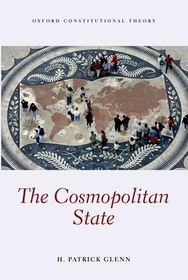
The Cosmopolitan State
Sorozatcím: Oxford Constitutional Theory;
-
10% KEDVEZMÉNY?
- A kedvezmény csak az 'Értesítés a kedvenc témákról' hírlevelünk címzettjeinek rendeléseire érvényes.
- Kiadói listaár GBP 112.50
-
50 793 Ft (48 375 Ft + 5% áfa)
Az ár azért becsült, mert a rendelés pillanatában nem lehet pontosan tudni, hogy a beérkezéskor milyen lesz a forint árfolyama az adott termék eredeti devizájához képest. Ha a forint romlana, kissé többet, ha javulna, kissé kevesebbet kell majd fizetnie.
- Kedvezmény(ek) 10% (cc. 5 079 Ft off)
- Kedvezményes ár 45 714 Ft (43 538 Ft + 5% áfa)
Iratkozzon fel most és részesüljön kedvezőbb árainkból!
Feliratkozom
50 793 Ft

Beszerezhetőség
Megrendelésre a kiadó utánnyomja a könyvet. Rendelhető, de a szokásosnál kicsit lassabban érkezik meg.
Why don't you give exact delivery time?
A beszerzés időigényét az eddigi tapasztalatokra alapozva adjuk meg. Azért becsült, mert a terméket külföldről hozzuk be, így a kiadó kiszolgálásának pillanatnyi gyorsaságától is függ. A megadottnál gyorsabb és lassabb szállítás is elképzelhető, de mindent megteszünk, hogy Ön a lehető leghamarabb jusson hozzá a termékhez.
A termék adatai:
- Kiadó OUP Oxford
- Megjelenés dátuma 2013. május 23.
- ISBN 9780199682423
- Kötéstípus Keménykötés
- Terjedelem400 oldal
- Méret 241x170x28 mm
- Súly 756 g
- Nyelv angol 0
Kategóriák
Rövid leírás:
The idea of the 'nation-state' has failed, Glenn argues, and a major shift in our understanding of the state is needed. He provides an original approach by situating cosmopolitanism in its historical context and demonstrating that the state is necessarily cosmopolitan in character, and has always been subject to transnational law-making.
TöbbHosszú leírás:
For more than two centuries the idea of the nation-state has been widespread. The expression is now widely used and is even to be unavoidable. The 'nation-state' implies that the population of a state should be homogenous in terms of language, religion, and ethnicity; the nation and the state should coincide. However history demonstrates that there never has been, and there never will be, a nation-state. Human diversity is manifest in states of all sizes, locations, and origins. This wide-ranging book argues that there should be no regret in the recognition of this empirical reality, since the notion of a nation-state has been the justification for some of the worst atrocities in human history. Since the nation-state is impossible, all states are cosmopolitan in character. They are cosmopolitan regardless of the language of their constitutions or official teaching and regardless of the extent to which they officially recognize their own diversity. The most successful states are those which are most successful in their own forms of cosmopolitanism. Cosmopolitan ways are infinitely varied, however, and must be sought in the intricate workings of individual states.
The cosmopolitan character of states is necessarily reflected in their law. The main instruments of legal cosmopolitanism have been those of common laws, constitutionalism, and what is best described as institutional cosmopolitanism. The relative importance of these legal instruments has changed over time but all three have been constantly operative, even in times of attempted national and territorial closure. All three remain present in the contemporary cosmopolitan state, understood in terms of cosmopolitan citizens, cosmopolitan sources and cosmopolitan thought. The cosmopolitan state is, moreover, the only appropriate conceptualization of the state in a time of globalization.
This book outlines the subtlety of the law of cosmopolitan states, law which has survived through periods of nationalism and which provides the working methods for the reconciliation of diverse populations. Combining law, history, political science, political philosophy, international relations, and the new logics, it demonstrates that the idea of the nation-state has failed and should yield to an understanding of the state as necessarily cosmopolitan in character. This will be invaluable reading to all those interested in constitutional law, international law, and political theory.
Glenn provides us once more with an essential contribution to the development of an updated general theory of state.
Tartalomjegyzék:
Introduction: Thinking the State
Part I: Cosmopolitan Origins
Antecedents
Persistence
Part II: Closure?
A Territorial State?
A Nation State?
Part III: Cosmopolitanism Sustained
Common Laws
Constitutionalism
Institutional Cosmopolitanism
Part IV: The Contemporary Cosmopolitan State
Globalization, Cosmopolitan Theory, and the State
Cosmopolitan Citizens
Cosmopolitan Sources I: Constitutionalism
Cosmopolitan Sources II: Common Laws
Cosmopolitan Sources III: Institutional Cosmopolitanism
Cosmopolitan Thought
Concluding Remarks
Bibliography

