

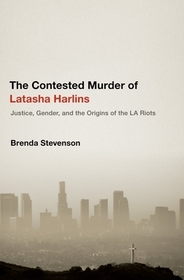
The Contested Murder of Latasha Harlins
Justice, Gender, and the Origins of the LA Riots
-
10% KEDVEZMÉNY?
- A kedvezmény csak az 'Értesítés a kedvenc témákról' hírlevelünk címzettjeinek rendeléseire érvényes.
- Kiadói listaár GBP 45.49
-
20 538 Ft (19 560 Ft + 5% áfa)
Az ár azért becsült, mert a rendelés pillanatában nem lehet pontosan tudni, hogy a beérkezéskor milyen lesz a forint árfolyama az adott termék eredeti devizájához képest. Ha a forint romlana, kissé többet, ha javulna, kissé kevesebbet kell majd fizetnie.
- Kedvezmény(ek) 10% (cc. 2 054 Ft off)
- Kedvezményes ár 18 484 Ft (17 604 Ft + 5% áfa)
Iratkozzon fel most és részesüljön kedvezőbb árainkból!
Feliratkozom
20 538 Ft

Beszerezhetőség
Megrendelésre a kiadó utánnyomja a könyvet. Rendelhető, de a szokásosnál kicsit lassabban érkezik meg.
Why don't you give exact delivery time?
A beszerzés időigényét az eddigi tapasztalatokra alapozva adjuk meg. Azért becsült, mert a terméket külföldről hozzuk be, így a kiadó kiszolgálásának pillanatnyi gyorsaságától is függ. A megadottnál gyorsabb és lassabb szállítás is elképzelhető, de mindent megteszünk, hogy Ön a lehető leghamarabb jusson hozzá a termékhez.
A termék adatai:
- Kiadó OUP USA
- Megjelenés dátuma 2013. augusztus 15.
- ISBN 9780199944576
- Kötéstípus Keménykötés
- Terjedelem444 oldal
- Méret 239x160x35 mm
- Súly 771 g
- Nyelv angol
- Illusztrációk 20 halftone illustrations 0
Kategóriák
Rövid leírás:
In this book, Stevenson explores the long-simmering resentment within LA's black community that ultimately erupted in April 1992 by focusing on an preceding event that encapsulated the growing racial and social polarization in the city over the course of the 1980s and early 1990s: the 1991 shooting of a fifteen-year old African American girl, Latasha Harlins, by a Korean grocer who suspected Harlins of shoplifting.
TöbbHosszú leírás:
The Los Angeles Riot of 1992 was one of the most destructive civil disturbances in twentieth century America. Dozens of people died, and the property damage estimate was in the billions of dollars. The most powerful images from the riots remained etched in America's collective memory: Reginald Denny being beaten in South Central, the beating of Rodney King, towering plumes of smoke throughout the city on a crystal-clear day, and Korean shopkeepers perched on rooftops with rifles, defending their property. The not guilty verdict for the LAPD officers charged with beating Rodney King was the immediate trigger, but as Brenda Stevenson shows in this truly novel excavation of the riot's causes, there were many sources of anger that stretched back decades. The King episode was merely the straw that broke the camel's back.
In, The Contested Murder of Latasha Harlins Stevenson explores the long-simmering resentment within LA's black community that ultimately erupted in April 1992 by focusing on a preceding event that encapsulated the growing racial and social polarization in the city over the course of the 1980s and early 1990s: the 1991 shooting of a fifteen-year old African American girl, Latasha Harlins, by a Korean grocer who suspected Harlins of shoplifting. The female storeowner, Soon Ja Du, was charged with manslaughter, and the resulting trial presided over by the Jewish judge Joye Karlin was widely publicized. In the end, Ja Du received no jail time. After the riots occurred, many came to realize that the killing of Harlins was an important precursor event. Stevenson not only provides a rich account of the case and its aftermath, but uses the lives of the three protagonists to explore the intertwined histories of three immigrant ethnic groups who arrived in Los Angeles in different erea: blacks, Koreans, and Jews. And, since all of her protagonists were female, she explores the relationship between gender and the law. The result is a kaleidoscopic and rich history of race, class and gender in late twentieth century America that will reshape our understanding of that era.
Contested Murder makes it clear the tragedy inside the Empire Market and the violence that followed in South L.A. and Koreatown should be remembered by all Angelenos as a turning point in their history
Tartalomjegyzék:
1. 'Tasha: "Always Energetic, Positive, Full of Energy"
2. Soon Ja Du: "She Had a Good Life in Korea"
3. March 16, 1991: Not Just Another Saturday in South Central
4. People v. Du: The Trial
5. Judge Joyce Karlin: "I Would Dream of Closing Arguments "
6. The People v. Du: Sentencing
7. Whose Fire This Time?
Epilogue: Justice?

