

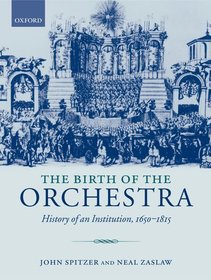
The Birth of the Orchestra
History of an Institution, 1650-1815
-
10% KEDVEZMÉNY?
- A kedvezmény csak az 'Értesítés a kedvenc témákról' hírlevelünk címzettjeinek rendeléseire érvényes.
- Kiadói listaár GBP 370.00
-
167 055 Ft (159 100 Ft + 5% áfa)
Az ár azért becsült, mert a rendelés pillanatában nem lehet pontosan tudni, hogy a beérkezéskor milyen lesz a forint árfolyama az adott termék eredeti devizájához képest. Ha a forint romlana, kissé többet, ha javulna, kissé kevesebbet kell majd fizetnie.
- Kedvezmény(ek) 10% (cc. 16 706 Ft off)
- Kedvezményes ár 150 350 Ft (143 190 Ft + 5% áfa)
Iratkozzon fel most és részesüljön kedvezőbb árainkból!
Feliratkozom
167 055 Ft

Beszerezhetőség
Megrendelésre a kiadó utánnyomja a könyvet. Rendelhető, de a szokásosnál kicsit lassabban érkezik meg.
Why don't you give exact delivery time?
A beszerzés időigényét az eddigi tapasztalatokra alapozva adjuk meg. Azért becsült, mert a terméket külföldről hozzuk be, így a kiadó kiszolgálásának pillanatnyi gyorsaságától is függ. A megadottnál gyorsabb és lassabb szállítás is elképzelhető, de mindent megteszünk, hogy Ön a lehető leghamarabb jusson hozzá a termékhez.
A termék adatai:
- Kiadó OUP Oxford
- Megjelenés dátuma 2004. április 29.
- ISBN 9780198164340
- Kötéstípus Keménykötés
- Terjedelem650 oldal
- Méret 252x195x41 mm
- Súly 1682 g
- Nyelv angol
- Illusztrációk 16pp halftone plates, numerous line drawings & music examples 0
Kategóriák
Rövid leírás:
This is the story of the orchestra, from 16th-century string bands to the 'classical' orchestra of Haydn, Mozart, and Beethoven. Spitzer and Zaslaw document orchestral organization, instrumentation, social roles, repertories, and performance practices in Europe and the American colonies, concluding around 1800 with the widespread awareness of the orchestra as a central institution in European life.
TöbbHosszú leírás:
This book traces the emergence of the orchestra from 16th-century string bands to the 'classical' orchestra of Haydn, Mozart, Beethoven, and their contemporaries. Ensembles of bowed stringed instruments, several players per part plus continuo and wind instruments, were organized in France in the mid-17th century and then in Rome at the end of the century. The prestige of these ensembles and of the music and performing styles of their leaders, Jean-Baptiste Lully and Arcangelo Corelli, caused them to be imitated elsewhere, until by the late 18th century, the orchestra had become a pan-European phenomenon.
Spitzer and Zaslaw review previous accounts of these developments, then proceed to a thoroughgoing documentation and discussion of orchestral organization, instrumentation, and social roles in France, Italy, Germany, England, and the American colonies. They also examine the emergence of orchestra musicians, idiomatic music for orchestras, orchestral performance practices, and the awareness of the orchestra as a central institution in European life.
This is a most substantial book, with a long detailed text, massive bibliography and references, generous illustrations, copious tables, graphs and backup statistics, interesting music examples in the penultimate chapter, full index, and appendices centering on the second half of the 18th century. It will remain a major work on its subject.
Tartalomjegyzék:
Introduction
Pre-orchestral Ensembles
Lully's Orchestra
Corelli's Orchestra
The Orchestra in Italy
The Orchestra in France
The Orchestra in Germany
The Orchestra in England
The Classical Orchestra
Placement, Seating, and Acoustics
Orchestral Performance Practices
Life and Times of the Orchestra Musician
The Birth of Orchestration
The Meaning of the Orchestra

