

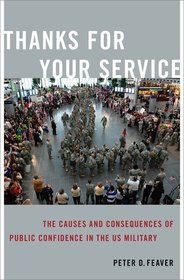
Thanks for Your Service
The Causes and Consequences of Public Confidence in the US Military
Sorozatcím: BRIDGING THE GAP SERIES;
-
20% KEDVEZMÉNY?
- A kedvezmény csak az 'Értesítés a kedvenc témákról' hírlevelünk címzettjeinek rendeléseire érvényes.
- Kiadói listaár GBP 19.99
-
9 025 Ft (8 595 Ft + 5% áfa)
Az ár azért becsült, mert a rendelés pillanatában nem lehet pontosan tudni, hogy a beérkezéskor milyen lesz a forint árfolyama az adott termék eredeti devizájához képest. Ha a forint romlana, kissé többet, ha javulna, kissé kevesebbet kell majd fizetnie.
- Kedvezmény(ek) 20% (cc. 1 805 Ft off)
- Kedvezményes ár 7 220 Ft (6 876 Ft + 5% áfa)
- A kedvezmény érvényes eddig: 2026. június 30.
Iratkozzon fel most és részesüljön kedvezőbb árainkból!
Feliratkozom
9 025 Ft

Beszerezhetőség
Becsült beszerzési idő: A Prosperónál jelenleg nincsen raktáron, de a kiadónál igen. Beszerzés kb. 3-5 hét..
A Prosperónál jelenleg nincsen raktáron.
Why don't you give exact delivery time?
A beszerzés időigényét az eddigi tapasztalatokra alapozva adjuk meg. Azért becsült, mert a terméket külföldről hozzuk be, így a kiadó kiszolgálásának pillanatnyi gyorsaságától is függ. A megadottnál gyorsabb és lassabb szállítás is elképzelhető, de mindent megteszünk, hogy Ön a lehető leghamarabb jusson hozzá a termékhez.
A termék adatai:
- Kiadó OUP USA
- Megjelenés dátuma 2024. február 15.
- ISBN 9780197681138
- Kötéstípus Puhakötés
- Terjedelem328 oldal
- Méret 235x156x21 mm
- Súly 454 g
- Nyelv angol
- Illusztrációk 67 b/w figures; 51 tables 479
Kategóriák
Rövid leírás:
In Thanks for Your Service, Peter D. Feaver shows that the public's high confidence in the military is based partly on deservedness and partly based on an underlying partisan gap and social desirability bias: extremely high confidence levels among self-identified Republican respondents but much less among Democrats and still weaker confidence among Independents. Not only does Feaver helps us understand how and why the public has confidence in the military, but he also exposes problems that policymakers need to be aware of. Specifically, he elucidates how confidence or over-confidence in the institution shapes public attitudes on the use of force and may not support the best practices in democratic civil-military relations.
TöbbHosszú leírás:
A definitive study on the decades-long run of high public confidence in the military and why it may rest on some shaky foundations.
What explains the high levels of public confidence in the US military and does high confidence matter? In Thanks for Your Service, the eminent civil-military relations scholar Peter D. Feaver addresses this question and focuses on what it means for the military. Proprietary survey data show that confidence is partly based on public beliefs about the military's high competence, adherence to high professional ethics, and a determination to stand apart from the bitter divisions of partisan politics. However, as Feaver argues, confidence is also shaped by a partisan gap and by social desirability bias, the idea that some individuals express confidence in the military because they believe that is the socially approved attitude to hold. Not only does Feaver help us understand how and why the public has confidence in the military, but he also exposes problems that policymakers need to be aware of. Specifically, this book traces how confidence in the institution shapes public attitudes on the use of force and may not always reinforce best practices in democratic civil-military relations.
This important book provides data that is going to fuel a decade of civil-military scholarship. Peter Feaver is the lighthouse for all of us in the field and shows conclusively that our military needs to work harder to keep its feet out of the wolf trap of partisan politics if it is to remain broadly respected by Americans.
Tartalomjegyzék:
Acknowledgments
List of Tables
List of Figures
Chapter 1: Introduction
PART I: Who Has Confidence in the Military?
Chapter 2: Confidence in the Military Over Time and Today
Chapter 3: Confidence and the Gaps: Knowledge, Media, Education, Social Contact
PART II: Why Do People Have Confidence in the Military
Chapter 4: How Confidence in the Military Relates to Confidence in other Institutions
Chapter 5: Performance, Professional Ethics and Public Confidence
Chapter 6: Politics, Politicization and Public Confidence
Chapter 7: How Social Desirability Bias Props Up Public Support for the Military
PART III: Why Confidence in the Military Matters
Chapter 8: Whether/How Confidence Shapes Concrete Support for the Military
Chapter 9: Whether/How Confidence Shapes Attitudes about the Military as an Instrument of Foreign Policy
Chapter 10: Whether/How Confidence Shapes Intangible Benefits Enjoyed By the Military
Chapter 11: Conclusion
List of References
Index

