

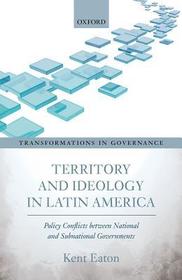
Territory and Ideology in Latin America
Policy Conflicts between National and Subnational Governments
Sorozatcím: Transformations in Governance;
-
10% KEDVEZMÉNY?
- A kedvezmény csak az 'Értesítés a kedvenc témákról' hírlevelünk címzettjeinek rendeléseire érvényes.
- Kiadói listaár GBP 100.00
-
45 150 Ft (43 000 Ft + 5% áfa)
Az ár azért becsült, mert a rendelés pillanatában nem lehet pontosan tudni, hogy a beérkezéskor milyen lesz a forint árfolyama az adott termék eredeti devizájához képest. Ha a forint romlana, kissé többet, ha javulna, kissé kevesebbet kell majd fizetnie.
- Kedvezmény(ek) 10% (cc. 4 515 Ft off)
- Kedvezményes ár 40 635 Ft (38 700 Ft + 5% áfa)
Iratkozzon fel most és részesüljön kedvezőbb árainkból!
Feliratkozom
45 150 Ft

Beszerezhetőség
Megrendelésre a kiadó utánnyomja a könyvet. Rendelhető, de a szokásosnál kicsit lassabban érkezik meg.
Why don't you give exact delivery time?
A beszerzés időigényét az eddigi tapasztalatokra alapozva adjuk meg. Azért becsült, mert a terméket külföldről hozzuk be, így a kiadó kiszolgálásának pillanatnyi gyorsaságától is függ. A megadottnál gyorsabb és lassabb szállítás is elképzelhető, de mindent megteszünk, hogy Ön a lehető leghamarabb jusson hozzá a termékhez.
A termék adatai:
- Kiadó OUP Oxford
- Megjelenés dátuma 2017. június 1.
- ISBN 9780198800576
- Kötéstípus Keménykötés
- Terjedelem230 oldal
- Méret 240x161x18 mm
- Súly 512 g
- Nyelv angol 0
Kategóriák
Rövid leírás:
This book examines the connection between territorial politics and ideological conflict in the global economic sphere, particularly in Latin America, based on in-depth field research in Bolivia, Ecuador, and Peru.
TöbbHosszú leírás:
Around the world, familiar ideological conflicts over the market are becoming increasingly territorialized in the form of policy conflicts between national and subnational governments. Thanks to a series of trends like globalization, democratization, and especially decentralization, subnational governments are now in a position to more effectively challenge the ideological orientation of the national government.
The book conceptualizes these challenges as operating in two related but distinct modes. The first stems from elected subnational officials who use their authority, resources, and legitimacy to design, implement, and defend subnational policy regimes that deviate ideologically from national policy regimes. The second occurs when these same officials use their authority, resources, and legitimacy to question, oppose, and alter the ideological content of national policy regimes. The book focuses on three similarly-situated countries in Latin America where these two types of policy challenges met different fates; neither challenge succeeded in Peru, both succeeded in Bolivia, and Ecuador experienced an intermediate outcome marked by the success of the first type of challenge (i.e. the defence of a deviant, neoliberal subnational policy regime) and the failure of the second (i.e. the inability to alter a statist national policy regime). Derived from the in-depth study of these countries, the book's theoretical argument emphasizes three critical variables: 1) the structural significance of the territory over which subnational elected officials preside, 2) the level of institutional capacity they can harness, and 3) the strength of the societal coalitions they can build both within and across subnational jurisdictions.
Transformations in Governance is a major new academic book series from Oxford University Press. It is designed to accommodate the impressive growth of research in comparative politics, international relations, public policy, federalism, environmental and urban studies concerned with the dispersion of authority from central states up to supranational institutions, down to subnational governments, and side-ways to public-private networks. It brings together work that significantly advances our understanding of the organization, causes, and consequences of multilevel and complex governance. The series is selective, containing annually a small number of books of exceptionally high quality by leading and emerging scholars.
The series targets mainly single-authored or co-authored work, but it is pluralistic in terms of disciplinary specialization, research design, method, and geographical scope. Case studies as well as comparative studies, historical as well as contemporary studies, and studies with a national, regional, or international focus are all central to its aims. Authors use qualitative, quantitative, formal modeling, or mixed methods. A trade mark of the books is that they combine scholarly rigour with readable prose and an attractive production style.
The series is edited by Liesbet Hooghe and Gary Marks of the University of North Carolina, Chapel Hill, and Walter Mattli of the University of Oxford.
Tartalomjegyzék:
Introduction
When do Subnational Policy Challenges Succeed? Structure, Institutions, and Coalitions
Subnational Contention in Neoliberal Peru
Policy Regime Juxtaposition in Ecuador
Territorial Conflict and Reconciliation in Bolivia
Conclusion

