

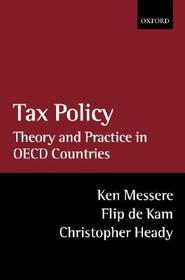
Tax Policy
Theory and Practice in OECD Countries
-
10% KEDVEZMÉNY?
- A kedvezmény csak az 'Értesítés a kedvenc témákról' hírlevelünk címzettjeinek rendeléseire érvényes.
- Kiadói listaár GBP 297.50
-
134 321 Ft (127 925 Ft + 5% áfa)
Az ár azért becsült, mert a rendelés pillanatában nem lehet pontosan tudni, hogy a beérkezéskor milyen lesz a forint árfolyama az adott termék eredeti devizájához képest. Ha a forint romlana, kissé többet, ha javulna, kissé kevesebbet kell majd fizetnie.
- Kedvezmény(ek) 10% (kb. 13 432 Ft)
- Kedvezményes ár 120 889 Ft (115 133 Ft + 5% áfa)
Iratkozzon fel most és részesüljön kedvezőbb árainkból!
Feliratkozom
134 321 Ft

Beszerezhetőség
Megrendelésre a kiadó utánnyomja a könyvet. Rendelhető, de a szokásosnál kicsit lassabban érkezik meg.
Why don't you give exact delivery time?
A beszerzés időigényét az eddigi tapasztalatokra alapozva adjuk meg. Azért becsült, mert a terméket külföldről hozzuk be, így a kiadó kiszolgálásának pillanatnyi gyorsaságától is függ. A megadottnál gyorsabb és lassabb szállítás is elképzelhető, de mindent megteszünk, hogy Ön a lehető leghamarabb jusson hozzá a termékhez.
A termék adatai:
- Kiadó OUP Oxford
- Megjelenés dátuma 2003. május 15.
- ISBN 9780199241484
- Kötéstípus Keménykötés
- Terjedelem280 oldal
- Méret 241x162x20 mm
- Súly 577 g
- Nyelv angol
- Illusztrációk numerous figures and tables 0
Kategóriák
Rövid leírás:
This book provides a broad analysis of standard tax policy in OECD countries in the first half of the twentieth century. It identifies broad trends in policy, summarises developments in the theory of tax policy and describes and compares policies actually adopted by various groups of countries. It is invaluable for anyone studying or involved in implementing tax policy. Public finance theory and the complexities of tax administration are kept to a minimum throughout to ensure accessibility.
TöbbHosszú leírás:
How do governments justify their choice of tax policy? What are the arguments for and against the choices they make? Are there common trends in the tax policy choices of OECD countries? This book provides a unique guide to tax policies pursued by the governments of OECD countries by assessing recent policies, offering a thorough critique of their justification and looking at actual examples of policy choice.
The authors give an overview of post-war tax developments, addressing in detail topics such as the dynamics of tax revenues and public sector developments. They go on to examine the arguments for and against governments' main tax policy choices, looking at personal income tax, social security contributions, business taxes, consumption taxation and taxes on wealth, capital gains, and property. They rigorously examine arguments used by governments to justify certain policy choices, providing an objective evaluation of both the valid and invalid arguments for the choices made with regard to domestic taxation.
In addition to a thorough critique of recent tax policies, the book looks at the actual tax choices of 25 of the thirty OECD countries and aims to identify the similarities and the differences between them. The authors draw on these real examples and on their considerable experience in assessing possibilities for future tax systems.
The book will be of special interest to academics and students in the field of public finance, national and international tax policymakers, politicians, and journalists.
Tartalomjegyzék:
Introduction
Part I: Tax Trends of the Twentieth Century
Trends in Tax Policy
Post-war Tax Revenue Trends
Tax Policy and Public Sector Trends
Tax Aspects of Fiscal Federalism
Part II: The Design of Taxes
The Personal Income Tax
Social Security Contributions
Corporate Income Taxes and Other Taxes on Business
Consumption Taxation
Taxes on Wealth, Capital Gains, and Property
Part III: Tax Policy in Practice
Tax Choices of OECD Countries
Future Tax Systems
Annexes

