

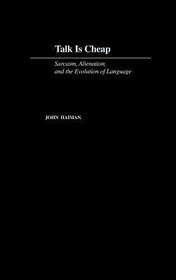
Talk Is Cheap
Sarcasm, Alienation, and the Evolution of Language
-
10% KEDVEZMÉNY?
- A kedvezmény csak az 'Értesítés a kedvenc témákról' hírlevelünk címzettjeinek rendeléseire érvényes.
- Kiadói listaár GBP 100.00
-
45 150 Ft (43 000 Ft + 5% áfa)
Az ár azért becsült, mert a rendelés pillanatában nem lehet pontosan tudni, hogy a beérkezéskor milyen lesz a forint árfolyama az adott termék eredeti devizájához képest. Ha a forint romlana, kissé többet, ha javulna, kissé kevesebbet kell majd fizetnie.
- Kedvezmény(ek) 10% (cc. 4 515 Ft off)
- Kedvezményes ár 40 635 Ft (38 700 Ft + 5% áfa)
Iratkozzon fel most és részesüljön kedvezőbb árainkból!
Feliratkozom
45 150 Ft

Beszerezhetőség
Megrendelésre a kiadó utánnyomja a könyvet. Rendelhető, de a szokásosnál kicsit lassabban érkezik meg.
Why don't you give exact delivery time?
A beszerzés időigényét az eddigi tapasztalatokra alapozva adjuk meg. Azért becsült, mert a terméket külföldről hozzuk be, így a kiadó kiszolgálásának pillanatnyi gyorsaságától is függ. A megadottnál gyorsabb és lassabb szállítás is elképzelhető, de mindent megteszünk, hogy Ön a lehető leghamarabb jusson hozzá a termékhez.
A termék adatai:
- Kiadó OUP USA
- Megjelenés dátuma 2001. február 22.
- ISBN 9780195115246
- Kötéstípus Keménykötés
- Terjedelem232 oldal
- Méret 231x160x22 mm
- Súly 454 g
- Nyelv angol
- Illusztrációk 9 line illustrations, 3 music examples 0
Kategóriák
Rövid leírás:
In this fascinating book, John Haiman argues that 'cheap talk', in which we don't mean what we say (for instance, by the use of sarcasm and irony) is central to the way we now talk. He traces this radical change in our use of language to the emergence of a post-modern 'divided self' who is hyper-conscious that what he or she is saying has been said before; 'cheap talk' thus allows us to distance ourselves from a social role with which we are uncomfortable. Haiman examines the full range of these pervasive distancing mechanisms, from clichés and quotation marks to camp and parody. In the process he sheds important new light on the ways in which the English language is evolving in responses to our world view.
TöbbHosszú leírás:
Putting aside questions of truth and falsehood, the old 'talk is cheap' maxim carries as much weight as ever. Indeed, perhaps more. For one need not be an expert in irony or sarcasm to realize that people don't necessarily mean what they say. Phrases such as 'Yeah, right' and 'I could care less' are so much a part of the way we speak - and the way we live - that we are more likely to notice when they are absent (for example, Forrest Gump). From our everyday dialogues and conversations ('Thanks a lot!') to the screenplays of our popular films (Pulp Fiction), what is said is frequently very different from what is meant.
Talk is Cheap begins with this telling observation and proceeds to argue that such 'unplain speaking' is fundamentally embedded in the way we now talk. Author John Haiman traces this sea-change in our use of language to the emergence of a postmodern 'divided self' who is hyper-conscious that what he or she is saying has been said before; 'cheap talk' thus allows us to distance ourselves from a social role with which we are uncomfortable. Haiman goes on to examine the full range of these pervasive distancing mechanisms, from clichés and quotation marks to camp and parody. Also, and importantly, Haiman highlights several ways in which language is evolving (and has evolved) from non-linguistic behaviour. In other words, this study shows us how what we are saying is continually separating itself from how we say it.
As provocative as it is timely, the book will be fascinating reading for students of linguistics, literature, communication, anthropology, philosophy, and popular culture.

