

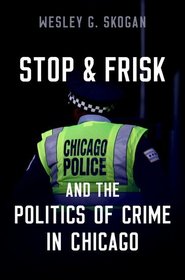
Stop & Frisk and the Politics of Crime in Chicago
-
20% KEDVEZMÉNY?
- A kedvezmény csak az 'Értesítés a kedvenc témákról' hírlevelünk címzettjeinek rendeléseire érvényes.
- Kiadói listaár GBP 26.99
-
12 185 Ft (11 605 Ft + 5% áfa)
Az ár azért becsült, mert a rendelés pillanatában nem lehet pontosan tudni, hogy a beérkezéskor milyen lesz a forint árfolyama az adott termék eredeti devizájához képest. Ha a forint romlana, kissé többet, ha javulna, kissé kevesebbet kell majd fizetnie.
- Kedvezmény(ek) 20% (cc. 2 437 Ft off)
- Kedvezményes ár 9 748 Ft (9 284 Ft + 5% áfa)
- A kedvezmény érvényes eddig: 2026. június 30.
Iratkozzon fel most és részesüljön kedvezőbb árainkból!
Feliratkozom
12 185 Ft

Beszerezhetőség
Becsült beszerzési idő: A Prosperónál jelenleg nincsen raktáron, de a kiadónál igen. Beszerzés kb. 3-5 hét..
A Prosperónál jelenleg nincsen raktáron.
Why don't you give exact delivery time?
A beszerzés időigényét az eddigi tapasztalatokra alapozva adjuk meg. Azért becsült, mert a terméket külföldről hozzuk be, így a kiadó kiszolgálásának pillanatnyi gyorsaságától is függ. A megadottnál gyorsabb és lassabb szállítás is elképzelhető, de mindent megteszünk, hogy Ön a lehető leghamarabb jusson hozzá a termékhez.
A termék adatai:
- Kiadó OUP USA
- Megjelenés dátuma 2023. február 9.
- ISBN 9780197675069
- Kötéstípus Puhakötés
- Terjedelem280 oldal
- Méret 237x154x16 mm
- Súly 413 g
- Nyelv angol
- Illusztrációk 42 b/w line drawings and 5 tables 278
Kategóriák
Rövid leírás:
In Stop & Frisk and the Politics of Crime in Chicago, Wesley G. Skogan offers a comprehensive analysis of the stop & frisk policy, its origins as Chicago's predominant strategy for responding to violent crime, and its impact on public opinion. Drawing on a crime database of over 14 million incidents, interviews with 1,450 Chicagoans and 714 police officers, and the author's 30 years of studying, talking to, and riding along with Chicago police officers, Skogan looks at the inner workings of police departments and the history and politics of crime prevention that motivate these policies. Rather than looking at individual stops and how they are handled, he argues for considering stop & frisk as an organizational strategy, intimately tied to the move from reactive to preventive policing.
TöbbHosszú leírás:
A comprehensive analysis of the stop & frisk policy, its origins as Chicago's predominant strategy for responding to violence, and its impact on crime and public opinion.
Stop & frisk has drawn a great deal of attention--and heated criticism--in recent years, for racial bias in its application and for the often violent and sometimes fatal nature of these encounters. In Stop & Frisk and the Politics of Crime in Chicago, Wesley G. Skogan offers a comprehensive analysis of the stop-and-frisk policy, its origins as Chicago's predominant strategy for responding to violence, and its impact on crime and public opinion. Drawing on a crime database of over 14 million incidents, interviews with 1,450 Chicagoans and 714 police officers, and the author's 30 years of studying, talking to, and riding along with Chicago police officers, Skogan looks at the inner workings of police departments and the history and politics of crime prevention that motivate these policies. Rather than looking at individual stops and how they are handled, he argues for considering stop & frisk as an organizational strategy, intimately tied to the move from reactive to preventive policing. Examining one of America's predominant crime control strategies, this book provides an essential analysis of the origins, implementation, and effects of stop & frisk in Chicago and on urban policing in general.
What was the cost of stop & search preventing an estimated 703 murders over 180 months in Chicago (4 murders per month), primarily in minority areas? Skogan's unprecedented analysis allows us to ask whether that price could be lower, avoiding both under-policing and over-policing for 'just right' targeting of the most volatile strategy police use against weapons crime.
Tartalomjegyzék:
Acknowledgments
Chapter 1: The Era of Stop & Frisk
Chapter 2: Twenty-first Century Crime
Chapter 3: Stop & Frisk as an Organizational Strategy
Chapter 4: What Happens During Stop & Frisks?
Chapter 5: Police Versus the Community?
Chapter 6: The Collapse of Stop & Frisk
Chapter 7: The Great Crime Spike of 2016
Chapter 8: Assessing Stop & Frisk
Epilogue
Data Appendix
References
Index

