

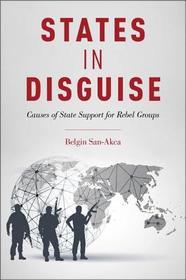
States in Disguise
Causes of State Support for Rebel Groups
-
10% KEDVEZMÉNY?
- A kedvezmény csak az 'Értesítés a kedvenc témákról' hírlevelünk címzettjeinek rendeléseire érvényes.
- Kiadói listaár GBP 135.00
-
60 952 Ft (58 050 Ft + 5% áfa)
Az ár azért becsült, mert a rendelés pillanatában nem lehet pontosan tudni, hogy a beérkezéskor milyen lesz a forint árfolyama az adott termék eredeti devizájához képest. Ha a forint romlana, kissé többet, ha javulna, kissé kevesebbet kell majd fizetnie.
- Kedvezmény(ek) 10% (cc. 6 095 Ft off)
- Kedvezményes ár 54 857 Ft (52 245 Ft + 5% áfa)
Iratkozzon fel most és részesüljön kedvezőbb árainkból!
Feliratkozom
60 952 Ft

Beszerezhetőség
Megrendelésre a kiadó utánnyomja a könyvet. Rendelhető, de a szokásosnál kicsit lassabban érkezik meg.
Why don't you give exact delivery time?
A beszerzés időigényét az eddigi tapasztalatokra alapozva adjuk meg. Azért becsült, mert a terméket külföldről hozzuk be, így a kiadó kiszolgálásának pillanatnyi gyorsaságától is függ. A megadottnál gyorsabb és lassabb szállítás is elképzelhető, de mindent megteszünk, hogy Ön a lehető leghamarabb jusson hozzá a termékhez.
A termék adatai:
- Kiadó OUP USA
- Megjelenés dátuma 2016. november 3.
- ISBN 9780190250881
- Kötéstípus Keménykötés
- Terjedelem320 oldal
- Méret 160x239x25 mm
- Súly 680 g
- Nyelv angol 0
Kategóriák
Rövid leírás:
States in Disguise builds a rigorous theoretical framework within which to study the complex and fluid network of relationships between states and rebel groups, including ethnic and religious insurgents, revolutionary groups, and terrorists.
TöbbHosszú leírás:
There is a long history of state governments providing support to nonstate armed groups fighting battles in other countries. Examples include Syria's aid to Hamas, Ecuador's support for FARC, and Libya's donation of arms to the IRA. What motivates states to do this? And why would rebel groups align themselves with these states?
In States in Disguise, Belgin San-Akca builds a rigorous theoretical framework within which to study the complex and fluid network of relationships between states and rebel groups, including ethnic and religious insurgents, revolutionary groups, and terrorists. She proves that patterns of alliances between armed rebels and modern states are hardly coincidental, but the result of systematic and strategic choices made by both states and rebel groups. San-Akca demonstrates that these alliances are the result of shared conflictual, material and ideational interests, and her theory shows how to understand these ties via the domestic and international environment. Drawing from an original data set of 455 groups, their target states, and supporters over a span of more than sixty years, she explains that states are most likely to support rebel groups when they are confronted with internal and external threats simultaneously, while rebels select strong states and democracies when seeking outside support. She also shows that states and rebels look to align with one another when they share ethnic, religious and ideological ties. Through its broad chronological sweep, States in Disguise reveals how and why the phenomenon of state and rebel group alliances has evolved over time.
Tartalomjegyzék:
List of Maps
List of Figures
List of Tables
List of Abbreviations
Acknowledgments
1. Introduction: Bringing Nonstate Armed Groups into the Study of International Relations
2. A Selection Theory of State Support for Rebel Groups
3. Dangerous Companions: Research Design, Data Collection and Coding Procedures
4. States' Selection Model
5. Rebels' Selection Model
6. Conclusion: Main Trends in State Support of Nonsate Armed Groups
Appendix 1. Sample Data Table
Appendix 2. Dangerous Companions: Cooperation between States and Nonstate Armed Groups (NAGs)
Appendix 3. States with a Single-Party Communist Regime (Up to 2010)
Appendix 4. The Entire Cases of International Support, 1945-2010
Appendix 5. The Entire Cases of De Facto Support, 1945-2010
Bibliography
Index

