

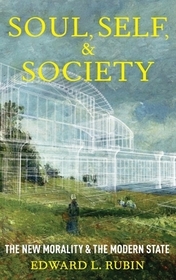
State, Soul, and Society
The Transformation of Morality and the Modern State
-
10% KEDVEZMÉNY?
- A kedvezmény csak az 'Értesítés a kedvenc témákról' hírlevelünk címzettjeinek rendeléseire érvényes.
- Kiadói listaár GBP 31.49
-
14 217 Ft (13 540 Ft + 5% áfa)
Az ár azért becsült, mert a rendelés pillanatában nem lehet pontosan tudni, hogy a beérkezéskor milyen lesz a forint árfolyama az adott termék eredeti devizájához képest. Ha a forint romlana, kissé többet, ha javulna, kissé kevesebbet kell majd fizetnie.
- Kedvezmény(ek) 10% (cc. 1 422 Ft off)
- Kedvezményes ár 12 795 Ft (12 186 Ft + 5% áfa)
Iratkozzon fel most és részesüljön kedvezőbb árainkból!
Feliratkozom
14 217 Ft

Beszerezhetőség
Megrendelésre a kiadó utánnyomja a könyvet. Rendelhető, de a szokásosnál kicsit lassabban érkezik meg.
Why don't you give exact delivery time?
A beszerzés időigényét az eddigi tapasztalatokra alapozva adjuk meg. Azért becsült, mert a terméket külföldről hozzuk be, így a kiadó kiszolgálásának pillanatnyi gyorsaságától is függ. A megadottnál gyorsabb és lassabb szállítás is elképzelhető, de mindent megteszünk, hogy Ön a lehető leghamarabb jusson hozzá a termékhez.
A termék adatai:
- Kiadó OUP USA
- Megjelenés dátuma 2015. április 2.
- ISBN 9780199348657
- Kötéstípus Keménykötés
- Terjedelem502 oldal
- Méret 238x177x36 mm
- Súly 776 g
- Nyelv angol 0
Kategóriák
Rövid leírás:
Morality is not declining in the modern world. Instead, a new morality is replacing the previous one. Centered on individual self-fulfillment, and linked to administrative government, it permits things the old morality forbid, like sex for pleasure, but forbids things the old morality allowed, like intolerance and equality of opportunity.
TöbbHosszú leírás:
Given the complexity of human societies, the idea that a society's moral norms track the stages of its historical development is both controversial and difficult to demonstrate. Yet in The New Morality, Edward Rubin, an eminent scholar of the modern state, offers an ambitious account of how current moral norms are inherently connected to the type of state that currently dominates the developed world. He contends that the moral system of 'self-fulfillment'--the idea that people are entitled to the most pleasurable and meaningful life possible, without unnecessary constraints--that has emerged in the last two centuries parallels the rise of the modern administrate state. The modern state's functions--education, unemployment relief, health, and environmental protection, among others--are designed to support that moral system. However, just as the rise of the administrative state generated tensions as it replaced an older state model, self-fulfillment has created stresses because it has gradually supplanted the pre-existing moral code: the religiously based morality of higher purposes, which demanded that people serve God and king. This moral system tracked the rise of centralizing monarchies in Western Europe, and that system in turn replaced a morality of 'honor,' which dominated in the pre-absolutist era where governmental power was private in orientation and the state was weak. Rubin traces how paired state-moral system models have emerged and withered over time, paying close attention to the stresses that emerge when a new order replaces an existing one. He provides a close analysis of the components of the morality of self-fulfillment, exploring sex, pleasure, friendship, hobbies, careers, voting behavior and public obligations. Our entire system of government, he argues, is bound up in this morality, and its primary purpose is to further it. A sweeping, big-idea book in the vein of Richard Sennett's The Fall of Public Man and David Riesman's The Lonely Crowd, The New Morality promises to reshape our understanding of the ultimate aims of modern politics and society.
Without doubt, Ed Rubin has written a truly inspirational book that provides lots food for thought and raises important questions.
Tartalomjegyzék:
Introduction
The Thesis
An Illustration: The 2012 Election
Plan of the Book
The Boundaries and Limits of the Thesis
Part I: Origins of the New Morality
Chapter 1: The Morality of Honor
The Privatization of Government in the Roman Empire The Privatization of Governance in Early Medieval Europe The Morality of Honor and the Man of Honor
The Man of Honor in Action The Morality of Honor and Other Members of Society
The Co-Causal Connection
Chapter 2: The Morality of Higher Purposes
The Publification of Governance
The Monarchy as a Higher Purpose of Its People and Government
The Spiritualization of Christianity
The Morality of Higher Purposes
Sexual Love as a Higher Purpose
The Co-Causal Connection
Chapter 3: The Morality of Self-Fulfillment
The Idea of the Administrative State
The Advent of the Administrative State
Self-Fulfillment Morality: The Process of Secularization
Self-Fulfillment Morality: The Concept of Mental Health
The Co-Causal Connection
Resistance to the New Morality
Part II: The Nature of the New Morality
Chapter 4: The Morality of the Self
The Basic Principle: The Self as a Life-Path
The Basic Principle: Fulfillment as Pleasure, Planning and Reflection
Secondary Principles: Non-Interference, Incommensurability and Equality
Components of the Life Path: Careers
Components of the Life-Path: Family, Religion and Leisure
The End of the Life-Path
Chapter 5: The Morality of Intimate and Personal Relations
The Validation of Sex
The Reformulation of Childhood Sex
The Deregulation of Sex
The Domestication of Love
The Personalization of Parenthood
The Personalization of Friendship and the Officialization of Work
Chapter 6: The Morality of Relations with Society
The Self's Relation to the Nation-State
The Morality of Self-National Relations
The Non-Interference Principle and Negative Rights
The Equality Principle and Positive Rights
Moral Action Beyond Voting: Reiteration and Emergent Consequences
The New Morality and Environmentalism
Conclusion: The Future of Christianity
Christianity and Western History (Chapters 1, 2 and 3)
Christianity and the New Morality of the Self (Chapter 4)
Christianity and the New Morality of Personal Relations (Chapter 5)
Christianity and the New Morality of Relations with Society (Chapter 6)
A Final Word

