

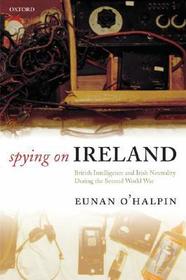
Spying on Ireland
British Intelligence and Irish Neutrality during the Second World War
-
10% KEDVEZMÉNY?
- A kedvezmény csak az 'Értesítés a kedvenc témákról' hírlevelünk címzettjeinek rendeléseire érvényes.
- Kiadói listaár GBP 94.00
-
42 441 Ft (40 420 Ft + 5% áfa)
Az ár azért becsült, mert a rendelés pillanatában nem lehet pontosan tudni, hogy a beérkezéskor milyen lesz a forint árfolyama az adott termék eredeti devizájához képest. Ha a forint romlana, kissé többet, ha javulna, kissé kevesebbet kell majd fizetnie.
- Kedvezmény(ek) 10% (cc. 4 244 Ft off)
- Kedvezményes ár 38 197 Ft (36 378 Ft + 5% áfa)
Iratkozzon fel most és részesüljön kedvezőbb árainkból!
Feliratkozom
42 441 Ft

Beszerezhetőség
Megrendelésre a kiadó utánnyomja a könyvet. Rendelhető, de a szokásosnál kicsit lassabban érkezik meg.
Why don't you give exact delivery time?
A beszerzés időigényét az eddigi tapasztalatokra alapozva adjuk meg. Azért becsült, mert a terméket külföldről hozzuk be, így a kiadó kiszolgálásának pillanatnyi gyorsaságától is függ. A megadottnál gyorsabb és lassabb szállítás is elképzelhető, de mindent megteszünk, hogy Ön a lehető leghamarabb jusson hozzá a termékhez.
A termék adatai:
- Kiadó OUP Oxford
- Megjelenés dátuma 2008. április 17.
- ISBN 9780199253296
- Kötéstípus Keménykötés
- Terjedelem360 oldal
- Méret 241x163x25 mm
- Súly 701 g
- Nyelv angol 0
Kategóriák
Rövid leírás:
Irish neutrality during the Second World War presented Britain with significant challenges to its security. Exploring how British agencies identified and addressed these problems, Eunan O'Halpin casts fresh light on the significance of both espionage and cooperation between agencies for developing wider relations between the two countries.
TöbbHosszú leírás:
Irish neutrality during the Second World War presented Britain with significant challenges to its security. Exploring how British agencies identified and addressed these problems, this book reveals how Britain simultaneously planned sabotage in and spied on Ireland, and at times sought to damage the neutral state's reputation internationally through black propaganda operations. It analyses the extent of British knowledge of Axis and other diplomatic missions in Ireland, and shows the crucial role of diplomatic code-breaking in shaping British policy. The book also underlines just how much Ireland both interested and irritated Churchill throughout the war.
Rather than viewing this as a uniquely Anglo-Irish experience, Eunan O'Halpin argues that British activities concerning Ireland should be placed in the wider context of intelligence and security problems that Britain faced in other neutral states, particularly Afghanistan and Persia. Taking a comparative approach, he illuminates how Britain dealt with challenges in these countries through a combination of diplomacy, covert gathering of intelligence, propaganda, and intimidation. The British perspective on issues in Ireland becomes far clearer when discussed in terms of similar problems Britain faced with neutral states worldwide.
Drawing heavily on British and American intelligence records, many disclosed here for the first time, Eunan O'Halpin presents the first country study of British intelligence to describe and analyse the impact of all the secret agencies during the war. He casts fresh light on British activities in Ireland, and on the significance of both espionage and cooperation between intelligence agencies for developing wider relations between the two countries.
It is a careful study of the role of British intelligence in Ireland during the Second World War. It is the most complete survey of this relationship we are likely to obtain in the foreseeable future and is based on extensive archival research.
Tartalomjegyzék:
Preface
List of Tables
Abbreviations and Acronyms
Biographical Notes
Britain's Irish security problem, 1922-1939
Phoney war, phoney spies: September 1939-April 1940
Invasion fears: May 1940-June 1941
From Barbarossa to Torch: July 1941-December 1942
Preparation for Overlord: January-December 1943
Anomalous, benighted, backwater: January 1944 to the late 1940s
Conclusion
Bibliography
Index

