

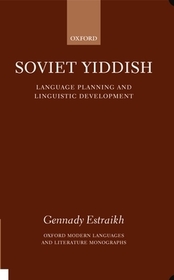
Soviet Yiddish
Language-Planning and Linguistic Development
Sorozatcím: Oxford Modern Languages and Literature Monographs;
-
10% KEDVEZMÉNY?
- A kedvezmény csak az 'Értesítés a kedvenc témákról' hírlevelünk címzettjeinek rendeléseire érvényes.
- Kiadói listaár GBP 175.00
-
79 012 Ft (75 250 Ft + 5% áfa)
Az ár azért becsült, mert a rendelés pillanatában nem lehet pontosan tudni, hogy a beérkezéskor milyen lesz a forint árfolyama az adott termék eredeti devizájához képest. Ha a forint romlana, kissé többet, ha javulna, kissé kevesebbet kell majd fizetnie.
- Kedvezmény(ek) 10% (cc. 7 901 Ft off)
- Kedvezményes ár 71 111 Ft (67 725 Ft + 5% áfa)
Iratkozzon fel most és részesüljön kedvezőbb árainkból!
Feliratkozom
79 012 Ft

Beszerezhetőség
Megrendelésre a kiadó utánnyomja a könyvet. Rendelhető, de a szokásosnál kicsit lassabban érkezik meg.
Why don't you give exact delivery time?
A beszerzés időigényét az eddigi tapasztalatokra alapozva adjuk meg. Azért becsült, mert a terméket külföldről hozzuk be, így a kiadó kiszolgálásának pillanatnyi gyorsaságától is függ. A megadottnál gyorsabb és lassabb szállítás is elképzelhető, de mindent megteszünk, hogy Ön a lehető leghamarabb jusson hozzá a termékhez.
A termék adatai:
- Kiadó OUP Oxford
- Megjelenés dátuma 1999. február 4.
- ISBN 9780198184799
- Kötéstípus Keménykötés
- Terjedelem227 oldal
- Méret 224x144x18 mm
- Súly 384 g
- Nyelv angol 0
Kategóriák
Rövid leírás:
This is the first comprehensive study of Yiddish in the former Soviet Union. A chronicle of orthographic and other reforms from the state of the language in pre-Revolutionary Russia, through active language-planning in the 1920s and 1930s, repression, and subsequent developments up to the 1980s is recreated from contemporary publications and archival materials. Soviet Yiddish language-planning is compared with concurrent reforms in Russian, Ukrainian, Belorussian, and German; and the features and types of Soviet Yiddish word-formation are analysed.
TöbbHosszú leírás:
This is the first comprehensive study of Yiddish in the former Soviet Union. A chronicle of orthographic and other reformsfrom the state of the language in pre-Revolutionary Russia, through active language-planning in the 1920s and 1930s, repression, and subsequent developments up to the 1980sis recreated from contemporary publications and archival materials. Later chapters draw on the author's own experience as a Yiddish writer and lexicographer in Moscow.
At a time when the Bolshevik party's Jewish sections held an influential position, Yiddish attained a functional diversity without precedent in its history; but underlying contradictions between ideas expressed in the slogans `Proletarians of all countries, unite!' and `The right of nations to self-determination' led to extremes in language-planning. A golden mean was achieved after the 1934 Yiddish language conference in Kiev. Using contemporary literary works as a source of linguistic and sociolinguistic information, Gennady Estraikh charts the development of the resultant variety of the language, `Soviet Yiddish'; the effects of severe repression in the late 1930s and 1940s; and the subsequent decline in usage. Comparisons are drawn between Soviet Yiddish language-planning and concurrent reforms in Russian, Ukrainian, Belorussian, and German; and the features and types of Soviet Yiddish word-formation are analysed, notably univerbation, or compressing a phrase into one word.
Yiddish continues to interest both linguists and those among Russian Jews who prefer to stay in the country without being completely assimilated. Whether they will create another spoken variety of Yiddish or the Yiddish of their ancestors will be studied as a dead language, one thing is clear enough: no student of Soviet/Russian Yiddish will be able to do without Estraikh's book
Tartalomjegyzék:
Yiddish in late Imperial Russia
Yiddish proletarian language
Language-planning of the 1930s
Soviet Yiddish in the 1940s80s
Soviet Yiddish orthography
Soviet Yiddish word-formation
Conclusion
Bibliography
Index of Yiddish lexical items
Index of names and subjects

