

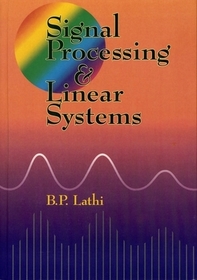
Signal Processing and Linear Systems
-
10% KEDVEZMÉNY?
- A kedvezmény csak az 'Értesítés a kedvenc témákról' hírlevelünk címzettjeinek rendeléseire érvényes.
- Kiadói listaár GBP 39.99
-
18 055 Ft (17 195 Ft + 5% áfa)
Az ár azért becsült, mert a rendelés pillanatában nem lehet pontosan tudni, hogy a beérkezéskor milyen lesz a forint árfolyama az adott termék eredeti devizájához képest. Ha a forint romlana, kissé többet, ha javulna, kissé kevesebbet kell majd fizetnie.
- Kedvezmény(ek) 10% (kb. 1 806 Ft)
- Kedvezményes ár 16 249 Ft (15 476 Ft + 5% áfa)
Iratkozzon fel most és részesüljön kedvezőbb árainkból!
Feliratkozom
18 055 Ft

Beszerezhetőség
Bizonytalan a beszerezhetőség. Érdemes még egyszer keresni szerzővel és címmel. Ha nem talál másik, kapható kiadást, forduljon ügyfélszolgálatunkhoz!
Why don't you give exact delivery time?
A beszerzés időigényét az eddigi tapasztalatokra alapozva adjuk meg. Azért becsült, mert a terméket külföldről hozzuk be, így a kiadó kiszolgálásának pillanatnyi gyorsaságától is függ. A megadottnál gyorsabb és lassabb szállítás is elképzelhető, de mindent megteszünk, hogy Ön a lehető leghamarabb jusson hozzá a termékhez.
A termék adatai:
- Kiadó OUP USA
- Megjelenés dátuma 2003. február 27.
- ISBN 9780195219173
- Kötéstípus Keménykötés
- Terjedelem864 oldal
- Méret 260x183x43 mm
- Súly 1710 g
- Nyelv angol
- Illusztrációk numerous line figures and halftones 0
Kategóriák
Hosszú leírás:
This text presents a comprehensive treatment of signal processing and linear systems suitable for juniors and seniors in electrical engineering. Based on B. P. Lathi's widely used book, Linear Systems and Signals, it features additional applications to communications, controls, and filtering as well as new chapters on analog and digital filters and digital signal processing. Lathi emphasizes the physical appreciation of concepts rather than the mere mathematical
manipulation of symbols. Avoiding the tendency to treat engineering as a branch of applied mathematics, he uses mathematics to enhance physical and intuitive understanding of concepts, instead of employing it only to prove axiomatic theory. Theoretical results are supported by carefully chosen examples
and analogies, allowing students to intuitively discover meaning for themselves.
Tartalomjegyzék:
Background
Complex Numbers
Sinusoids
Sketching Signals
Cramer's Rule
Partial Fraction Expansion
Vectors and Matrices
Miscellaneous
Chapter 1. Introduction to Signals and Systems
Size of a Signal
Classification of Signals
Some Useful Signal Operations
Some Useful Signal Models
Even and Odd Functions
Systems
Classification of Systems
System Model: Input-Output Description
Chapter 2. Time-Domain Analysis of Continuous-Time Systems
Introduction
System Response to Internal Conditions: Zero-Input Response
The Unit Impulse Response h(t)
System Response to External Input: Zero-State Response
Classical Solution of Differential Equations
System Stability
Intuitive Insights into System Behavior
Appendix 2.1: Determining the Impulse Response
Chapter 3. Signal Representation by Fourier Series
Signals and Vectors
Signal Comparison: Correlation
Signal Representation by Orthogonal Signal Set
Trigonometric Fourier Series
Exponential Fourier Series
Numerical Computation of D[n
LTIC System response to Periodic Inputs
Appendix
Chapter 4. Continuous-Time Signal Analysis: The Fourier Transform
Aperiodic Signal Representation by Fourier Integral
Transform of Some Useful Functions
Some Properties of the Fourier Transform
Signal Transmission through LTIC Systems
Ideal and Practical Filters
Signal Energy
Application to Communications: Amplitude Modulation
Angle Modulation
Data Truncation: Window Functions
Chapter 5. Sampling
The Sampling Theorem
Numerical Computation of Fourier Transform: The Discrete Fourier Transform (DFT)
The Fast Fourier Transform (FFT)
Appendix 5.1
Chapter 6. Continuous-Time System Analysis Using the Laplace Transform
The Laplace Transform
Some Properties of the Laplace Transform
Solution of Differential and Integro-Differential Equations
Analysis of Electrical Networks: The Transformed Network
Block Diagrams
System Realization
Application to Feedback and Controls
The Bilateral Laplace Transform
Appendix 6.1: Second Canonical Realization
Chapter 7. Frequency Response and Analog Filters
Frequency Response of an LTIC System
Bode Plots
Control System Design Using Frequency Response
Filter Design by Placement of Poles and Zeros of H(s)
Butterworth Filters
Chebyshev Filters
Frequency Transformations
Filters to Satisfy Distortionless Transmission Conditions
Chapter 8. Discrete-Time Signals and Systems
Introduction
Some Useful Discrete-Time Signal Models
Sampling Continuous-Time Sinusoids and Aliasing
Useful Signal Operations
Examples of Discrete-Time Systems
Chapter 9. Time-Domain Analysis of Discrete-Time Systems
Discrete-Time System Equations
System Response to Internal Conditions: Zero-Input Response
Unit Impulse Response h[k]
System Response to External Input: Zero-State Response
Classical Solution of Linear Difference Equations
System Stability
Appendix 9.1: Determining Impulse Response
Chapter 10. Fourier Analysis of Discrete-Time Signals
Periodic Signal Representation by Discrete-Time Fourier Series
10.2 Aperiodic Signal Representation by Fourier Integral
Properties of DTFT
DTFT Connection with the Continuous-Time Fourier Transform
Discrete-Time Linear System Analysis by DTFT
Signal Processing Using DFT and FFT
Generalization of DTFT to the Z-Transform
Chapter 11. Discrete-Time System Analysis Using the Z-Transform
The Z-Transform
Some Properties of the Z-Transform
Z-Transform Solution of Linear Difference Equations
System Realization
Connection Between the Laplace and the Z-Transform
Sampled-Data (Hybrid) Systems
The Bilateral Z-Transform
Chapter 12. Frequency Response and Digital Filters
Frequency Response of Discrete-Time Systems
Frequency Response From Pole-Zero Location
Digital Filters
Filter Design Criteria
Recursive Filter Design: The Impulse Invariance Method
Recursive Filter Design: The Bilinear Transformation Method
Nonrecursive Filters
Nonrecursive Filter Design
Chapter 13. State-Space Analysis
Introduction
Systematic Procedure for Determining State Equations
Solution of State Equations
Linear Transformation of State Vector
Controllability and Observability
State-Space Analysis of Discrete-Time Systems
Answers to Selected Problems
Supplementary Reading
Index
Each chapter ends with a Summary

