

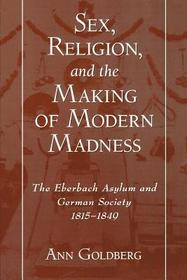
Sex, Religion, and the Making of Modern Madness
The Eberbach Asylum and German Society, 1815-1849
-
10% KEDVEZMÉNY?
- A kedvezmény csak az 'Értesítés a kedvenc témákról' hírlevelünk címzettjeinek rendeléseire érvényes.
- Kiadói listaár GBP 75.00
-
33 862 Ft (32 250 Ft + 5% áfa)
Az ár azért becsült, mert a rendelés pillanatában nem lehet pontosan tudni, hogy a beérkezéskor milyen lesz a forint árfolyama az adott termék eredeti devizájához képest. Ha a forint romlana, kissé többet, ha javulna, kissé kevesebbet kell majd fizetnie.
- Kedvezmény(ek) 10% (kb. 3 386 Ft)
- Kedvezményes ár 30 476 Ft (29 025 Ft + 5% áfa)
Iratkozzon fel most és részesüljön kedvezőbb árainkból!
Feliratkozom
33 862 Ft

Beszerezhetőség
Megrendelésre a kiadó utánnyomja a könyvet. Rendelhető, de a szokásosnál kicsit lassabban érkezik meg.
Why don't you give exact delivery time?
A beszerzés időigényét az eddigi tapasztalatokra alapozva adjuk meg. Azért becsült, mert a terméket külföldről hozzuk be, így a kiadó kiszolgálásának pillanatnyi gyorsaságától is függ. A megadottnál gyorsabb és lassabb szállítás is elképzelhető, de mindent megteszünk, hogy Ön a lehető leghamarabb jusson hozzá a termékhez.
A termék adatai:
- Kiadó OUP USA
- Megjelenés dátuma 2001. március 15.
- ISBN 9780195140521
- Kötéstípus Puhakötés
- Terjedelem252 oldal
- Méret 226x150x22 mm
- Súly 386 g
- Nyelv angol
- Illusztrációk 4 halftones, 1 map 0
Kategóriák
Rövid leírás:
Drawing on a rich set of asylum patient case-records, this book reconstructs the encounters of state officials and medical practitioners with peasant madness and deviancy during a transitional period in the history of both Germany and psychiatry. Focusing on religious madness, nymphomania, masturbatory insanity, and Jewishness, this study probes the daily encounters in which psychiatric categories were applied, experienced, and resisted within the settings of family, village, and insane asylum. Goldberg's careful examination sheds light on a range of issues concerning gender, sexuality, religious politics, class relations, state-building, and antisemitism.
TöbbHosszú leírás:
How did the affliction we now know as insanity move from a religious phenomenon to a medical one? How did social class, gender, and ethnicity affect the experience of mental trauma and the way psychiatrists diagnosed and treated patients? In answering these questions, this important volume mines the rich and unusually detailed records of one of Germany's first modern insane asylums, the Eberbach Asylum in the duchy of Nassau. It is a book on the historical relationship between madness and modernity that both builds upon and challenges Michel Foucault's landmark work on this topic, a bold study that gives generous consideration to madness from the patient's perspective while also shedding new light on sexuality, politics, and antisemitism in nineteenth-century Germany.
Drawing on the case records of several hundred asylum patients, Sex, Religion, and the Making of Modern Madness reconstructs the encounters of state officials and medical practitioners with peasant madness and deviancy during a transitional period in the history of both Germany and psychiatry. As author Ann Goldberg explains, this era witnessed the establishment of psychiatry as a legitimate medical specialty during a time of social upheaval, as Germany underwent the shift toward a capitalist order and the modern state. Focusing on such "illnesses" as religious madness, nymphomania, and masturbatory insanity, as well as the construct of Jewishness, she probes the daily encounters in which psychiatric categories were applied, experienced, and resisted within the settings of family, village, and insane asylum.
The book is a model of microhistory, breaking new ground in the historiography of psychiatry as it synthetically applies approaches from "the history of everyday life," anthropology, poststructuralism, and feminist studies. In contrast to earlier, anecdotal studies of "the asylum patient," Goldberg employs diagnostic patterns to illuminate the ways in which madness--both in psychiatric practice and in the experience of patients--was structured by gender, class, and "race." She thus examines both the social basis of rural mental trauma in the Vormärz and the political and medical practices that sought to refashion this experience.
This study sheds light on a range of issues concerning gender, religion, class relations, ethnicity, and state-building. It will appeal to students and scholars of a number of disciplines.
Goldberg's excellent study ... raises many fruitful questions for future research. It demonstrates well how sensitive, deep reading of local sources can deepen our understanding of large-scale social, intellectual and institutional transformations.
Tartalomjegyzék:
Introduction
The Duchy of Nassau and the Eberbach Asylum
Section I: Religion
Religious Madness in the Vormarz: Culture, Politics, and the Professionalization of Psychiatry
Religious Madness and the Formation of Patients
Section II: Sexuality and Gender
Medical Representation of Sexual Madness: Nymphomania and Masturbatory Insanity
Doctors and Patients: The Practice(s) of Nymphomania
Women, Sex, and Rural Life
Section III: Delinquincy and Criminality
Masturbatory Insanity and Delinquincy
Jews and the Criminalization of Madness
Conclusion

