

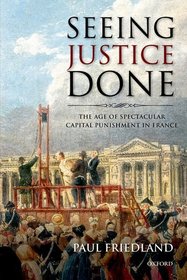
Seeing Justice Done
The Age of Spectacular Capital Punishment in France
-
10% KEDVEZMÉNY?
- A kedvezmény csak az 'Értesítés a kedvenc témákról' hírlevelünk címzettjeinek rendeléseire érvényes.
- Kiadói listaár GBP 36.99
-
16 700 Ft (15 905 Ft + 5% áfa)
Az ár azért becsült, mert a rendelés pillanatában nem lehet pontosan tudni, hogy a beérkezéskor milyen lesz a forint árfolyama az adott termék eredeti devizájához képest. Ha a forint romlana, kissé többet, ha javulna, kissé kevesebbet kell majd fizetnie.
- Kedvezmény(ek) 10% (cc. 1 670 Ft off)
- Kedvezményes ár 15 030 Ft (14 315 Ft + 5% áfa)
Iratkozzon fel most és részesüljön kedvezőbb árainkból!
Feliratkozom
16 700 Ft

Beszerezhetőség
Megrendelésre a kiadó utánnyomja a könyvet. Rendelhető, de a szokásosnál kicsit lassabban érkezik meg.
Why don't you give exact delivery time?
A beszerzés időigényét az eddigi tapasztalatokra alapozva adjuk meg. Azért becsült, mert a terméket külföldről hozzuk be, így a kiadó kiszolgálásának pillanatnyi gyorsaságától is függ. A megadottnál gyorsabb és lassabb szállítás is elképzelhető, de mindent megteszünk, hogy Ön a lehető leghamarabb jusson hozzá a termékhez.
A termék adatai:
- Kiadó OUP Oxford
- Megjelenés dátuma 2014. július 3.
- ISBN 9780198715993
- Kötéstípus Puhakötés
- Terjedelem346 oldal
- Méret 234x157x17 mm
- Súly 494 g
- Nyelv angol
- Illusztrációk 15 black and white images 0
Kategóriák
Rövid leírás:
A history of public executions in France from the medieval spectacle of suffering to the invention of the Revolutionary guillotine, up to the last public execution in 1939. Paul Friedland explores why spectacles of public execution were staged, as well as why thousands of spectators came to watch them.
TöbbHosszú leírás:
From the early Middle Ages to the twentieth century, capital punishment in France, as in many other countries, was staged before large crowds of spectators. Paul Friedland traces the theory and practice of public executions over time, both from the perspective of those who staged these punishments as well as from the vantage point of the many thousands who came to 'see justice done'. While penal theorists often stressed that the fundamental purpose of public punishment was to strike fear in the hearts of spectators, the eagerness with which crowds flocked to executions, and the extent to which spectators actually enjoyed the spectacle of suffering suggests that there was a wide gulf between theoretical intentions and actual experiences. Moreover, public executions of animals, effigies, and corpses point to an enduring ritual function that had little to do with exemplary deterrence. In the eighteenth century, when a revolution in sensibilities made it unseemly for individuals to take pleasure in or even witness the suffering of others, capital punishment became the target of reformers. From the invention of the guillotine, which reduced the moment of death to the blink of an eye, to the 1939 decree which moved executions behind prison walls, capital punishment in France was systematically stripped of its spectacular elements.
Partly a history of penal theory, partly an anthropologically-inspired study of the penal ritual, Seeing Justice Done traces the historical roots of modern capital punishment, and sheds light on the fundamental 'disconnect' between the theory and practice of punishment which endures to this day, nit only in France but in the Western penal tradition more generally.
Seeing Justice Done would be a worthwhile addition to any academic law library or other library seeking to enhance its legal history collection and to provide its users with a unique and educational book selection ... It is highly recommended.
Tartalomjegyzék:
Introduction: Reading and Writing a History of Punishment
Part I: The Roots of Modern Punishment in Pre-Modern Europe
The Fall and Rise of Rome: Compensation, Atonement, and Deterrence in the Early Middle Ages
Criminal Intent and Spectacular Punishment: The Infiltration of Roman Legal Theory and Practice into French Customary Law
PART II: Executioners and the Ritual of Execution
Extraordinary Beings: The Life and Work of Executioners
The Execution of Justice: The Ritual of Punishment in Medieval and Early Modern France
PART III: Spectators & Spectacle
From Ritual to Spectacle: The Rise of the Penal Voyeur in Early Modern France
Executions, Spectator Emotions, and the Naturalization of Sympathy
A Spectacular Crisis: Watching Executions in the Age of Sensibilité
Part IV: A Death Penalty for the Modern Age
Theorizing a New Death Penalty: Penal Reform on the Eve of the Revolution
Legislating the New Death Penalty: The Simple Deprivation of Life
Executing the New Death Penalty: The Invisible Spectacle of the Guillotine
Epilogue: The Play Over, The Actors (Slowly) Leave the Stage (1794-1939)
Conclusion: Punishment Past and Present

