

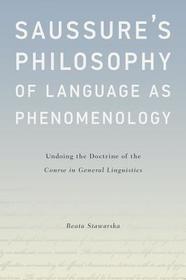
Saussure's Philosophy of Language as Phenomenology
Undoing the Doctrine of the Course in General Linguistics
-
10% KEDVEZMÉNY?
- A kedvezmény csak az 'Értesítés a kedvenc témákról' hírlevelünk címzettjeinek rendeléseire érvényes.
- Kiadói listaár GBP 93.00
-
41 989 Ft (39 990 Ft + 5% áfa)
Az ár azért becsült, mert a rendelés pillanatában nem lehet pontosan tudni, hogy a beérkezéskor milyen lesz a forint árfolyama az adott termék eredeti devizájához képest. Ha a forint romlana, kissé többet, ha javulna, kissé kevesebbet kell majd fizetnie.
- Kedvezmény(ek) 10% (cc. 4 199 Ft off)
- Kedvezményes ár 37 791 Ft (35 991 Ft + 5% áfa)
Iratkozzon fel most és részesüljön kedvezőbb árainkból!
Feliratkozom
41 989 Ft

Beszerezhetőség
Megrendelésre a kiadó utánnyomja a könyvet. Rendelhető, de a szokásosnál kicsit lassabban érkezik meg.
Why don't you give exact delivery time?
A beszerzés időigényét az eddigi tapasztalatokra alapozva adjuk meg. Azért becsült, mert a terméket külföldről hozzuk be, így a kiadó kiszolgálásának pillanatnyi gyorsaságától is függ. A megadottnál gyorsabb és lassabb szállítás is elképzelhető, de mindent megteszünk, hogy Ön a lehető leghamarabb jusson hozzá a termékhez.
A termék adatai:
- Kiadó OUP USA
- Megjelenés dátuma 2015. március 12.
- ISBN 9780190213022
- Kötéstípus Keménykötés
- Terjedelem304 oldal
- Méret 236x160x30 mm
- Súly 517 g
- Nyelv angol 0
Kategóriák
Rövid leírás:
This book draws on recent developments in research on Ferdinand de Saussure's general linguistics to challenge the structuralist doctrine associated with the Course in General Linguistics (1916) and to propose a phenomenological interpretation of Saussure's study of language.
TöbbHosszú leírás:
This book draws on recent developments in research on Ferdinand de Saussure's general linguistics to challenge the structuralist doctrine associated with the posthumous Course in General Linguistics (1916) and to develop a new philosophical interpretation of Saussure's conception of language based solely on authentic source materials. This project follows two new editorial paradigms: 1. a critical re-examination of the 1916 Course in light of the relevant sources and 2. a reclamation of the historically authentic materials from Saussure's Nachlass, some of them recently discovered. In Stawarska's book, this editorial paradigm shift serves to expose the difficulties surrounding the official Saussurean doctrine with its sets of oppositional pairings: the signifier and the signified; la langue and la parole; synchrony and diachrony. The book therefore puts pressure not only on the validity of the posthumous editorial redaction of Saussure's course in general linguistics in the Course, but also on its structuralist and post-structuralist legacy within the works of Levi-Strauss, Lacan, and Derrida. Its constructive contribution consists in reclaiming the writings from Saussure's Nachlass in the service of a linguistic phenomenology, which intersects individual expression in the present with historically sedimented social conventions. Stawarska develops such a conception of language by engaging Saussure's own reflections with relevant writings by Hegel, Husserl, Roman Jakobson, and Merleau-Ponty. Finally, she enriches her philosophical critique with a detailed historical account of the material and institutional processes that led to the ghostwriting and legitimizing the Course as official Saussurean doctrine.
Stawarska's lucid and energetic analysis questions the identification of Saussure with prevalent views on structuralism and makes the case for reexamining Saussures legacy from a phenomenological perspective in order to reveal philosophical complexity of his work. In doing so, her study succeeds in challenging received ideas with broader implications, emphasizing the need to rethink the history of ideas in Europe and to retrace the intellectual connections severed after the Second World War.
Tartalomjegyzék:
Introduction
Part I. 'Saussurean doctrine' and its discontents
Chapter 1. The signifier and the signified
Chapter 2. Phonocentrism: Derrida
Chapter 3. La langue and la parole, synchrony and diachrony
Part II. General linguistics: science and/or philosophy of language
Chapter 4. Involuntary assumption of substance, and points of view in linguistics
Chapter 5. Saussure's general linguistics as linguistic phenomenology
Chapter 6: Contributions to linguistic phenomenology: Hegel, Husserl, Merleau-Ponty
Part III. The Inception and the Reception of the 'Saussurean doctrine': the Course
Chapter 7. The Editorial inception of the Course: Bally and Sechehaye
Chapter 8. Structuralist and post-structuralist reception of the Course: Levi-Strauss, Lacan, Derrida
Appendix 1. English translations of the Course
Appendix 2. Saussure's silence
Bibliography

