

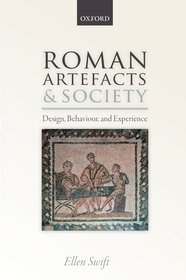
Roman Artefacts and Society
Design, Behaviour, and Experience
-
10% KEDVEZMÉNY?
- A kedvezmény csak az 'Értesítés a kedvenc témákról' hírlevelünk címzettjeinek rendeléseire érvényes.
- Kiadói listaár GBP 39.99
-
18 055 Ft (17 195 Ft + 5% áfa)
Az ár azért becsült, mert a rendelés pillanatában nem lehet pontosan tudni, hogy a beérkezéskor milyen lesz a forint árfolyama az adott termék eredeti devizájához képest. Ha a forint romlana, kissé többet, ha javulna, kissé kevesebbet kell majd fizetnie.
- Kedvezmény(ek) 10% (cc. 1 806 Ft off)
- Kedvezményes ár 16 249 Ft (15 476 Ft + 5% áfa)
Iratkozzon fel most és részesüljön kedvezőbb árainkból!
Feliratkozom
18 055 Ft

Beszerezhetőség
Megrendelésre a kiadó utánnyomja a könyvet. Rendelhető, de a szokásosnál kicsit lassabban érkezik meg.
Why don't you give exact delivery time?
A beszerzés időigényét az eddigi tapasztalatokra alapozva adjuk meg. Azért becsült, mert a terméket külföldről hozzuk be, így a kiadó kiszolgálásának pillanatnyi gyorsaságától is függ. A megadottnál gyorsabb és lassabb szállítás is elképzelhető, de mindent megteszünk, hogy Ön a lehető leghamarabb jusson hozzá a termékhez.
A termék adatai:
- Kiadó OUP Oxford
- Megjelenés dátuma 2020. június 25.
- ISBN 9780198866886
- Kötéstípus Puhakötés
- Terjedelem320 oldal
- Méret 235x158x16 mm
- Súly 566 g
- Nyelv angol
- Illusztrációk 73 Figures and 13 Tables 15
Kategóriák
Rövid leírás:
The text examines Roman artefacts using design theory to shed new light on our understanding of the relationship between the design and function of objects, and on aspects of Roman behaviour and experience. It examines how artefacts are designed for particular categories of users and what the implications are for discrepant experience.
TöbbHosszú leírás:
In this book, Ellen Swift uses design theory, previously neglected in Roman archaeology, to investigate Roman artefacts in a new way, making a significant contribution to both Roman social history, and our understanding of the relationships that exist between artefacts and people.
Based on extensive data collection and the close study of artefacts from museum collections and archives, the book examines the relationship between artefacts, everyday behaviour, and experience. The concept of 'affordances'?features of an artefact that make possible, and incline users towards, particular uses for functional artefacts?is an important one for the approach taken. This concept is carefully evaluated by considering affordances in relation to other sources of evidence, such as use?wear, archaeological context, the end?products resulting from artefact use, and experimental reconstruction. Artefact types explored in the case studies include locks and keys, pens, shears, glass vessels, dice, boxes, and finger-rings, using material mainly drawn from the north-western Roman provinces, with some material also from Roman Egypt.
The book then considers how we can use artefacts to understand particular aspects of Roman behaviour and experience, including discrepant experiences according to factors such as age, social position, and left- or right-handedness, which are fostered through artefact design. The relationship between production and users of artefacts is also explored, investigating what particular production methods make possible in terms of user experience, and also examining production constraints that have unintended consequences for users.
The book examines topics such as the perceived agency of objects, differences in social practice across the provinces, cultural change and development in daily practice, and the persistence of tradition and social convention. It shows that design intentions, everyday habits of use, and the constraints of production processes each contribute to the reproduction and transformation of material culture.
What Swift has produced is a unique contribution to material culture studies which provides a set of tools for thinking with and about everyday objects. It is rare to find such sensitive and nuanced theoretical discussion combined with a grounded focus on archaeological data, and Swift's book deserves to be widely read.
Tartalomjegyzék:
Introduction
Function
Behaviour/Experience
Users
Production and Users
Conclusion
Appendix 1: Ring-Keys Data
Appendix 2: Pens Data
Appendix 3: Shears Data
Appendix 4: Dice Data
Appendix 5: Dice Chi-squared Statistics
Appendix 6: Finger-Ring Motifs
Appendix 7: Square-sided Glass Bottles Data

