

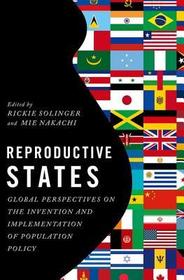
Reproductive States
Global Perspectives on the Invention and Implementation of Population Policy
-
10% KEDVEZMÉNY?
- A kedvezmény csak az 'Értesítés a kedvenc témákról' hírlevelünk címzettjeinek rendeléseire érvényes.
- Kiadói listaár GBP 135.00
-
60 952 Ft (58 050 Ft + 5% áfa)
Az ár azért becsült, mert a rendelés pillanatában nem lehet pontosan tudni, hogy a beérkezéskor milyen lesz a forint árfolyama az adott termék eredeti devizájához képest. Ha a forint romlana, kissé többet, ha javulna, kissé kevesebbet kell majd fizetnie.
- Kedvezmény(ek) 10% (cc. 6 095 Ft off)
- Kedvezményes ár 54 857 Ft (52 245 Ft + 5% áfa)
Iratkozzon fel most és részesüljön kedvezőbb árainkból!
Feliratkozom
60 952 Ft

Beszerezhetőség
Megrendelésre a kiadó utánnyomja a könyvet. Rendelhető, de a szokásosnál kicsit lassabban érkezik meg.
Why don't you give exact delivery time?
A beszerzés időigényét az eddigi tapasztalatokra alapozva adjuk meg. Azért becsült, mert a terméket külföldről hozzuk be, így a kiadó kiszolgálásának pillanatnyi gyorsaságától is függ. A megadottnál gyorsabb és lassabb szállítás is elképzelhető, de mindent megteszünk, hogy Ön a lehető leghamarabb jusson hozzá a termékhez.
A termék adatai:
- Kiadó OUP USA
- Megjelenés dátuma 2016. január 28.
- ISBN 9780199311071
- Kötéstípus Keménykötés
- Terjedelem400 oldal
- Méret 163x239x27 mm
- Súly 774 g
- Nyelv angol 0
Kategóriák
Rövid leírás:
In Reproductive States, a group of international scholars explore the population politics, policies and practices adopted in various countries and offer reflections on the outcomes of those policies and their legacies.
TöbbHosszú leírás:
Over the past hundred years, population policy has been a powerful tactic for achieving national goals. Whether the focus has been on increasing the birth rate to project strength and promote nation-building--as in Brazil in the 1960s, where the military government insisted that a "powerful nation meant a populous nation, " -- or on limiting population through contraception and sterilization as a means of combatting overpopulation, poverty, and various other social ills, states have always used women's bodies as a political resource.
In Reproductive States, a group of international scholars--specialists in population and reproductive politics of Japan, Germany, India, Egypt, Nigeria, China, Brazil, the Soviet Union/Russia, and the United States--explore the population politics, policies and practices adopted in these countries and offer reflections on the outcomes of those policies and their legacies. The essays in this volume focus on the context that stimulated nations to develop demographic imperatives regarding population size and "quality," and consider how those imperatives became unique sets of priorities and strategies. They also illuminate how these nations crafted their own policies and practices, often while responding to United Nations- and U.S.- driven population goals, tactics, and interventions.
The global perspective of this volume shines light on national specificities, including change over time within a nation, while also capturing interconnections among various national politics and discourses, including evolving constructions of the key and complex concept of "overpopulation."
The first volume to survey population policies from key countries on five continents and to interweave gender politics, reproductive rights, statecraft, and world systems, Reproductive States will be an essential work for scholars of anthropology, women and gender studies, feminist theory, and biopolitics.
The stories Reproductive States tells bring us back to the connections between population policies and economic growth, and their relationship, in turn, to women ... The stories told in these chapters expose the racial, ethnic, religious, gender and class biases that shaped the establishment and implementation of each country's population policies.
Tartalomjegyzék:
TABLE OF CONTENTS
1. Introduction: Reproductive States by Rickie Solinger and Mie Nakachi
2. Bio-politics, Demographobia, and Individual Freedom: Lessons from Germany's Century of Extremes, by Annette F. Timm
3. Bleeding Across Time: First Principles of U.S. Population Policy by Rickie Solinger
4. From Abortion to ART: A History of Conflict between the State and the Women's Reproductive Rights Movement in Post World War II by Miho Ogino
5. From Gandhi to Gandhi: Contraceptive Technologies and Sexual Politics in Post-Colonial India, 1947-1977 by Sanjam Ahluwalia and Daksha Parmar
6. Reproducing the Family: Biopolitics in Twentieth Century Egypt by Omnia El Shakry
7. Iran's Population Policies: A Historical Debate, by Firoozeh Kashani-Sabet
8. Reproductive Statecraft: The Case of Brazil by Sonia Correa, Margareth Arilha, and Maísa Faleiros da Cunha
9. Interpreting Population Policy in Nigeria by Elisha P. Renne
10. Liberation without Contraception?: The Rise of the Abortion Empire and Pronatalism in Socialist/Post Socialist Russia by Mie Nakachi
11. China's Population Policy in Historical Context by Tyrene White

