

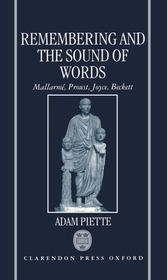
Remembering and the Sound of Words
Mallarmé, Proust, Joyce, Beckett
-
10% KEDVEZMÉNY?
- A kedvezmény csak az 'Értesítés a kedvenc témákról' hírlevelünk címzettjeinek rendeléseire érvényes.
- Kiadói listaár GBP 167.50
-
75 626 Ft (72 025 Ft + 5% áfa)
Az ár azért becsült, mert a rendelés pillanatában nem lehet pontosan tudni, hogy a beérkezéskor milyen lesz a forint árfolyama az adott termék eredeti devizájához képest. Ha a forint romlana, kissé többet, ha javulna, kissé kevesebbet kell majd fizetnie.
- Kedvezmény(ek) 10% (cc. 7 563 Ft off)
- Kedvezményes ár 68 064 Ft (64 823 Ft + 5% áfa)
Iratkozzon fel most és részesüljön kedvezőbb árainkból!
Feliratkozom
75 626 Ft

Beszerezhetőség
Megrendelésre a kiadó utánnyomja a könyvet. Rendelhető, de a szokásosnál kicsit lassabban érkezik meg.
Why don't you give exact delivery time?
A beszerzés időigényét az eddigi tapasztalatokra alapozva adjuk meg. Azért becsült, mert a terméket külföldről hozzuk be, így a kiadó kiszolgálásának pillanatnyi gyorsaságától is függ. A megadottnál gyorsabb és lassabb szállítás is elképzelhető, de mindent megteszünk, hogy Ön a lehető leghamarabb jusson hozzá a termékhez.
A termék adatai:
- Kiadó Clarendon Press
- Megjelenés dátuma 1996. április 11.
- ISBN 9780198182689
- Kötéstípus Keménykötés
- Terjedelem294 oldal
- Méret 224x145x22 mm
- Súly 485 g
- Nyelv angol 0
Kategóriák
Rövid leírás:
Remembering and the Sound of Words is a major new study of four of modern literature's most important writers - and the first serious attempt to account for complex sound effects in prose. Mallarmé, Proust, Joyce, and Beckett are all masters of complex musical prose, and all four are fascinated by the powers of memory. Through close readings of their writing, which reveal the way in which all four use key-words and sound effects to mimic the processes of memory, Adam Piette provides answers to two important but neglected questions - how do we respond to poetic prose; and how do writers represent the subtle forces of memory.
TöbbHosszú leírás:
Remembering the Sound of Words is a major new studyof four of modern literature's most important writers--and the first serious attempt to account for complex sound effects in prose
Adam Piette establishes fascinating new links between such sound effects and the representation of memory in literary texts. He sets out a workable taxonomy of sound-repetitions in prose and formulates, throught a theory of alternating-devices, the ways in which the reader's attention is drawn to the acoustic surface of the text. Through close analysis of Mallarmé's prose-poetry, Proust's musical syntax, Joyce's memory-rhymes (from the Portrait of the Artist through Ulysses to Finegan's Wake), and Beckett's prose and drama, Piette demonstrates that sound effects act as intricate reminders of memory-traces in the text. Despite wide divergence in these four writers' representations of memory, the book shows that the use of this memory-rhyme technique is common to them all, and is emplyed in particular to express the textual migration of past key-words, self-centred comic tyranny, and the fitful unifaction of body and memory within the narrative voice. Mimesis is redefined in terms of textual rhymes--facsimiles of the complex resemblances, fusions, and re-enactments of the mind's verbal memory.
Remembering and the Sound of Words is one of the more remarkable critical studies it has been my good fortune and delight to have read. ... it should be greeted in triumph, if only for having vanquished a few recent impieties and for restoring the remembering mind to its rightful eminence. ... this is that rare instance of a critical work that waves no banners, nor proclaims a post-Derridean superiority over its ostensible subjects, but instead, quietly and unpretentiously, respects the texts it discusses, and does what criticism so rarely does, i.e. illuminating those texts by sensitive close reading. ... It is an exciting thesis, complex and ambitious, yet clearly stated and meticulously worked out. The effect is compelling. ... What is consistently impressive is not simply the range of Piette's reference, nor the precision of his detail, but the quality of the insight be brings to and derives from the texts he examines.

