

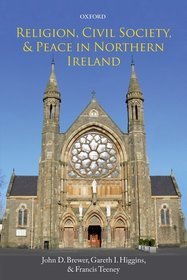
Religion, Civil Society, and Peace in Northern Ireland
-
10% KEDVEZMÉNY?
- A kedvezmény csak az 'Értesítés a kedvenc témákról' hírlevelünk címzettjeinek rendeléseire érvényes.
- Kiadói listaár GBP 38.99
-
17 603 Ft (16 765 Ft + 5% áfa)
Az ár azért becsült, mert a rendelés pillanatában nem lehet pontosan tudni, hogy a beérkezéskor milyen lesz a forint árfolyama az adott termék eredeti devizájához képest. Ha a forint romlana, kissé többet, ha javulna, kissé kevesebbet kell majd fizetnie.
- Kedvezmény(ek) 10% (kb. 1 760 Ft)
- Kedvezményes ár 15 843 Ft (15 089 Ft + 5% áfa)
Iratkozzon fel most és részesüljön kedvezőbb árainkból!
Feliratkozom
17 603 Ft

Beszerezhetőség
Megrendelésre a kiadó utánnyomja a könyvet. Rendelhető, de a szokásosnál kicsit lassabban érkezik meg.
Why don't you give exact delivery time?
A beszerzés időigényét az eddigi tapasztalatokra alapozva adjuk meg. Azért becsült, mert a terméket külföldről hozzuk be, így a kiadó kiszolgálásának pillanatnyi gyorsaságától is függ. A megadottnál gyorsabb és lassabb szállítás is elképzelhető, de mindent megteszünk, hogy Ön a lehető leghamarabb jusson hozzá a termékhez.
A termék adatai:
- Kiadó OUP Oxford
- Megjelenés dátuma 2013. december 5.
- ISBN 9780198702078
- Kötéstípus Puhakötés
- Terjedelem264 oldal
- Méret 235x157x15 mm
- Súly 386 g
- Nyelv angol 0
Kategóriák
Rövid leírás:
Religion is traditionally portrayed as nothing but trouble in Ireland, but the churches played a key role in Northern Ireland's peace process. This study challenges many existing assumptions about the peace process, drawing on four years of interviewing with those involved, including church leaders, politicians, and paramilitary members.
TöbbHosszú leírás:
Religion was thought to be part of the problem in Ireland and incapable of turning itself into part of the solution. Many commentators deny the churches a role in Northern Ireland's peace process or belittle it, focusing on the few well-known events of church involvement and the small number of high profile religious peacebuilders. This new study seeks to correct various misapprehensions about the role of the churches by pointing to their major achievements in both the social and political dimensions of the peace process, by small-scale, lesser-known religious peacebuilders as well as major players. The churches are not treated lightly or sentimentally and major weaknesses in their contribution are highlighted. The study challenges the view that ecumenism was the main religious driver of the peace process, focusing instead on the role of evangelicals, it warns against romanticising civil society, pointing to its regressive aspects and counter-productive activities, and queries the relevance of the idea of 'spiritual capital' to understanding the role of the churches in post-conflict reconstruction, which the churches largely ignore.
This book is written by three 'insiders' to church peacebuilding in Northern Ireland, who bring their insight and expertise as sociologists to bear in their analysis of four-years in-depth interviewing with a wide cross section of people involved in the peace process, including church leaders and rank-and-file, members of political parties, prime ministers, paramilitary organisations, community development and civil society groups, as well as government politicians and advisors. Many of these are speaking for the first time about the role of religious peacebuilding in Northern Ireland, and doing so with remarkable candour. The volume allows the Northern Irish case study to speak to other conflicts where religion is thought to be problematic by developing a conceptual framework to understand religious peacebuilding.
[This book] is so convincing and important because it is exhaustively researched and presented in a form which builds inexorably to its conclusions.
Tartalomjegyzék:
Introduction: Civil Society, Religion, and Democratic Transitions
Contributions to the Social Peace Process
Contributions to the Political Peace Process
Opportunities and Constraints in Religious Peace Work
Weaknesses in the Churches Peacemaking
Conclusion: Religion, Civil Society, and Peace in Northern Ireland

