

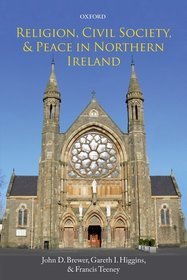
Religion, Civil Society, and Peace in Northern Ireland
- Publisher's listprice GBP 38.99
-
17 603 Ft (16 765 Ft + 5% VAT)
The price is estimated because at the time of ordering we do not know what conversion rates will apply to HUF / product currency when the book arrives. In case HUF is weaker, the price increases slightly, in case HUF is stronger, the price goes lower slightly.
- Discount 10% (cc. 1 760 Ft off)
- Discounted price 15 843 Ft (15 089 Ft + 5% VAT)
Subcribe now and take benefit of a favourable price.
Subscribe
17 603 Ft

Availability
printed on demand
Why don't you give exact delivery time?
Delivery time is estimated on our previous experiences. We give estimations only, because we order from outside Hungary, and the delivery time mainly depends on how quickly the publisher supplies the book. Faster or slower deliveries both happen, but we do our best to supply as quickly as possible.
Product details:
- Publisher OUP Oxford
- Date of Publication 5 December 2013
- ISBN 9780198702078
- Binding Paperback
- No. of pages264 pages
- Size 235x157x15 mm
- Weight 386 g
- Language English 0
Categories
Short description:
Religion is traditionally portrayed as nothing but trouble in Ireland, but the churches played a key role in Northern Ireland's peace process. This study challenges many existing assumptions about the peace process, drawing on four years of interviewing with those involved, including church leaders, politicians, and paramilitary members.
MoreLong description:
Religion was thought to be part of the problem in Ireland and incapable of turning itself into part of the solution. Many commentators deny the churches a role in Northern Ireland's peace process or belittle it, focusing on the few well-known events of church involvement and the small number of high profile religious peacebuilders. This new study seeks to correct various misapprehensions about the role of the churches by pointing to their major achievements in both the social and political dimensions of the peace process, by small-scale, lesser-known religious peacebuilders as well as major players. The churches are not treated lightly or sentimentally and major weaknesses in their contribution are highlighted. The study challenges the view that ecumenism was the main religious driver of the peace process, focusing instead on the role of evangelicals, it warns against romanticising civil society, pointing to its regressive aspects and counter-productive activities, and queries the relevance of the idea of 'spiritual capital' to understanding the role of the churches in post-conflict reconstruction, which the churches largely ignore.
This book is written by three 'insiders' to church peacebuilding in Northern Ireland, who bring their insight and expertise as sociologists to bear in their analysis of four-years in-depth interviewing with a wide cross section of people involved in the peace process, including church leaders and rank-and-file, members of political parties, prime ministers, paramilitary organisations, community development and civil society groups, as well as government politicians and advisors. Many of these are speaking for the first time about the role of religious peacebuilding in Northern Ireland, and doing so with remarkable candour. The volume allows the Northern Irish case study to speak to other conflicts where religion is thought to be problematic by developing a conceptual framework to understand religious peacebuilding.
[This book] is so convincing and important because it is exhaustively researched and presented in a form which builds inexorably to its conclusions.
Table of Contents:
Introduction: Civil Society, Religion, and Democratic Transitions
Contributions to the Social Peace Process
Contributions to the Political Peace Process
Opportunities and Constraints in Religious Peace Work
Weaknesses in the Churches Peacemaking
Conclusion: Religion, Civil Society, and Peace in Northern Ireland

