

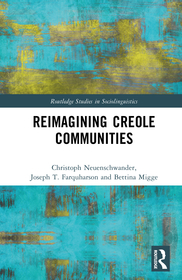
Reimagining Creole Communities
Sorozatcím: Routledge Studies in Sociolinguistics;
-
20% KEDVEZMÉNY?
- A kedvezmény csak az 'Értesítés a kedvenc témákról' hírlevelünk címzettjeinek rendeléseire érvényes.
- Kiadói listaár GBP 155.00
-
69 982 Ft (66 650 Ft + 5% áfa)
Az ár azért becsült, mert a rendelés pillanatában nem lehet pontosan tudni, hogy a beérkezéskor milyen lesz a forint árfolyama az adott termék eredeti devizájához képest. Ha a forint romlana, kissé többet, ha javulna, kissé kevesebbet kell majd fizetnie.
- Kedvezmény(ek) 20% (cc. 13 996 Ft off)
- Kedvezményes ár 55 986 Ft (53 320 Ft + 5% áfa)
- A kedvezmény érvényes eddig: 2026. június 30.
Iratkozzon fel most és részesüljön kedvezőbb árainkból!
Feliratkozom
62 984 Ft

Beszerezhetőség
Még nem jelent meg, de rendelhető. A megjelenéstől számított néhány héten belül megérkezik.
Why don't you give exact delivery time?
A beszerzés időigényét az eddigi tapasztalatokra alapozva adjuk meg. Azért becsült, mert a terméket külföldről hozzuk be, így a kiadó kiszolgálásának pillanatnyi gyorsaságától is függ. A megadottnál gyorsabb és lassabb szállítás is elképzelhető, de mindent megteszünk, hogy Ön a lehető leghamarabb jusson hozzá a termékhez.
A termék adatai:
- Kiadás sorszáma 1
- Kiadó Routledge
- Megjelenés dátuma 2026. április 30.
- ISBN 9781032378091
- Kötéstípus Keménykötés
- Terjedelem272 oldal
- Méret 229x152 mm
- Súly 453 g
- Nyelv angol
- Illusztrációk 3 Illustrations, black & white; 3 Line drawings, black & white; 2 Tables, black & white 700
Kategóriák
Rövid leírás:
This volume undertakes a reimagination of Creole communities in the Caribbean and beyond by addressing the persistent disconnect between contemporary research on Creole communities and Sociolinguistics.
TöbbHosszú leírás:
This volume undertakes a reimagination of Creole communities in the Caribbean and beyond by addressing the persistent disconnect between contemporary research on Creole communities and Sociolinguistics. While it acknowledges that early interactions between these fields have been fruitful, especially in understanding variation, Creole grammars and their relationship to their input languages, research on Creole communities subsequently prioritised typological and genealogical research, neglecting social meaning, speaker agency, and stylistic variation.
The book advocates for a ‘social turn’ in research on Creole communities, urging a (re)connection with contemporary sociolinguistic concepts to normalise Creoles and their lexifiers, such as English, as objects of study within broader paradigms. It embraces post-structuralist approaches, focusing on language ideologies, identity work, and indexicality, and capitalise on concepts such as ‘forcefields’ and ‘(semiotic) assemblages’ to analyse the complex interplay of linguistic, social, political, economic, and ideological influences. The exploration challenges binary or linear framings of the linguistic landscape in Creole communities, such as diglossia or (post-)Creole continua, which often fail to capture the fluid, messy realities of language use. Crucially, we critique the ‘myth of orderly multilingualism’, an ideology that misrepresents the diverseness of linguistic practices in Creole contexts by assuming languages can be neatly separated.
Drawing on insights from the English-official Caribbean, Guiana region, and the Pacific, this book will be a valuable resource for students and scholars in Pidgin and Creole Studies, contact linguistics, World Englishes, and sociolinguistics.
TöbbTartalomjegyzék:
Chapter 1: Setting the stage for reimagining Creole communities, Chapter 2: Identifying Language Ideologies in Creole Contexts, Chapter 3: Exploring different perspectives on language ideology, Chapter 4: Deconstructing English in the Caribbean and beyond, Chapter 5: Researching the sociolinguistics of Creoles, Chapter 6: Rethinking empowerment in Creole communities: Applied approaches, Chapter 7: Revisiting forcefields, Index
Több
