

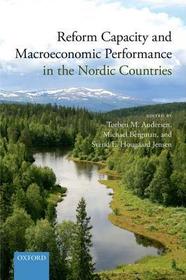
Reform Capacity and Macroeconomic Performance in the Nordic Countries
-
10% KEDVEZMÉNY?
- A kedvezmény csak az 'Értesítés a kedvenc témákról' hírlevelünk címzettjeinek rendeléseire érvényes.
- Kiadói listaár GBP 122.50
-
55 308 Ft (52 675 Ft + 5% áfa)
Az ár azért becsült, mert a rendelés pillanatában nem lehet pontosan tudni, hogy a beérkezéskor milyen lesz a forint árfolyama az adott termék eredeti devizájához képest. Ha a forint romlana, kissé többet, ha javulna, kissé kevesebbet kell majd fizetnie.
- Kedvezmény(ek) 10% (cc. 5 531 Ft off)
- Kedvezményes ár 49 778 Ft (47 408 Ft + 5% áfa)
Iratkozzon fel most és részesüljön kedvezőbb árainkból!
Feliratkozom
55 308 Ft

Beszerezhetőség
Megrendelésre a kiadó utánnyomja a könyvet. Rendelhető, de a szokásosnál kicsit lassabban érkezik meg.
Why don't you give exact delivery time?
A beszerzés időigényét az eddigi tapasztalatokra alapozva adjuk meg. Azért becsült, mert a terméket külföldről hozzuk be, így a kiadó kiszolgálásának pillanatnyi gyorsaságától is függ. A megadottnál gyorsabb és lassabb szállítás is elképzelhető, de mindent megteszünk, hogy Ön a lehető leghamarabb jusson hozzá a termékhez.
A termék adatai:
- Kiadó OUP Oxford
- Megjelenés dátuma 2015. február 5.
- ISBN 9780198717102
- Kötéstípus Keménykötés
- Terjedelem382 oldal
- Méret 241x162x30 mm
- Súly 742 g
- Nyelv angol
- Illusztrációk Figures and Tables 0
Kategóriák
Rövid leírás:
This volume examines whether the reform experiences in the Nordic economies offer some lessons for the design of the general fiscal framework in the wake of the financial crisis.
TöbbHosszú leírás:
The outbreak of the financial crisis in 2008 has had significant effects on economic activity, unemployment, and public finances for all European countries. However, European economies do not form a homogenous region, and any serious analysis of macroeconomic imbalances in Europe must account for the fact that different economic and political models and circumstances operate across the continent. This book focuses on the Nordic countries (Denmark, Finland, Iceland, Norway, and Sweden) which have a relatively good record of undertaking fiscal and structural reforms after their own financial and debt crises in the 1980s and 1990s. The Nordic countries are small and open economies, well-known for their high income levels, high employment rates, organized labour markets, a relatively equal distribution of incomes, and large public sectors. From this perspective, the book asks whether there are lessons that might be learned from the Nordic economies. Is there a distinctive Nordic model that could be usefully followed, by other small open economies, in terms of fiscal and monetary policy design, labour market policies and reforms, and financial and housing market regulation? It is inappropriate to define the Nordic model in terms of a common set of policies. Since the key characteristics, including the overarching objectives and supporting institutions, have strong historical foundations, copying and pasting them to other countries is not easily done. Even though the Nordic experiences are not directly transferable, they may add new knowledge about the importance of institutional design, fiscal consolidation, and structural reforms not only for macroeconomic performance but also for how to preserve key objectives such as social balance and equity.
TöbbTartalomjegyzék:
Macroeconomic Perspectives on the Nordic Economies: Past, Present, and Future
Collective Risk Sharing: The Social Safety Net and Employment
Commentary on Chapter 2: Social Trust and the Efficiency-Equity Trade-Off
Missing the Link? On the Political Economy of Nordic Egalitarianism
Commentary on Chapter 3
Labour Market Policies in Denmark: A Story of Structural Reforms and Evidence Based Policy
Commentary on Chapter 4
What Scope for Monetary Policy? Experiences from the Nordic Countries after the Financial Crisis
Commentary on Chapter 5
Monetary Policy and Exchange Rate Stabilization in Norway and Sweden
Commentary on Chapter 6
House Prices in Denmark and Sweden
Commentary on Chapter 7
Reforming the Fiscal Framework: The Case of Sweden 1973-2013
Commentary on Chapter 8
Shaping the Fiscal Policy Framework: Lessons from Fiscal Consolidations in Denmark and Sweden
Commentary on Chapter 9
A Crisis Not Wasted: Institutional and Structural Reforms Behind Norway's Strong Macroeconomic Performance
Commentary on Chapter 10
Finland and Sweden in Cross-Country Comparison: What are the Lessons?
Commentary on Chapter 11
Iceland: How Could This Happen?
Commentary on Chapter 12
Challenges to the Nordic Model

